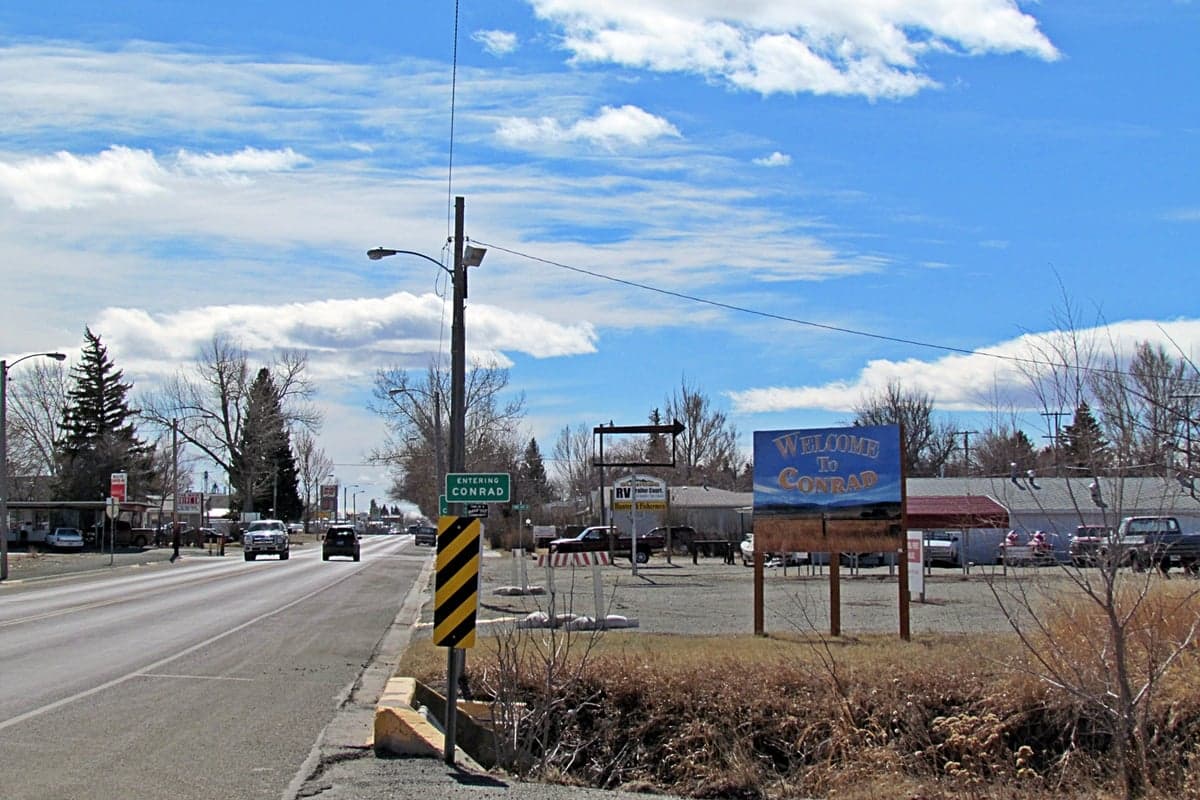
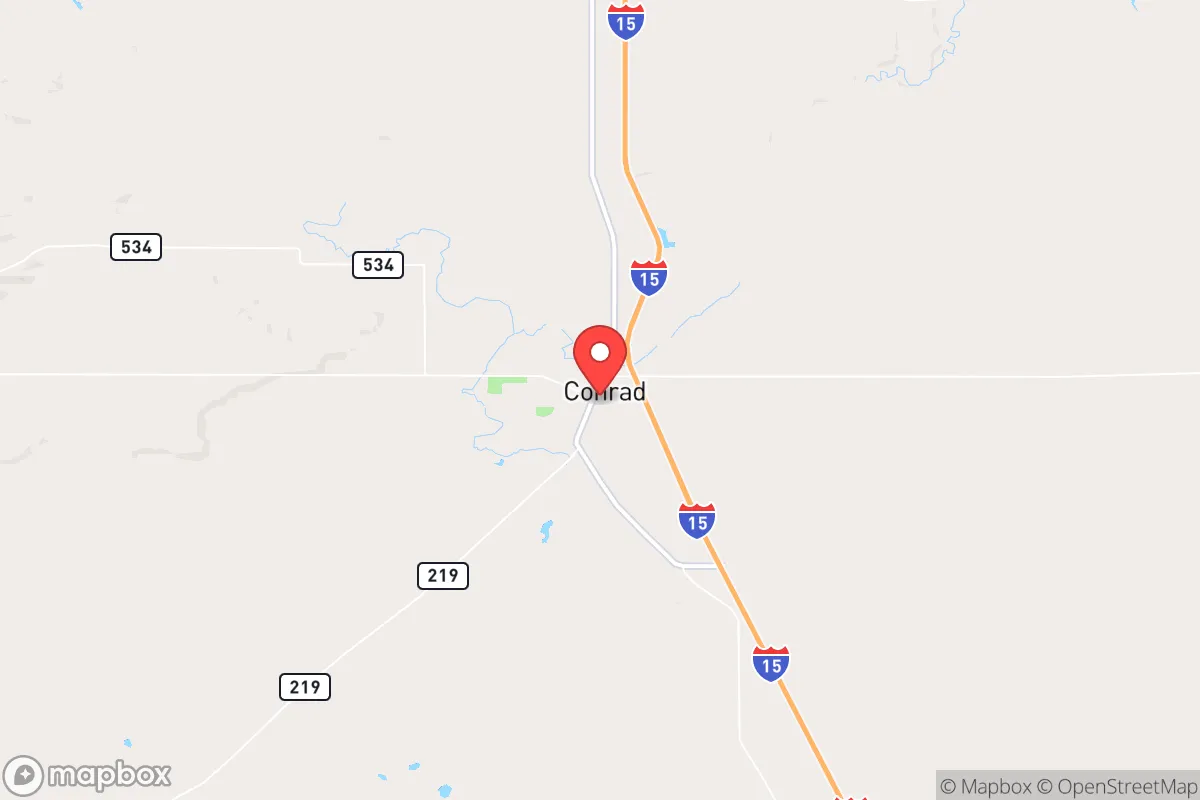
Photo: Wikipedia
Strategic Assessment of Conrad, MT
Workable tactical position. Some exposure to population density or targets, but generally defensible in a crisis.
What does the Strategic Assessment tell us?
Our Strategic Assessment grades tactical survivability of an area. Major population centers, military targets, fallout zones, natural disasters, and border exposure all drive risk — lower exposure means a more defensible position in a crisis.
This is heavily inspired by Joel Skousen's Strategic Relocation book. Highly recommended you checkout the book ($)What does this tell us?
Our Strategic Assessment grades tactical survivability of an area. Major population centers, military targets, fallout zones, natural disasters, and border exposure all drive risk — lower exposure means a more defensible position in a crisis.
This is heavily inspired by Joel Skousen's Strategic Relocation book. Highly recommended you checkout the book ($)Strategic Pillars

Key Distances
Regional Safe Places
Below is our recommended "safe zones" in Montana and the surrounding area based on our strategic heuristics. For most people, it's unrealistic to live in a “safe zone” full-time due to work, family or other personal reasons. They tend to be more rural. However, many of these areas are perfect for second homes and retreat properties that double as a vacation home or even a short-term rental.
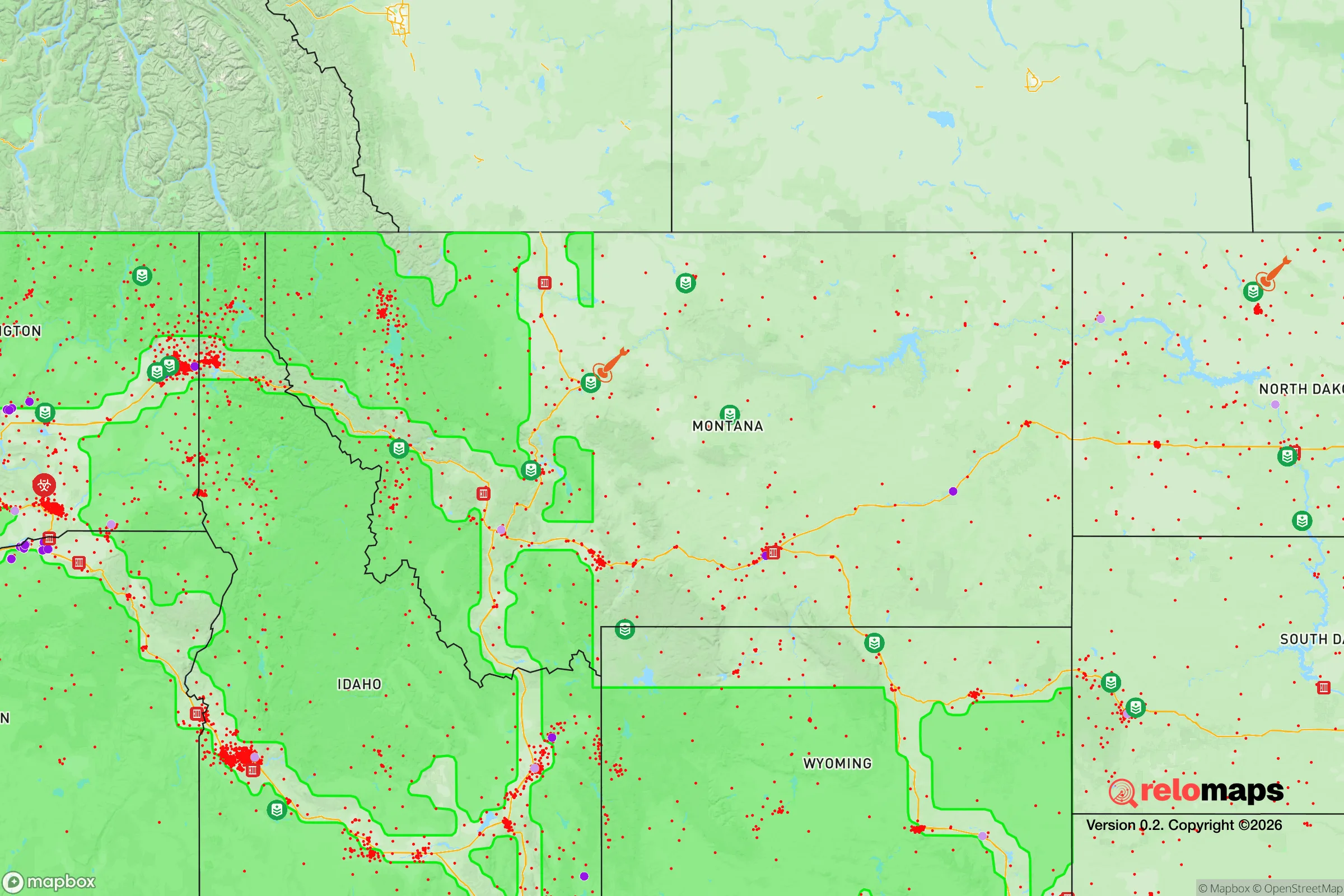


Important Note: For informational purposes only. This does not mean nothing bad ever happens in the green zones. Please use common sense. This is based on public data and modeled with AI. We tried to take a conservative approach but mistakes happen. We update this regularly as new information becomes available.
Solar Generator Recommendations
Backup power matters more here than in safer locations. We've picked three solar generators across budgets and capacity tiers — start with the budget unit if you only need a few essentials, or step up if you want to run a fridge and HVAC for days at a time.

Jackery Portable Power Station Explorer 300
Budget OptionPower on the Go: Weighing only 11 lbs, it's convenient to set up and store with book-sized foldable solar panels

BLUETTI Portable Power Station AC180
Designed for both indoor and outdoor scenarios, AC180 is highly capable as it has a robost capacity and continuous output power.

EF ECOFLOW DELTA Pro Ultra Power Station
Upgraded PickEcoFlow DELTA Pro Ultra is a whole-home energy system designed to grow with your family. Integrated with the Smart Home Panel 2, it scales to meet your evolving energy needs — keeping your home powered, intelligent, and secure through every stage of life.
We earn a commission, at no additional cost to you.
Strategic Assessment Analysis
Conrad, Montana, offers a strategic resilience profile that stands apart from the typical rural retreat, combining deep agricultural self-sufficiency with a location that buffers against the cascading failures of urban centers. Situated in Pondera County along the Rocky Mountain Front, this town of roughly 2,500 people sits at an elevation of 3,500 feet, providing a natural defensive position against both coastal fallout patterns and the social unraveling that tends to radiate from major population hubs. For the relocator thinking in terms of decades rather than election cycles, Conrad presents a rare combination of geographic isolation, resource independence, and community cohesion that makes it a serious candidate for long-term preparedness.
Geographic position and natural advantages for long-term security
Conrad’s location is its primary strategic asset, sitting roughly 60 miles from the Canadian border and 100 miles from the Rocky Mountain crest, placing it well outside the blast and fallout zones of any plausible nuclear target. The nearest city of any consequence is Great Falls, 45 miles to the southeast, which itself is a minor Air Force base town—not a primary target like Malmstrom’s missile fields near Great Falls, but still worth noting. More importantly, Conrad lies in the heart of the Golden Triangle, Montana’s most productive wheat-growing region, where the annual precipitation of 12-14 inches supports dryland farming without the irrigation dependency that plagues western states. The area’s aquifer is robust, with the Teton River and numerous artesian wells providing redundant water sources that don’t rely on municipal treatment plants vulnerable to cyberattack or grid failure. The surrounding terrain is open prairie with scattered buttes and coulees, offering good line-of-sight for observation while still providing enough topographic variation for concealment and defensive positioning. Winters are harsh—average January lows hit 10°F—but this cold acts as a natural population filter, discouraging the transient and unprepared from settling here. For the prepper, the climate also means that food storage is straightforward: a root cellar or unheated garage provides natural refrigeration for nine months of the year.
Risks, exposures, and proximity to fallout-relevant landmarks
No location is without vulnerabilities, and Conrad’s risk profile requires honest assessment. The most significant exposure is the proximity to Malmstrom Air Force Base near Great Falls, which hosts 150 Minuteman III intercontinental ballistic missiles in hardened silos spread across north-central Montana. While Conrad is 60 miles from the base itself, the missile fields extend westward into Pondera County, with some silos within 20-30 miles of town. In a full-scale nuclear exchange, these silos would be primary targets, and while they’re hardened to withstand direct hits, the ground-burst detonations would produce significant local fallout. The prevailing westerly winds would carry fallout eastward, meaning Conrad’s position west of the main missile field offers some protection, but a shift in wind patterns or a near-miss could still pose a hazard. Beyond nuclear risk, the area faces natural threats: severe winter storms can isolate the town for days, and the flat terrain makes it vulnerable to tornadoes, though they’re less frequent than in the Plains states. The nearest major medical facility is in Great Falls, 45 minutes away, which is a concern for trauma or serious illness during a grid-down scenario. There are no major industrial targets within 100 miles, no chemical plants, no refineries, and no nuclear power stations—which is a significant advantage compared to most of the country. The biggest man-made risk is actually the railroad line running through town, carrying freight that could include hazardous materials, but this is a minor concern relative to the broader threat landscape.
Practical resilience for a relocator: food, water, energy, and defensibility
Conrad’s practical resilience metrics are strong across the board, particularly for someone willing to invest in off-grid infrastructure. The agricultural base means that local food production is not a theoretical exercise—wheat, barley, and pulse crops are grown within sight of town, and there are active cattle ranches throughout the county. The Pondera County Farmers Market and local co-ops provide access to fresh produce during growing season, and the abundance of grain means that long-term food storage can be built around staples that are literally grown in neighboring fields. Water is the real strength here: the Teton River runs through the county, and the aquifer is shallow and reliable, with many rural properties having their own wells. Municipal water comes from groundwater sources, not surface reservoirs that could be contaminated or drained. For energy, the area has excellent wind potential—average speeds of 12-15 mph—and solar works well despite the latitude, with over 200 sunny days per year. Natural gas is available in town, and propane is common for rural properties, providing backup heating that doesn’t depend on the grid. Defensibility is where Conrad really shines: the town is compact, with a grid layout that’s easy to secure, and the surrounding farmland provides clear fields of fire. The population is overwhelmingly homogeneous in terms of values—conservative, self-reliant, and suspicious of federal overreach—which means that community response to a crisis would likely be coordinated and effective rather than chaotic. The county sheriff’s office is professional but small, and there’s a strong tradition of mutual aid among ranchers and farmers. For the relocator, the key is to buy property outside of town but within a 10-minute drive, giving you the benefits of community proximity while maintaining operational security and space for gardens, livestock, and defensive planning.
The overall strategic picture for Conrad is one of calculated viability rather than perfect safety. It’s not a bug-out location for a weekend warrior—it’s a place to build a life that’s already aligned with the principles of preparedness. The risks from Malmstrom’s missile fields are real but manageable with proper planning, including a basement or storm shelter for fallout protection and a pre-planned evacuation route eastward if necessary. The climate is harsh, the economy is limited, and the nearest major city is an hour away, but these are features, not bugs, for someone serious about resilience. Conrad offers what few places in the lower 48 can: a genuine agricultural surplus, redundant water sources, a like-minded community, and a location that’s far enough from the coasts and major cities to survive the first wave of whatever comes. For the conservative relocator who understands that preparation is a lifestyle, not a hobby, Conrad deserves a serious look.

* Values derived from national, state, county, city and local statistics and may differ in a specific area. Last updated: 2026-04-19T09:59:41.000Z
Narrative content on this page is AI-generated and may contain mistakes. Verify any details that matter before acting on them.
ReloMaps may earn a commission from affiliate links at no extra cost to you.

