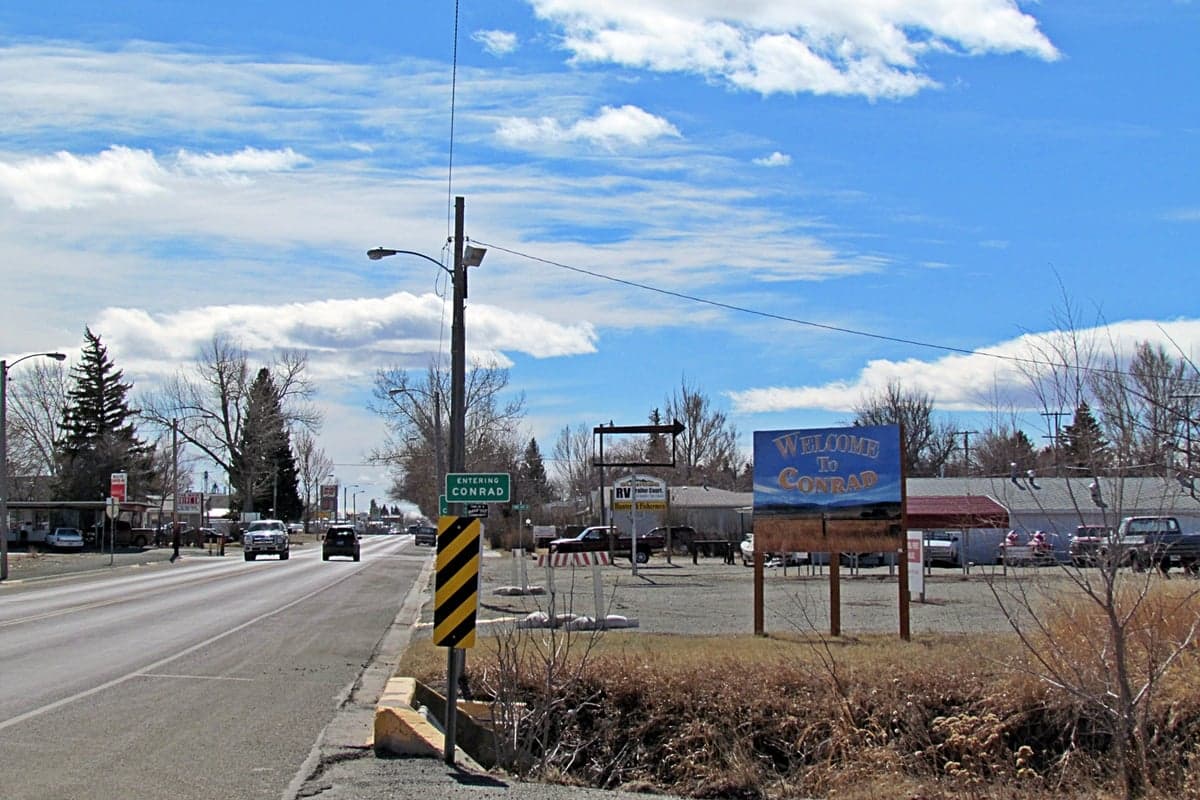
Photo: Wikipedia
Personal Sovereignty in Conrad, MT
Viable for self-reliance. Generally workable, though some barriers may limit total independence.
What does Personal Sovereignty tell us?
Personal Sovereignty measures your capacity for self-reliance and independence with minimal government friction. Higher scores mean fewer barriers between you and the way you want to live... but it assumes you have the space you need and good neighbors.
What does this tell us?
Personal Sovereignty measures your capacity for self-reliance and independence with minimal government friction. Higher scores mean fewer barriers between you and the way you want to live... but it assumes you have the space you need and good neighbors.
State Policy
Energy independence: Net exporter (120% of energy produced in-state)
Personal Liberty
Homesteading

Personal Liberty Analysis
Conrad, Montana, offers a level of personal sovereignty that is increasingly rare in the modern United States, functioning as a practical stronghold for those who prioritize autonomy over government accommodation. Located in Pondera County, this community of roughly 2,500 people operates within a state framework that consistently ranks among the most liberty-respecting in the nation, but it adds a layer of rural insulation that buffers against the creeping regulatory reach found in Bozeman or Missoula. For the survivalist-minded individual or family, Conrad represents a place where the default assumption is that you can handle your own affairs—unless you give the state a clear reason to intervene. This isn't a theoretical freedom; it's the lived reality of a town where the nearest traffic light is a suggestion, not a command, and where the county sheriff's office knows most residents by name.
Tax burden and regulatory posture: How Montana's low-tax environment protects your income and property
Montana's tax structure is a significant asset for anyone seeking to minimize government extraction from their labor and assets. The state imposes no sales tax, meaning every dollar you earn stays in your pocket or gets spent on your terms, not funneled through a state bureaucracy. Property taxes in Pondera County are notably low compared to national averages, with effective rates hovering around 0.7% of assessed value—roughly half of what you'd pay in many Midwestern or Northeastern states. For a $200,000 home, that translates to about $1,400 annually, a figure that leaves substantial room for reinvestment in supplies, land improvements, or savings. Income tax is a flat 6.75% on all taxable income above a modest threshold, which is straightforward and predictable, unlike the progressive brackets that penalize success elsewhere. The regulatory posture in Conrad is equally lean: there is no city planning department with the power to dictate what color you paint your shed or how many chickens you can keep. Zoning is minimal, and building permits are handled with a handshake and a fee that rarely exceeds $100 for residential structures. This isn't a place where you need a lawyer to build a fence—it's a place where you need a post-hole digger and a Saturday afternoon.
Self-defense and gun law specifics: Constitutional carry and the reality of armed autonomy in Pondera County
Montana is a constitutional carry state, meaning no permit is required to carry a concealed firearm for any law-abiding adult 18 or older. This is not a privilege granted by the state; it is a recognition of a pre-existing right, and Conrad's culture reflects that understanding. The local sheriff's office processes concealed carry permits for those who want reciprocity with other states, but the process is straightforward—a background check and a $50 fee, with no training requirement or waiting period. Open carry is legal without any license, and the town's gun shops, like the one on Main Street, report that most households own multiple firearms, including rifles suitable for both defense and hunting. Montana law also provides strong castle doctrine and Stand Your Ground protections: there is no duty to retreat from any place where you are lawfully present, and the use of deadly force is presumed justified if an intruder has unlawfully entered your home or vehicle. For the prepper, this means your property is your sovereign space, and the legal system backs that up. Magazine capacity restrictions, firearm registration, and waiting periods are nonexistent at the state level, and local ordinances in Conrad do not add any additional burdens. The nearest federal presence is the ATF field office in Great Falls, 40 miles away, but their attention is on commercial dealers, not private citizens exercising their rights.
Self-reliance and homesteading viability: Lot sizes, zoning, and off-grid feasibility in Conrad
Conrad's zoning code is a relic of a simpler era, and that works in your favor. Within the town limits, residential lots typically range from one-quarter to one-half acre, but the city has no prohibition on keeping livestock—chickens, goats, even a milk cow are common sights in backyards. The city water and sewer system is available, but there is no mandate to connect; many older homes still use private wells and septic systems, and new construction can opt for the same with a simple permit. Outside town, in the unincorporated areas of Pondera County, zoning is virtually nonexistent. You can purchase a 5- or 10-acre parcel for $2,000 to $4,000 per acre, and there are no restrictions on building a home, a workshop, or a root cellar. Off-grid living is fully legal: solar panels, wind turbines, rainwater collection, and composting toilets are all permitted without special waivers. The county health department requires a septic system permit, but the standards are reasonable and the inspection process takes days, not months. For the serious prepper, Conrad offers the rare combination of affordable land and permissive regulations that allow you to build a self-sufficient homestead without fighting a bureaucracy. The growing season is short—about 110 days—but cold frames and greenhouses extend it, and the local extension office offers free classes on dryland farming and water conservation.
Personal liberties: Parental rights, medical autonomy, speech, and property protections
Montana's legal framework strongly favors parental rights, and Conrad's community reinforces that. The state has no mandatory vaccination laws for school attendance—parents can opt out for any reason, including personal belief, with a simple form. Medical autonomy is similarly robust: there is no state-level vaccine mandate for adults, and the Montana Medical Freedom Act prohibits discrimination based on vaccination status for employment or services. During the COVID-19 pandemic, Pondera County saw minimal enforcement of mask mandates, and the local school board voted unanimously to keep schools open without restrictions. Free speech is protected by both the U.S. Constitution and Montana's own strong free-expression clause, which the state supreme court has interpreted more broadly than federal courts in cases involving political speech and religious expression. Property rights are protected by the Montana Constitution's explicit guarantee that "private property shall not be taken or damaged for public use without just compensation," and the state has a robust inverse condemnation statute that allows landowners to sue for regulatory takings. In Conrad, this means you can post political signs in your yard, homeschool your children without state interference, and refuse medical treatments you don't want—all without fear of government retaliation. The local culture is one of live and let live, where your neighbor might be a rancher, a mechanic, or a retired military officer, and everyone understands that your business is your own.
Compared to other regions of the country, Conrad, Montana, offers a sovereignty profile that rivals rural Texas or Idaho but with lower population pressure and less exposure to federal land management issues. The nearest national forest is 30 miles away, meaning you're not dealing with Forest Service restrictions on your property. The state government in Helena is 200 miles south, and its influence is diluted by distance and a legislature that meets only 90 days every two years. For the strategic relocator who values personal autonomy, self-defense rights, and the ability to live off-grid without government permission, Conrad represents a rare convergence of legal protections, cultural alignment, and affordable land. It's not a utopia—no place is—but it's a place where the default answer to most questions is "yes, you can," and that's a powerful foundation for building a sovereign life.

* Values derived from national, state, county, city and local statistics and may differ in a specific area. Last updated: 2026-04-19T09:59:41.000Z
Narrative content on this page is AI-generated and may contain mistakes. Verify any details that matter before acting on them.
ReloMaps may earn a commission from affiliate links at no extra cost to you.

