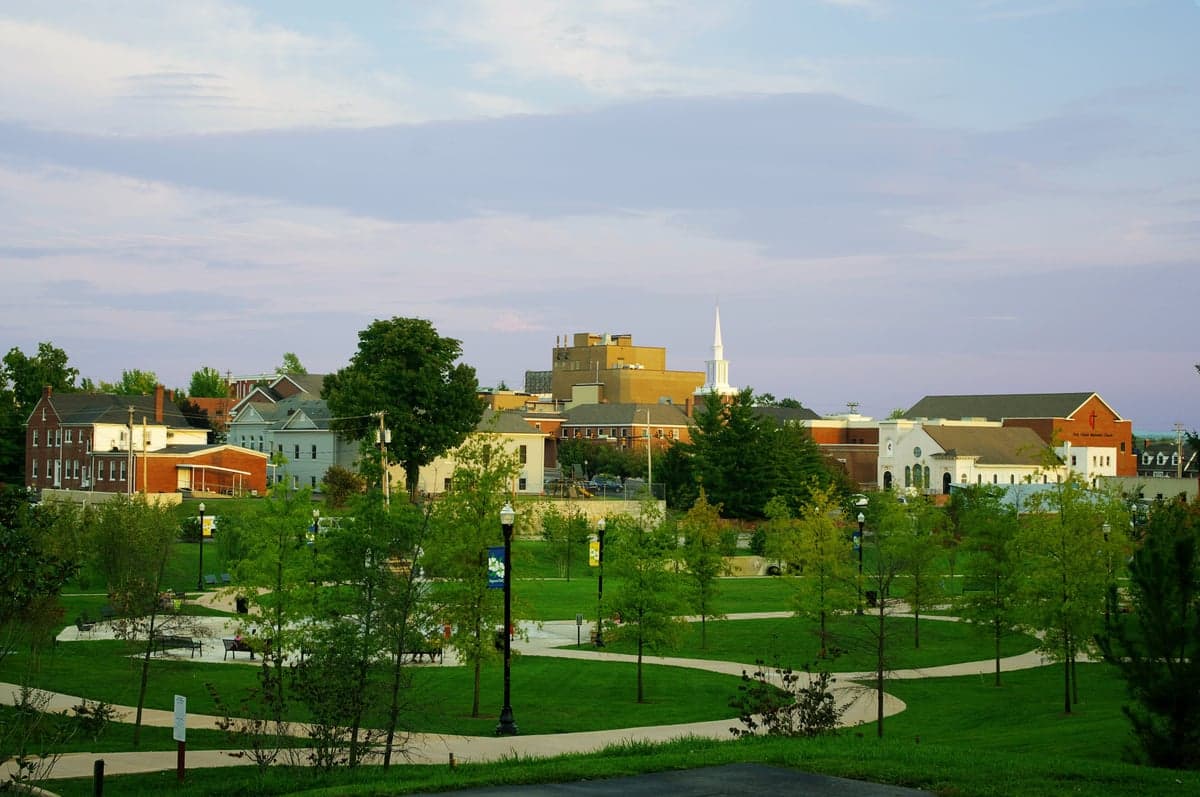
Photo: Wikipedia
Demographics of Cookeville, TN
Affluence Level in Cookeville, TN
A below-average socioeconomic profile. Incomes, home values, and educational attainment trail the U.S., with higher poverty and unemployment.
People of Cookeville, TN
Cookeville, Tennessee, is home to roughly 35,500 residents who form a predominantly white (79.5%), college-educated (35.4%) population with a growing Hispanic minority (11.2%) and small but established Black (3.6%), East/Southeast Asian (1.3%), and Indian-subcontinent (0.6%) communities. The city’s identity is shaped by its role as a regional education, healthcare, and retail hub for the Upper Cumberland, anchored by Tennessee Tech University. With a foreign-born share of just 4.7%, Cookeville remains less diverse than the national average but has seen steady diversification since the 1990s, driven largely by Hispanic in-migration for construction, manufacturing, and service work. The population is notably younger and more transient than surrounding rural areas, with many residents arriving for college or jobs and staying for the lower cost of living and family-friendly environment.
How the city was settled and grew
Cookeville was founded in 1854 as a railroad town on the newly completed Nashville and Knoxville Railroad, which drew the first wave of settlers—mostly Scots-Irish and English farmers, merchants, and craftsmen from the surrounding Cumberland Plateau. The town was named after Richard F. Cooke, a local landowner who donated the right-of-way, and its early growth centered on the Downtown Square and the adjacent West Side neighborhood, where merchants built homes and storefronts along the rail corridor. The arrival of Tennessee Polytechnic Institute (now Tennessee Tech) in 1915 brought a second wave: faculty, staff, and students from across the South, many of whom settled in the Tech Hill and North Spring Street areas near campus. Through the mid-20th century, Cookeville grew slowly as a farming and light-manufacturing center, with the South Jefferson Avenue corridor becoming home to working-class families employed at local mills and the Borden dairy plant. The city’s population remained overwhelmingly white and native-born until the 1970s, reflecting the broader demographics of the Upper Cumberland region.
Modern era (post-1965)
After the Hart-Cellar Act of 1965, Cookeville saw only modest immigration, with the first notable non-white arrivals being a small number of East/Southeast Asian professionals—primarily engineers and professors—recruited by Tennessee Tech in the 1970s and 1980s. These families concentrated in the University Heights subdivision near the campus, where they remain a small but stable community. The city’s most significant demographic shift began in the 1990s, when Hispanic workers—initially from Mexico and later from Central America—moved into Cookeville for jobs in construction, poultry processing, and the growing service sector. Many settled in the East Spring Street and Willow Avenue corridors, where affordable rental housing and proximity to industrial employers created a de facto Hispanic enclave. The Black population, historically small at around 3-4%, has remained stable and is dispersed across the city, with no single dominant neighborhood, though older Black families have roots in the West Side near the historic railroad depot. Indian-subcontinent residents, mostly professionals in healthcare and tech, arrived in the 2000s and tend to live in newer subdivisions like Hickory Hills on the city’s northern edge. The white population, while still the majority, has declined slightly as a share since 2000, from about 87% to 79.5%, as Hispanic and Asian groups have grown.
The future
Cookeville’s population is projected to continue growing at a moderate pace of 1-2% annually, driven by domestic in-migration from higher-cost states like California and Florida, as well as natural increase among the Hispanic community, which has a younger median age (28) compared to the white population (38). The Hispanic share is likely to rise to 14-16% by 2035, with the East Spring Street area becoming more established as a commercial and cultural hub for Latino families. The East/Southeast Asian and Indian-subcontinent populations are expected to grow slowly, primarily through professional recruitment by Tennessee Tech and Cookeville Regional Medical Center, and will likely remain concentrated in University Heights and Hickory Hills. The Black population is projected to remain stable at 3-4%, as Cookeville does not have the industrial base or urban pull factors that attract larger Black migration. The city is not tribalizing into sharply divided enclaves—neighborhoods remain relatively integrated by income and race—but the East Spring Street corridor is emerging as a distinct Hispanic-majority area, while the West Side and Tech Hill remain predominantly white and middle-class. Overall, Cookeville is becoming slightly more diverse, but it will remain a majority-white, college-town community with a growing Hispanic minority.
For a conservative-leaning individual or family considering a move, Cookeville offers a stable, family-oriented environment with a low crime rate, good schools, and a cost of living about 15% below the national average. The city is not undergoing rapid demographic upheaval—change is gradual and concentrated in specific neighborhoods—so newcomers can expect a community that feels familiar and safe, with the added benefit of a growing Hispanic presence that enriches local food and culture. The key takeaway: Cookeville is a quietly diversifying small city where the traditional white, native-born majority still sets the cultural tone, but where Hispanic and Asian communities are carving out stable, visible niches without significant friction.

* Values derived from national, state, county, city and local statistics and may differ in a specific area. Last updated: 2026-05-01T16:02:44.000Z
Narrative content on this page is AI-generated and may contain mistakes. Verify any details that matter before acting on them.
ReloMaps may earn a commission from affiliate links at no extra cost to you.

