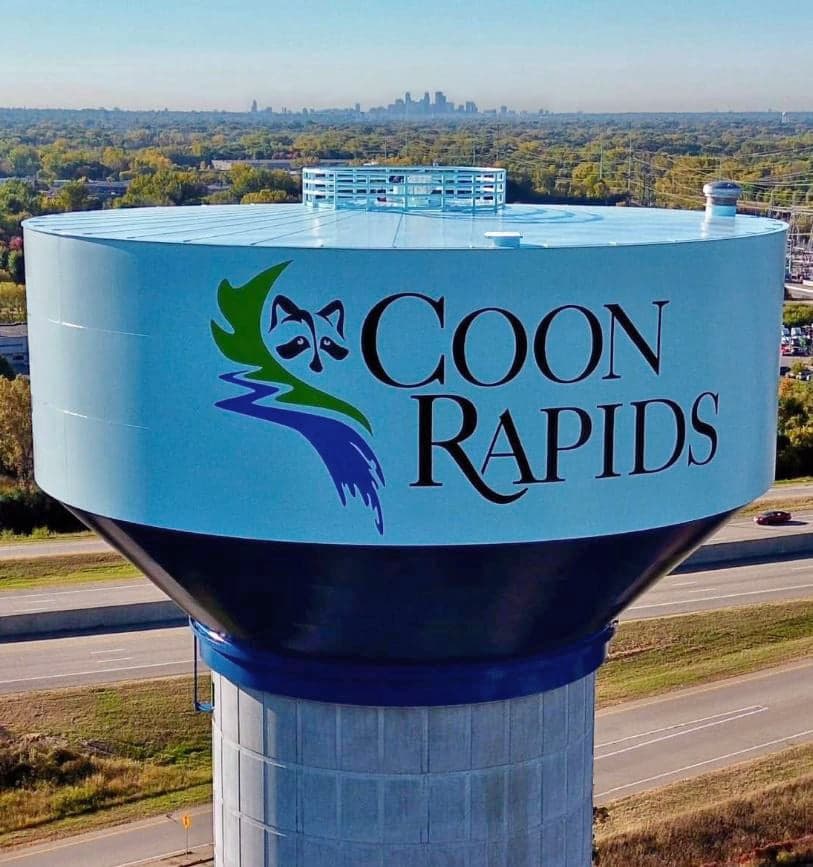
Photo: Wikipedia
Demographics of Coon Rapids, MN
Affluence Level in Coon Rapids, MN
A middle-class area roughly in line with national averages across income, home values, education, and employment.
People of Coon Rapids, MN
The people of Coon Rapids, Minnesota today form a predominantly white, middle-class suburban population of 63,348, with a distinctive blend of long-established Scandinavian and German families alongside growing East/Southeast Asian and Black communities. The city is notably less diverse than the broader Twin Cities metro, with a foreign-born population of just 3.6% and a college attainment rate of 24.3%, reflecting its historic roots as a working-class and trades-oriented suburb. Residents identify strongly with their individual neighborhoods—from the riverfront homes along the Mississippi to the post-war ramblers of the central grid—rather than with a single citywide identity. This is a place where generational continuity is visible in the number of families who have lived in the same subdivision for decades, even as new arrivals reshape the edges of the community.
How the city was settled and grew
Coon Rapids was not a pioneer-era settlement. The area was originally inhabited by the Dakota people, but European-American farmers—primarily of German, Irish, and Scandinavian stock—began arriving in the 1850s, drawn by the fertile Mississippi River valley bottomlands. The village of Coon Rapids was formally platted in 1879 along the St. Paul, Minneapolis & Manitoba Railway (later the Great Northern), which made it a shipping point for grain and timber. The original population clustered around the Riverdale neighborhood, near the Coon Rapids Dam, where the first general store, post office, and blacksmith shop served a scattered farming community. Through the early 20th century, the population grew slowly, reaching just 1,500 by 1940. The real transformation came after World War II, when returning veterans and their families sought affordable housing outside Minneapolis. The Sand Creek and Crooked Lake areas saw the first wave of suburban tract homes in the 1950s, built on former farmland and marketed to young families employed at the nearby Honeywell and Ford plants. These neighborhoods remain the city's demographic core, with many original homeowners aging in place and their children now raising families in the same houses.
Modern era (post-1965)
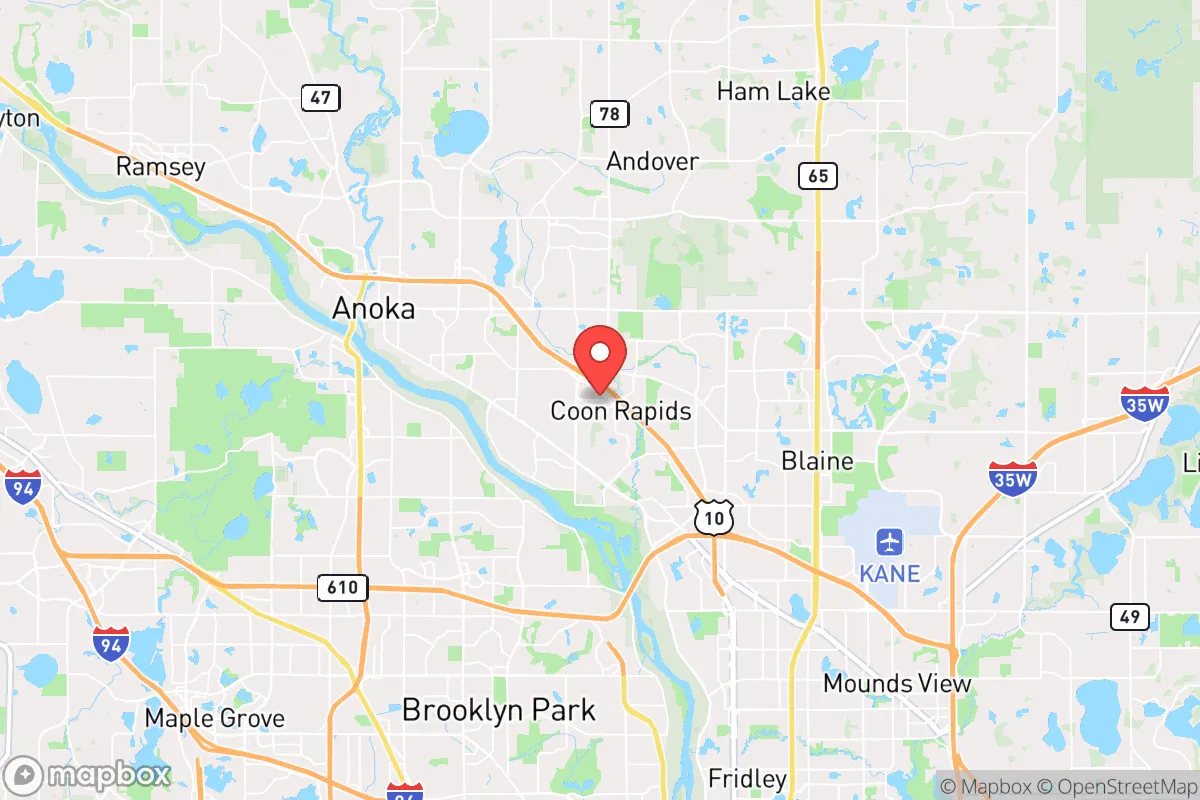
The 1965 Hart-Cellar Act had a modest direct impact on Coon Rapids compared to inner-ring suburbs, but the city did see its first significant non-white arrivals in the 1970s and 1980s. East/Southeast Asian families—primarily Hmong refugees from Laos and later Vietnamese and Burmese immigrants—settled in the Northdale and Riverview neighborhoods, drawn by affordable housing stock and proximity to entry-level manufacturing jobs in Anoka and Brooklyn Park. Today, East/Southeast Asian residents make up 7.3% of the population, the largest minority group. The Black population, at 8.5%, is more recent, arriving largely from other parts of the Twin Cities metro since 2000, and is concentrated in the Copperfield area near Highway 10. The Hispanic share of 5.6% is spread more evenly, with no single barrio, reflecting a pattern of gradual in-migration from Mexico and Central America for construction and service work. The Indian-subcontinent population remains tiny at 0.5%, mostly professionals working in healthcare and tech who live in newer developments near the Bunker Lake Boulevard corridor. Notably, the white share has declined from roughly 90% in 1990 to 72.5% today, but this shift has been gradual and largely peaceful, with little of the racial tension seen in some neighboring suburbs. The city's housing stock—predominantly single-family homes built between 1950 and 1980—has limited the kind of dense ethnic enclaves found in Minneapolis, so integration has been more dispersed.
The future
Demographic projections suggest Coon Rapids will continue to diversify slowly, but it is unlikely to become a majority-minority city within the next 20 years. The East/Southeast Asian population is plateauing as second-generation families move to newer suburbs like Blaine and Andover, while the Black and Hispanic shares are expected to grow modestly through domestic migration from within the metro. The white population is aging—the median age is 38.4, slightly above the state average—and younger white families are being partially replaced by minority households seeking the same affordable housing that drew their predecessors. The city is not tribalizing into distinct enclaves; rather, it is experiencing a slow, organic blending, with most neighborhoods remaining majority-white but with visible minority presence. The Riverdale area, once the historic core, is seeing the most new construction, including townhomes and apartments that may attract a more diverse, younger demographic. For a newcomer, Coon Rapids offers a stable, middle-ground environment: diverse enough to avoid insularity, but still overwhelmingly white and culturally traditional, with a strong sense of local identity rooted in its post-war suburban history.
Bottom-line: Coon Rapids is a slowly diversifying, middle-class suburb where the old Scandinavian-German foundation still dominates, but where East/Southeast Asian, Black, and Hispanic families are becoming a permanent part of the fabric. For a conservative-leaning mover, this means a community that is changing at a manageable pace, with no dramatic cultural upheaval, but with enough variety to avoid the homogeneity of a purely white exurb. The city's future is one of gradual integration, not rapid transformation—a place where tradition and modest change coexist.

* Values derived from national, state, county, city and local statistics and may differ in a specific area. Last updated: 2026-04-30T06:51:14.000Z
Narrative content on this page is AI-generated and may contain mistakes. Verify any details that matter before acting on them.
ReloMaps may earn a commission from affiliate links at no extra cost to you.

