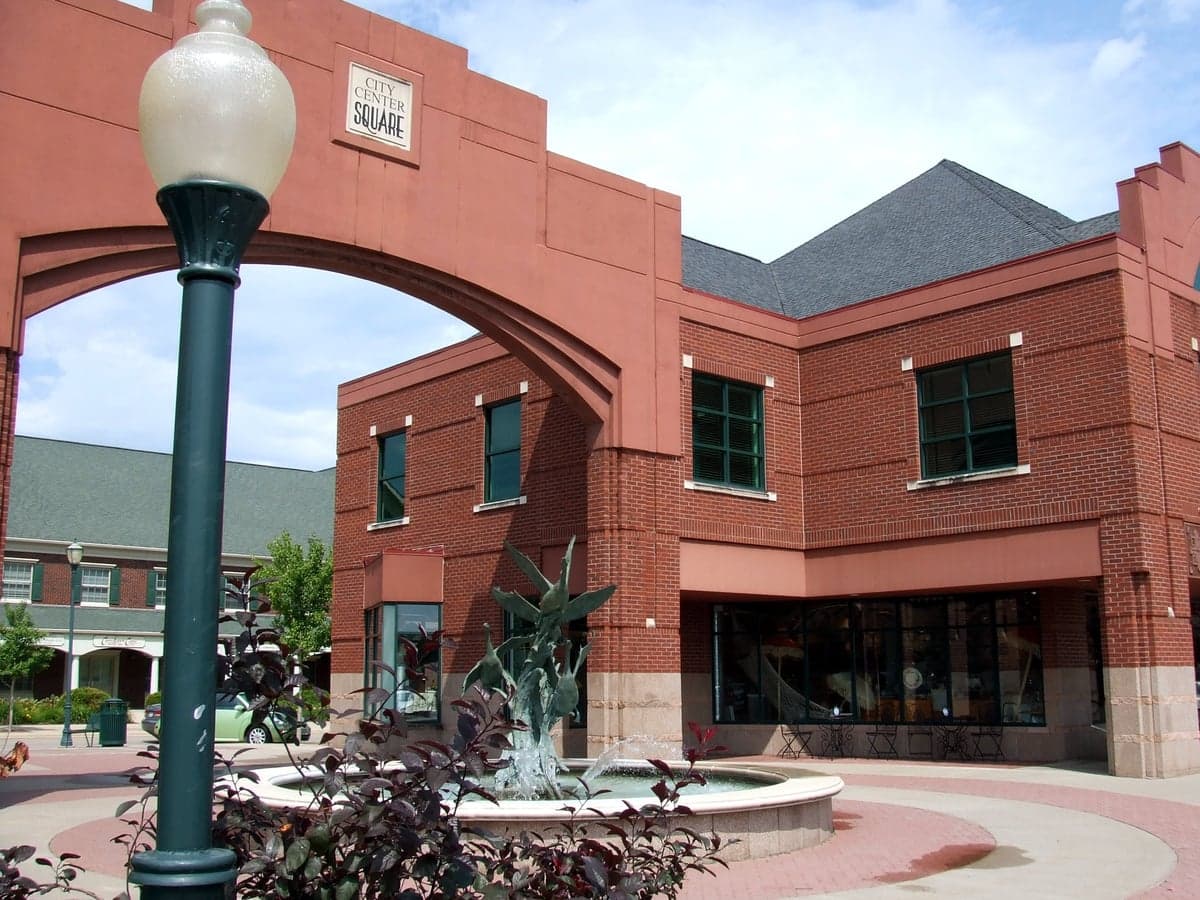
Photo: Wikipedia
Strategic Assessment of Coralville, IA
Meaningful friction. Expect exposure to either population pressure, blast zones, or natural disaster risk. Consider buying a retreat property.
What does the Strategic Assessment tell us?
Our Strategic Assessment grades tactical survivability of an area. Major population centers, military targets, fallout zones, natural disasters, and border exposure all drive risk — lower exposure means a more defensible position in a crisis.
This is heavily inspired by Joel Skousen's Strategic Relocation book. Highly recommended you checkout the book ($)What does this tell us?
Our Strategic Assessment grades tactical survivability of an area. Major population centers, military targets, fallout zones, natural disasters, and border exposure all drive risk — lower exposure means a more defensible position in a crisis.
This is heavily inspired by Joel Skousen's Strategic Relocation book. Highly recommended you checkout the book ($)Strategic Pillars

Key Distances
Regional Safe Places
Below is our recommended "safe zones" in Iowa and the surrounding area based on our strategic heuristics. For most people, it's unrealistic to live in a “safe zone” full-time due to work, family or other personal reasons. They tend to be more rural. However, many of these areas are perfect for second homes and retreat properties that double as a vacation home or even a short-term rental.
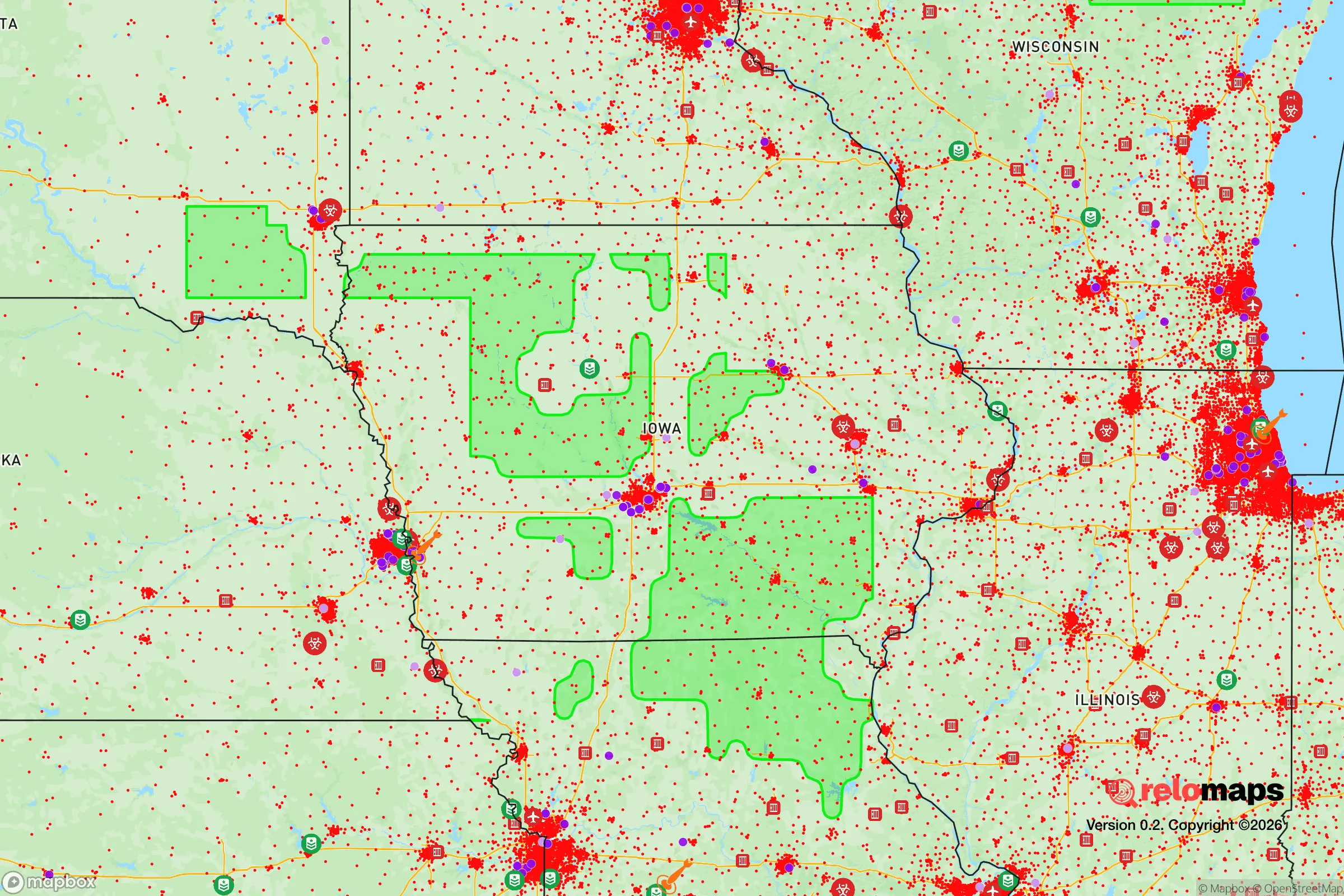
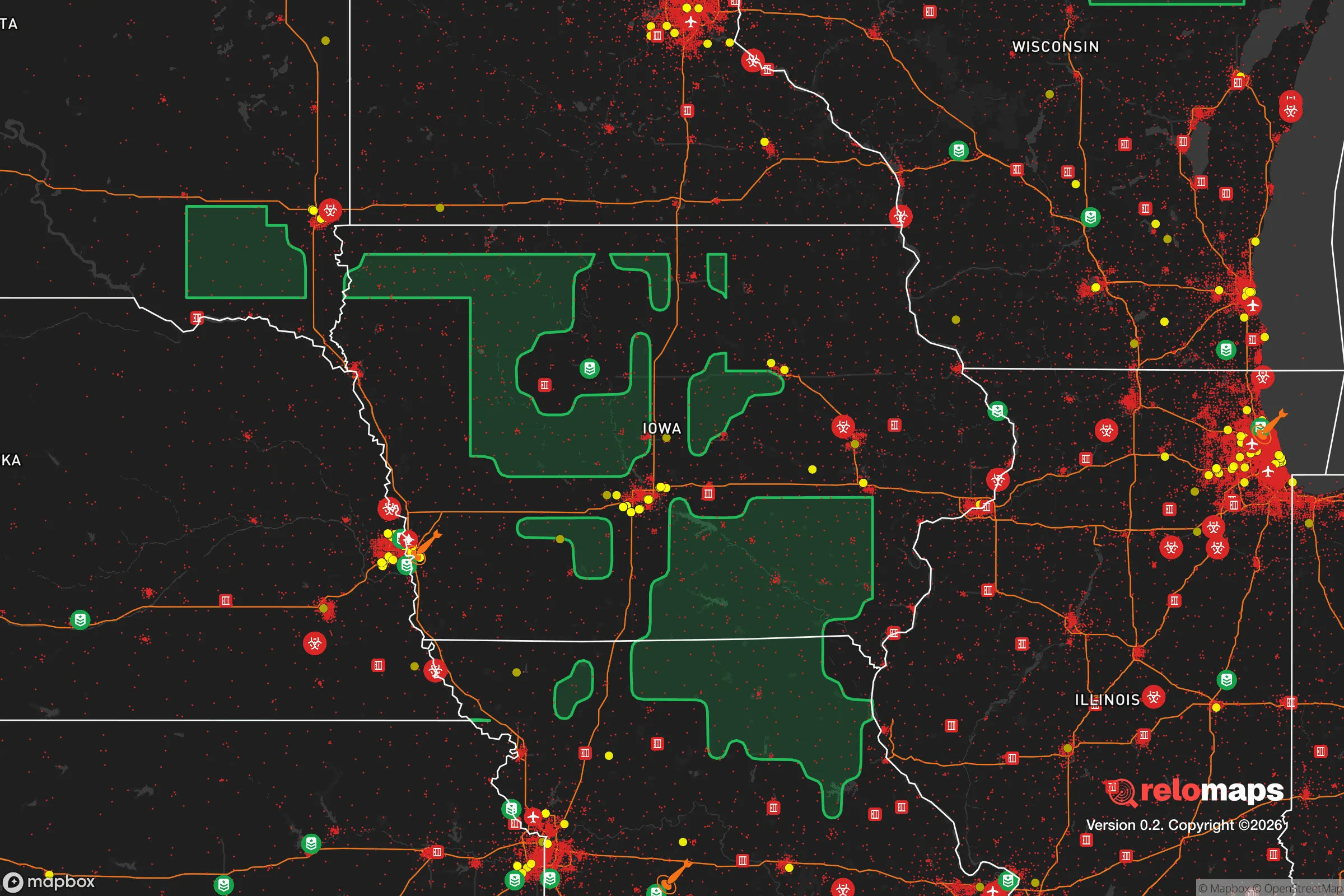


Important Note: For informational purposes only. This does not mean nothing bad ever happens in the green zones. Please use common sense. This is based on public data and modeled with AI. We tried to take a conservative approach but mistakes happen. We update this regularly as new information becomes available.
Solar Generator Recommendations
Backup power matters more here than in safer locations. We've picked three solar generators across budgets and capacity tiers — start with the budget unit if you only need a few essentials, or step up if you want to run a fridge and HVAC for days at a time.

Jackery Portable Power Station Explorer 300
Budget OptionPower on the Go: Weighing only 11 lbs, it's convenient to set up and store with book-sized foldable solar panels

BLUETTI Portable Power Station AC180
Designed for both indoor and outdoor scenarios, AC180 is highly capable as it has a robost capacity and continuous output power.

EF ECOFLOW DELTA Pro Ultra Power Station
Upgraded PickEcoFlow DELTA Pro Ultra is a whole-home energy system designed to grow with your family. Integrated with the Smart Home Panel 2, it scales to meet your evolving energy needs — keeping your home powered, intelligent, and secure through every stage of life.
We earn a commission, at no additional cost to you.
Strategic Assessment Analysis
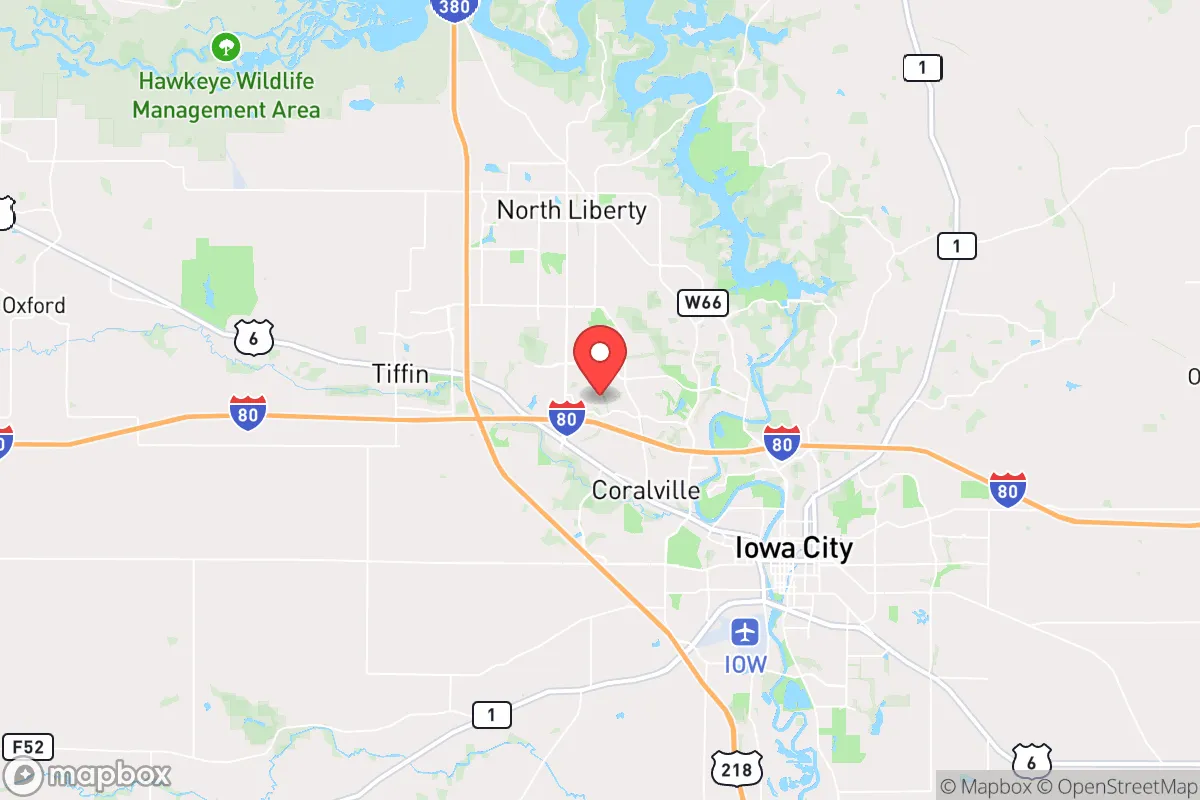
Coralville, Iowa, presents a mixed strategic picture for the conservative prepper or survivalist. Its primary resilience advantage is its location within the Iowa City-Coralville-North Liberty corridor, a regional economic hub that provides robust supply chains and medical infrastructure, yet its proximity to the University of Iowa and Interstate 80 creates significant vulnerabilities. For a relocator prioritizing long-term stability, the area offers solid agricultural access and a relatively low natural disaster risk, but the concentration of population and critical infrastructure along the I-80 corridor makes it a potential chokepoint during civil unrest or a mass casualty event. The key is understanding that Coralville’s strength—its connectivity—is also its greatest liability in a crisis scenario.
Geographic position and natural advantages for long-term stability
Coralville sits in the Iowa River Valley, a flat to gently rolling landscape that is part of the larger Corn Belt. This is a double-edged sword. On the positive side, the area is surrounded by some of the most productive agricultural land in the world. Within a 30-mile radius, you have access to Johnson, Washington, and Iowa counties, all of which are major producers of corn, soybeans, and livestock. For a prepper, this means local food sourcing is viable—farmers’ markets, CSAs, and direct-from-farm purchasing are well-established. The Iowa River itself provides a surface water source, though it’s not pristine; the Coralville Reservoir, formed by the Coralville Dam, is a key water storage feature. The dam, operated by the U.S. Army Corps of Engineers, offers flood control but also represents a single point of failure. The region’s Karst topography (limestone bedrock with sinkholes) is minimal here compared to eastern Iowa, so groundwater contamination from surface events is less of a concern. The natural advantages are real: fertile soil, reliable rainfall, and a temperate climate that supports year-round gardening with season extension techniques. However, the lack of significant topographic defensibility—no hills, no forests dense enough for cover—means you cannot rely on terrain for security. This is open country, and in a grid-down scenario, you are visible for miles.
Risks, exposures, and proximity to fallout-relevant landmarks
The biggest strategic risk for Coralville is its position along the I-80/I-380 interchange, a major east-west and north-south transportation artery. In a mass casualty event or civil unrest, this corridor becomes a funnel for displaced populations, looters, and refugees from Chicago, Des Moines, and the Quad Cities. Coralville is 30 miles from the Duane Arnold Energy Center (a decommissioned nuclear plant near Palo, IA), which, while no longer operating, still contains spent fuel in dry cask storage. A terrorist attack or accident at that site could render a 10-mile radius uninhabitable for years. More critically, the University of Iowa Hospitals and Clinics in Iowa City is a Level 1 trauma center and a regional hub for infectious disease research. In a pandemic or bioweapon scenario, this facility becomes a target or a contamination source. The Coralville Dam is another single-point-of-failure risk; a deliberate breach or structural failure would flood the downtown area and parts of Iowa City within hours. For a relocator, the proximity to these landmarks means you are not in a remote, off-grid location. You are in a suburban ring of a mid-sized metro area. The risk of being caught in a civil unrest event is moderate—Coralville itself is generally quiet, but the University of Iowa campus (3 miles away) has a history of protests and could be a flashpoint. The 2020 protests in Iowa City saw property damage and police clashes. If you are looking for a place to ride out a societal collapse, Coralville’s exposure to these vectors is a significant negative.
Practical resilience for a relocator: food, water, energy, and defensibility
For the prepper focused on practical resilience, Coralville offers a mixed bag. Food security is above average. The Coralville Farmers Market (May-October) is one of the best in the state, and the New Pioneer Food Co-op in Iowa City provides bulk grains, seeds, and local meats. You can also access Wilson’s Orchard and Dan & Debbie’s Creamery for dairy and produce. However, in a crisis, these supply chains will be among the first to be stripped. You need to establish your own garden and possibly a small livestock operation (chickens, rabbits) within city limits—Coralville’s zoning allows backyard chickens with a permit, but not larger animals. Water security is a concern. The municipal water supply comes from the Iowa River and is treated at the Coralville Water Treatment Plant. In a prolonged power outage or contamination event, this plant is vulnerable. A well is the gold standard, but most residential lots in Coralville are on city water. Drilling a private well is possible but expensive ($5,000-$10,000) and requires a permit. Rainwater catchment is legal but limited to non-potable uses. Energy resilience is moderate. The grid is reliable but not hardened against EMP or cyberattack. Solar is viable—Iowa gets about 200 sunny days per year—but net metering policies are favorable only if the grid is up. A backup generator with a 500-gallon propane tank is a smarter investment here than solar alone, given the cold winters. Defensibility is the weakest link. Coralville is a suburban grid of cul-de-sacs and strip malls. Your home is likely within 500 feet of a neighbor. There is no natural chokepoint to defend. The best you can do is a reinforced door, window film, and a well-stocked armory. The Johnson County Sheriff’s Office is professional but will be overwhelmed in a mass casualty event. Your security is your own responsibility, and the open terrain works against you.
The overall strategic picture for Coralville is that it is a moderate-risk, moderate-reward location for the conservative prepper. It is not a bug-out destination—it is too connected, too exposed, and too dependent on fragile infrastructure. However, for a relocator who wants to maintain a normal life while building resilience, it offers a solid base of operations: good soil, decent water access, and a community that is generally law-abiding and self-reliant. The key is to treat Coralville as a staging ground, not a fortress. You want to be here for the economic opportunities and the supply chains, but you need a secondary plan—a rural property within 50 miles in a county like Washington or Keokuk—where you can retreat if the I-80 corridor becomes a war zone. Coralville’s best use is as a place to stockpile, network, and train, not as a final redoubt. If you are serious about surviving a long-term crisis, you will eventually need to leave the suburbs. But for the next 5-10 years, while the country drifts toward instability, Coralville is a defensible enough place to raise a family and build your preps—provided you keep your eyes open and your bags packed.

* Values derived from national, state, county, city and local statistics and may differ in a specific area. Last updated: 2026-04-30T07:59:20.000Z
Narrative content on this page is AI-generated and may contain mistakes. Verify any details that matter before acting on them.
ReloMaps may earn a commission from affiliate links at no extra cost to you.

