Strategic Assessment of Cornelius, NC
Multiple tactical vulnerabilities. Population density, target proximity, or disaster risk are likely compounding. A retreat property and exit planning is required.
What does the Strategic Assessment tell us?
Our Strategic Assessment grades tactical survivability of an area. Major population centers, military targets, fallout zones, natural disasters, and border exposure all drive risk — lower exposure means a more defensible position in a crisis.
This is heavily inspired by Joel Skousen's Strategic Relocation book. Highly recommended you checkout the book ($)What does this tell us?
Our Strategic Assessment grades tactical survivability of an area. Major population centers, military targets, fallout zones, natural disasters, and border exposure all drive risk — lower exposure means a more defensible position in a crisis.
This is heavily inspired by Joel Skousen's Strategic Relocation book. Highly recommended you checkout the book ($)Strategic Pillars

Key Distances
Regional Safe Places
Below is our recommended "safe zones" in North Carolina and the surrounding area based on our strategic heuristics. For most people, it's unrealistic to live in a “safe zone” full-time due to work, family or other personal reasons. They tend to be more rural. However, many of these areas are perfect for second homes and retreat properties that double as a vacation home or even a short-term rental.

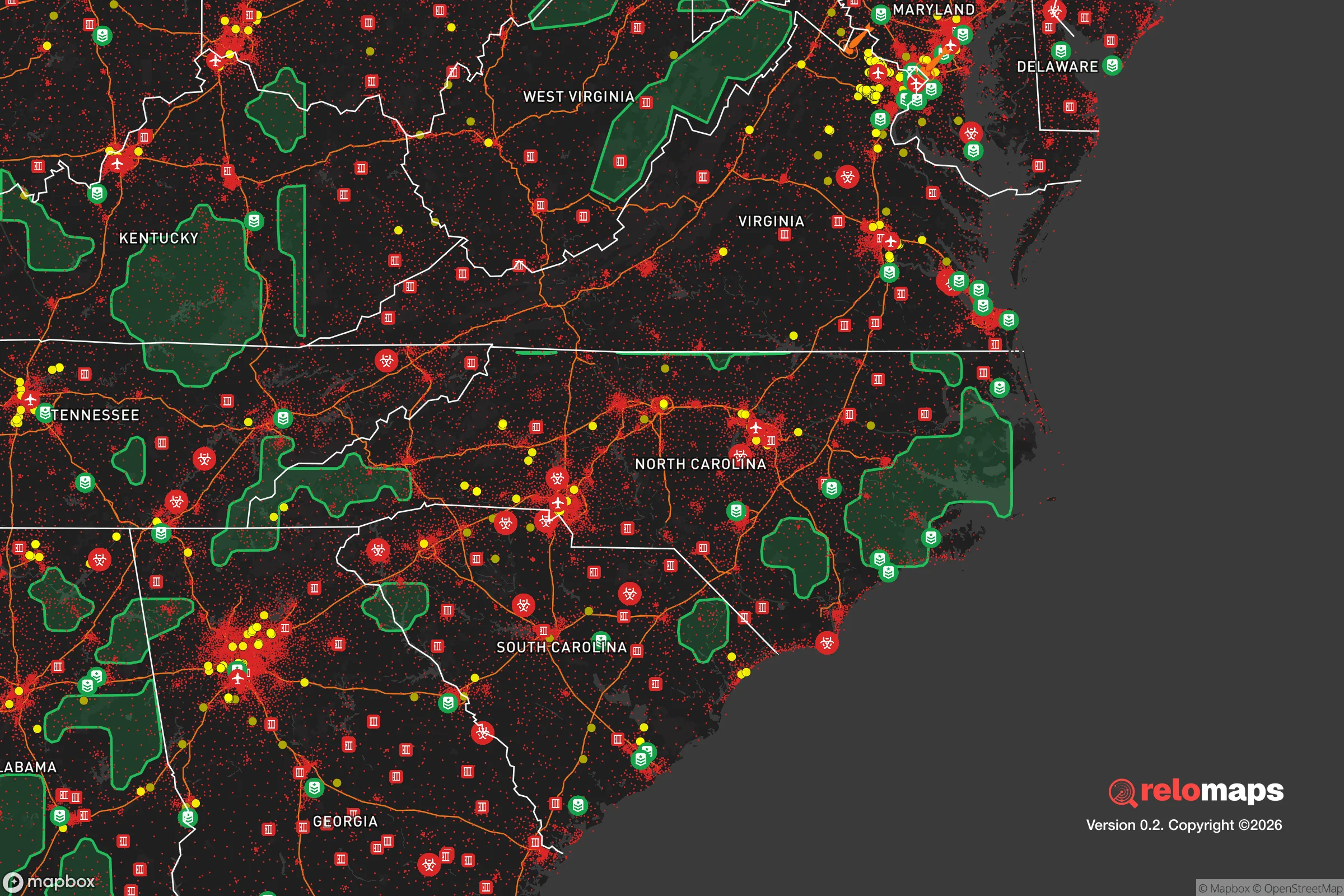


Important Note: For informational purposes only. This does not mean nothing bad ever happens in the green zones. Please use common sense. This is based on public data and modeled with AI. We tried to take a conservative approach but mistakes happen. We update this regularly as new information becomes available.
Solar Generator Recommendations
Backup power matters more here than in safer locations. We've picked three solar generators across budgets and capacity tiers — start with the budget unit if you only need a few essentials, or step up if you want to run a fridge and HVAC for days at a time.

Jackery Portable Power Station Explorer 300
Budget OptionPower on the Go: Weighing only 11 lbs, it's convenient to set up and store with book-sized foldable solar panels

BLUETTI Portable Power Station AC180
Designed for both indoor and outdoor scenarios, AC180 is highly capable as it has a robost capacity and continuous output power.

EF ECOFLOW DELTA Pro Ultra Power Station
Upgraded PickEcoFlow DELTA Pro Ultra is a whole-home energy system designed to grow with your family. Integrated with the Smart Home Panel 2, it scales to meet your evolving energy needs — keeping your home powered, intelligent, and secure through every stage of life.
We earn a commission, at no additional cost to you.
Strategic Assessment Analysis
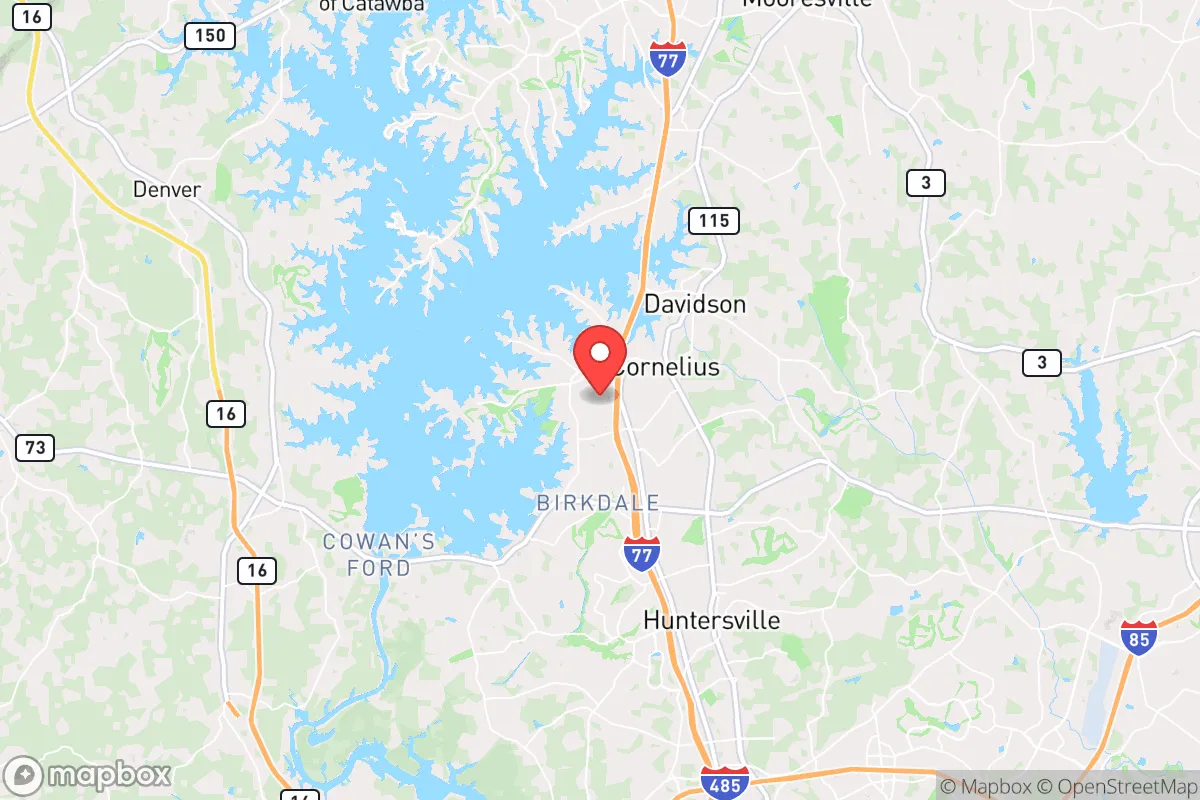
Cornelius, North Carolina, sits in a precarious but potentially advantageous position for those serious about strategic relocation. Nestled on the northern shore of Lake Norman, this town of roughly 33,000 offers a blend of suburban comfort and access to critical natural resources, but its proximity to Charlotte—just 20 miles south—introduces significant vulnerabilities. For the prepper or survivalist, Cornelius is a study in trade-offs: it provides a defensible water-adjacent base with decent local food potential, yet it lies within the blast radius of a major metropolitan target and the associated fallout risks. The key is understanding that this is not a remote retreat; it is a forward-operating base with specific strengths and glaring weaknesses that demand a clear-eyed assessment.
Geographic position and natural advantages for a strategic base
Cornelius’s primary asset is its location on Lake Norman, a 32,500-acre reservoir created by the Cowans Ford Dam on the Catawba River. This body of water offers a reliable, if not pristine, source of freshwater—critical for long-term survival when municipal systems fail. The lake also provides a natural barrier to the south and east, complicating ground approaches from Charlotte. The surrounding terrain is gently rolling Piedmont, with mixed hardwood forests that offer decent cover and modest hunting opportunities for deer and turkey. The climate is temperate, with four distinct seasons, meaning a relocator must prepare for both summer heat and occasional winter ice storms, but it avoids the extremes of the Deep South or the Northeast. The town’s position along I-77 and NC-73 gives it good road access for supply runs, but these same arteries become choke points during an evacuation—a double-edged sword. The Lake Norman area also benefits from relatively low seismic risk and no hurricane storm surge, though inland flooding from heavy rains is a periodic concern. For a strategic base, the water access and moderate climate are genuine pluses, but the reliance on a single dam for lake levels introduces a single point of failure that demands attention.
Risks, exposures, and proximity to fallout-relevant landmarks
The most glaring risk for Cornelius is its proximity to Charlotte, a city of nearly 900,000 that is a prime target for civil unrest, economic collapse, or a mass casualty event. Charlotte hosts a major financial hub (Bank of America, Truist), an international airport (CLT), and a significant federal presence, including the FBI’s Charlotte Field Office. In a grid-down scenario, Cornelius would be in the path of a massive refugee flow north along I-77, with the Lake Norman bridges becoming inevitable bottlenecks. The McGuire Nuclear Station (about 15 miles southwest of Cornelius, near Huntersville) is a more direct concern. While the plant has a good safety record, a catastrophic failure—whether from sabotage, earthquake, or EMP—would render large portions of the area uninhabitable for decades. The prevailing winds in the region blow from the southwest, meaning a plume from McGuire would push directly over Cornelius. Additionally, the Cowans Ford Dam itself is a critical infrastructure target; a breach would drain Lake Norman and cause catastrophic flooding downstream, but the immediate effect on Cornelius would be the loss of the lake as a water source and barrier. The area also has a moderate risk of tornadoes, with the 2020 Easter outbreak spawning an EF-1 that damaged homes in nearby Denver, NC. For the prepper, these are not abstract threats—they are concrete vulnerabilities that demand a layered defense plan, including multiple egress routes and a cache of potassium iodide tablets.
Practical resilience for a relocator: food, water, energy, and defensibility
For a single individual or family looking to hunker down, Cornelius offers a mixed bag. Water is the strongest suit: Lake Norman provides a massive, accessible reservoir, but it requires treatment. Boiling, filtration (Berkey or Sawyer systems), and chemical purification are non-negotiable. The lake is also popular for recreational boating, meaning a prepper with a small boat can access fishing and transportation, but this also means competition for resources during a crisis. Food is more challenging. The area has some local farms—like Hodges Family Farm in nearby Davidson—and a few community gardens, but Cornelius is primarily suburban, with most land given to housing and strip malls. A relocator would need to establish a substantial home garden, preferably with raised beds and a greenhouse for year-round production. The local soil is clay-heavy, requiring amendment. Energy is a vulnerability: Duke Energy provides grid power, but outages from storms or grid failure are common. Solar panels with battery storage (e.g., Tesla Powerwall or DIY lithium setups) are a wise investment, but the tree canopy in many neighborhoods limits sun exposure. A backup generator running on propane or diesel is more practical for immediate needs. Defensibility is the weakest link. Cornelius is a typical suburban layout with cul-de-sacs and open lots; there are few natural chokepoints or high-ground positions. A home on the lake offers a water-side escape route, but the front door remains exposed to the street. The local police department is responsive but small (around 40 officers), and in a widespread event, they would be overwhelmed. The best strategy is to form a neighborhood watch or mutual assistance group with like-minded neighbors, focusing on perimeter security and shared resources. The Mecklenburg County Sheriff’s Office has a strong presence, but during a crisis, their priority will be Charlotte, not Cornelius.
The overall strategic picture for Cornelius is one of calculated risk. It is not a remote survivalist paradise—it is a suburban lakeside town with real assets (water, moderate climate, decent local food potential) and real liabilities (proximity to Charlotte, nuclear plant, and major highways). For the conservative prepper who values community and wants to be within striking distance of urban resources while maintaining a defensible base, Cornelius can work, but only with serious preparation. The key is to treat it as a staging area, not a final redoubt. Have a bug-out plan for the mountains (the Blue Ridge is about 90 minutes west), stockpile supplies for at least 90 days of self-sufficiency, and invest in water purification and off-grid power. The town’s schools are solid (Charlotte-Mecklenburg Schools, with William A. Hough High School rated well), and the local economy is stable, but those are peacetime advantages. In a crisis, Cornelius’s fate is tied to Charlotte’s. If you are willing to accept that risk and prepare accordingly, it offers a viable base for weathering the storm—but do not mistake it for a sanctuary. It is a forward position, and you must be ready to move or fight.

* Values derived from national, state, county, city and local statistics and may differ in a specific area. Last updated: 2026-04-24T12:50:28.000Z
Narrative content on this page is AI-generated and may contain mistakes. Verify any details that matter before acting on them.
ReloMaps may earn a commission from affiliate links at no extra cost to you.

