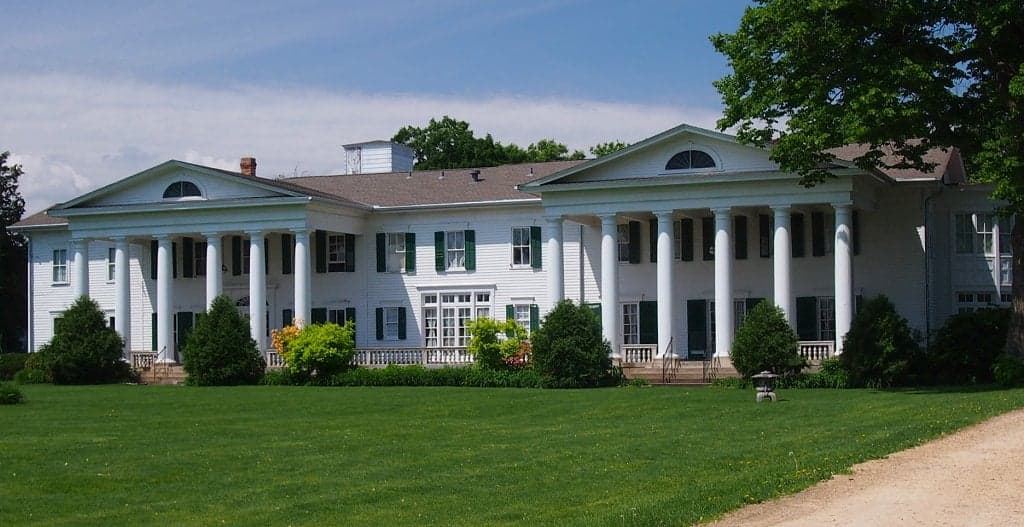
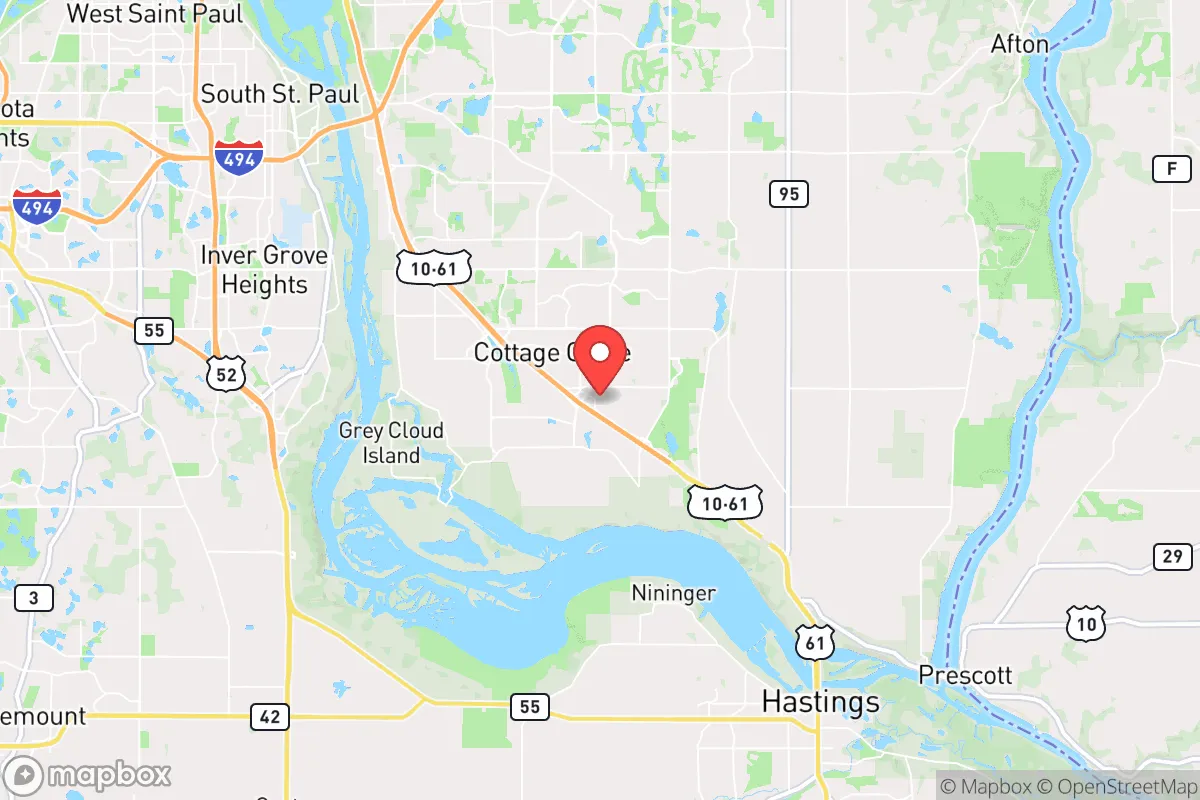
Photo: Wikipedia
Demographics of Cottage Grove, MN
Affluence Level in Cottage Grove, MN
An upper-middle-class area. Household wealth, education levels, and homeownership run ahead of national benchmarks.
People of Cottage Grove, MN
The people of Cottage Grove, Minnesota, today number roughly 40,100, forming a predominantly white, family-oriented suburb with a notably higher-than-average college attainment rate of 39.3%. The city’s character is one of steady, middle-class stability, shaped by successive waves of European-American settlers, post-war suburbanites, and a modest but growing presence of East and Southeast Asian and Hispanic families. Distinctive identity markers include a strong sense of local community centered around schools and parks, a population density that feels suburban rather than rural, and a demographic profile that remains less diverse than the Twin Cities metro as a whole.
How the city was settled and grew
Cottage Grove’s human history begins with the Dakota people, who used the area along the Mississippi River for seasonal camps and trade. European-American settlement began in earnest in the 1840s and 1850s, when Yankee and German immigrants were drawn by the fertile land of the St. Croix River Valley and the promise of farming. The original village core formed around what is now the Old Cottage Grove neighborhood, near the intersection of 80th Street and Hadley Avenue. A second wave of Scandinavian immigrants—primarily Swedes and Norwegians—arrived in the 1870s and 1880s, establishing farms and small clusters in what became the Woodridge and Ravenna areas. These groups built the first churches, schools, and civic institutions, laying a foundation of Lutheran and Catholic community life that persists in local culture today. The city remained a small agricultural hamlet through the early 20th century, with no major industrial draw beyond local mills and rail access.
Modern era (post-1965)
The post-1965 transformation of Cottage Grove was driven not by immigration reform but by domestic suburbanization. The construction of Interstate 94 and the expansion of the Twin Cities metro area turned Cottage Grove into a commuter suburb. Large-scale housing developments in the Hillside and Park Grove neighborhoods attracted young families—overwhelmingly white, native-born, and middle-class—who sought affordable homes and good schools. By the 1990s, the city’s population had more than doubled from its 1970 level. The foreign-born share remained very low, hovering around 2-3%, and the population was over 95% white. The modest diversification that has occurred since 2000 is concentrated in specific areas. East and Southeast Asian families (6.1% of the population) have settled primarily in the newer subdivisions of Woodbury East and the Valley Creek corridor, drawn by the same school-quality and housing-value calculus as their white neighbors. Hispanic residents (6.8%) are more dispersed but show a slight concentration in the older, more affordable housing stock of the Old Cottage Grove and Ravenna areas. The Black population (5.3%) is scattered across the city, with no single dominant neighborhood. The Indian-subcontinent population remains tiny at 0.5%, reflecting the city’s limited draw for the tech and medical professionals who cluster in nearby Woodbury and Eagan.
The future
The demographic trajectory of Cottage Grove points toward slow, incremental diversification rather than rapid change. The white share, while still dominant at 76.1%, is declining gradually as older residents age in place and younger, more diverse families move into new construction. The East and Southeast Asian and Hispanic populations are growing steadily, though from a small base, and are likely to reach 8-10% and 9-11% respectively within a decade. These groups are not forming isolated ethnic enclaves but are integrating into the existing neighborhood fabric, particularly in the Hillside and Park Grove areas where newer housing stock attracts a mix of buyers. The foreign-born share, at 2.3%, is unlikely to rise dramatically given the city’s lack of major employers or ethnic infrastructure. The larger trend is one of assimilation: second-generation children of immigrant families are graduating from Cottage Grove’s well-regarded schools and moving into professional careers, often leaving the city for denser urban areas. The population is homogenizing in terms of income and education—college attainment is rising—even as it becomes slightly more diverse in ancestry.
For someone moving in now, Cottage Grove is becoming a stable, moderately diverse suburb where the dominant culture remains Midwestern, family-centric, and politically moderate-to-conservative. The city offers a predictable, low-crime environment with strong schools, but those seeking a truly multicultural or urban-vibrant setting will find it lacking. The next 10-20 years will likely see a continuation of the same pattern: gradual diversification, steady middle-class growth, and a population that values stability over change.

* Values derived from national, state, county, city and local statistics and may differ in a specific area. Last updated: 2026-04-24T11:30:39.000Z
Narrative content on this page is AI-generated and may contain mistakes. Verify any details that matter before acting on them.
ReloMaps may earn a commission from affiliate links at no extra cost to you.

