Photo: Wikipedia
Demographics of Council Bluffs, IA
Affluence Level in Council Bluffs, IA
A middle-class area roughly in line with national averages across income, home values, education, and employment.
People of Council Bluffs, IA
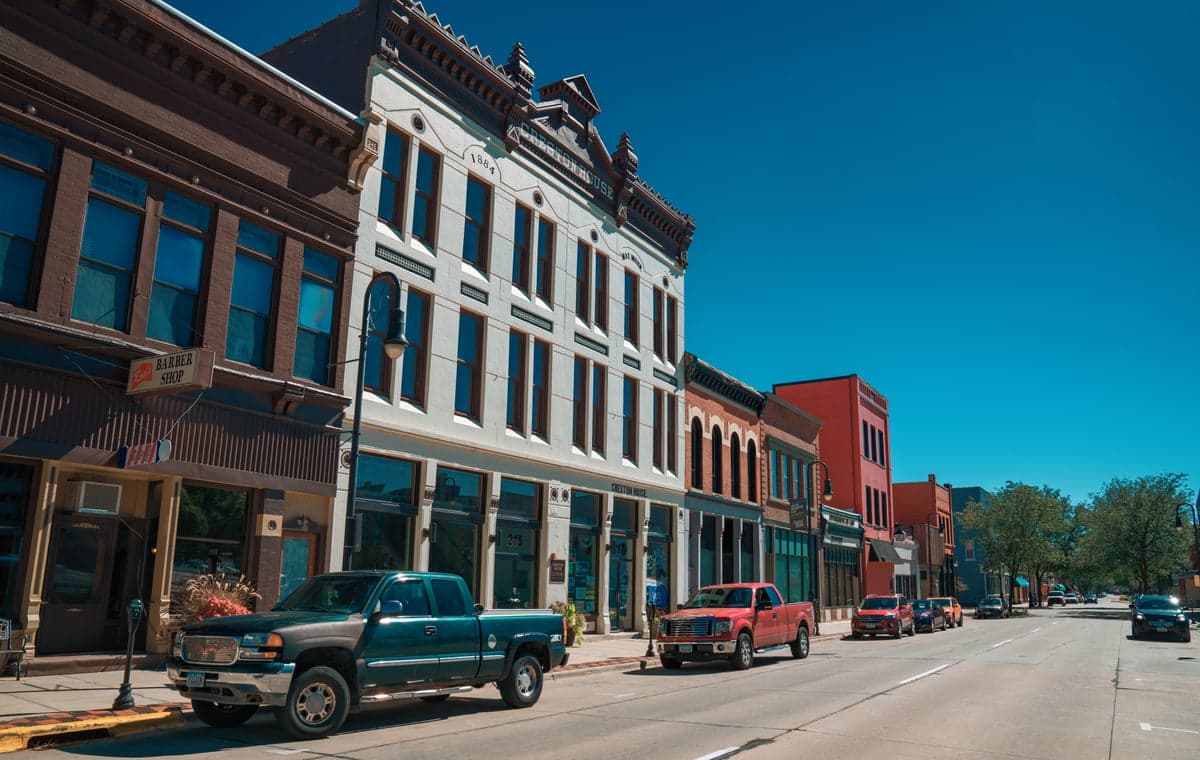
The people of Council Bluffs, Iowa, today number 62,564, forming a predominantly white (82.6%) and native-born (97.5% U.S.-born) community with a modest Hispanic minority (10.6%) and small Black (2.5%) and East/Southeast Asian (1.1%) populations. The city feels distinctly Midwestern—stable, family-oriented, and rooted in its railroad and agricultural heritage—with a lower college attainment rate (21.7%) than the national average, reflecting a blue-collar and service-oriented workforce. Residents identify strongly with specific neighborhoods like the historic West End, the suburban Lake Manawa area, and the older central districts near Bayliss Park, each carrying distinct settlement histories.
How the city was settled and grew
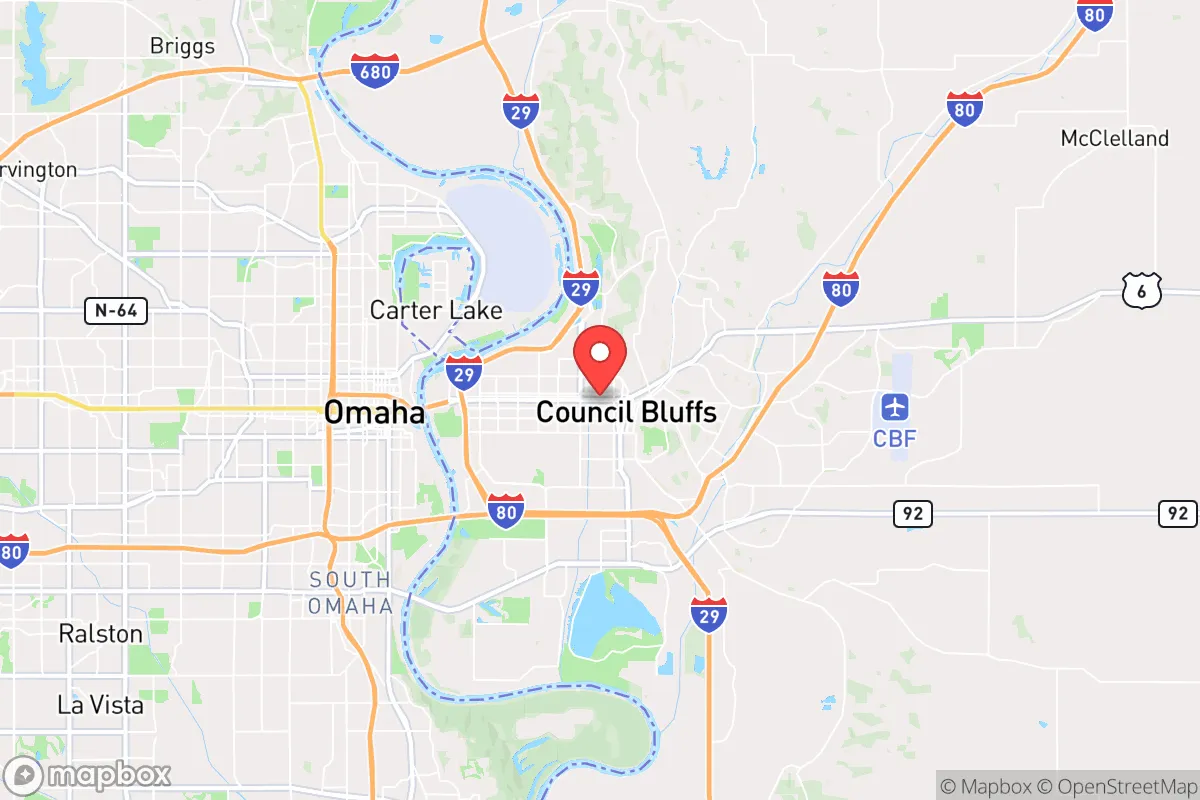
Council Bluffs was originally a Kanza and Omaha tribal territory before Euro-American settlement began in earnest in the 1820s, when fur traders and Mormon pioneers passed through. The city’s real population boom came after 1853, when it was chosen as the eastern terminus of the Union Pacific Railroad, drawing waves of Irish and German laborers who built the rail lines and settled in the West End and Railroad District near the Missouri River. By the 1880s, Swedish and Danish immigrants arrived to work in the growing lumber and milling industries, clustering in the North End around what is now North 16th Street. The city’s population peaked at over 60,000 by 1960, driven by railroad employment and the nearby Offutt Air Force Base, which brought a transient military population but little lasting ethnic diversification.
Modern era (post-1965)
After the 1965 Hart-Cellar Act, Council Bluffs saw minimal immigration compared to coastal cities—foreign-born residents today are just 2.5% of the population. The most notable post-1965 shift was the growth of a Hispanic community, primarily of Mexican origin, who arrived from the 1980s onward for work in meatpacking and construction. This group concentrated in the South End near South Omaha Bridge Road and in parts of the Manawa area, where a small but visible Hispanic commercial corridor emerged. The Black population (2.5%) remained small and largely centered in the West End and near the Iowa School for the Deaf, while East/Southeast Asian residents (1.1%)—mostly Vietnamese and Filipino families—settled in the Lake Manawa neighborhoods, drawn by affordable housing and proximity to Omaha’s job market. Domestic in-migration from rural Iowa and Nebraska kept the city overwhelmingly white and native-born, with suburbanization pulling middle-class families toward newer developments in the Westridge and Hillside subdivisions.
The future
Council Bluffs is slowly diversifying but remains on a trajectory of modest homogenization. The Hispanic share is projected to grow to 12-14% by 2035, driven by natural increase and continued labor migration, while the white share will decline gradually from 82.6%. The Black and East/Southeast Asian populations are expected to plateau, as the city lacks the job magnets or refugee resettlement programs that drive growth in larger metros. The Indian subcontinent population is effectively zero and unlikely to change. Neighborhoods are not tribalizing into stark enclaves—Hispanic residents are dispersing across the South End and Manawa areas rather than forming a single barrio—but the West End remains the most diverse pocket, with a mix of white, Black, and Hispanic households. The city’s low college attainment rate and aging housing stock in central districts may slow in-migration of younger professionals, who tend to prefer Omaha’s denser urban core across the river.
For a conservative-leaning mover today, Council Bluffs offers a stable, predominantly native-born community with low crime in its suburban fringes and a clear sense of local identity in neighborhoods like the West End and Lake Manawa. The population is aging slightly but remains family-oriented, with growth concentrated in the Hispanic community and new subdivisions near the interstate. It is not a melting pot or a rapidly diversifying hub—it is a steady, Midwestern city where most residents share a common cultural baseline, and where newcomers will find a place that values continuity over change.

* Values derived from national, state, county, city and local statistics and may differ in a specific area. Last updated: 2026-04-19T07:15:31.000Z
Narrative content on this page is AI-generated and may contain mistakes. Verify any details that matter before acting on them.
ReloMaps may earn a commission from affiliate links at no extra cost to you.

