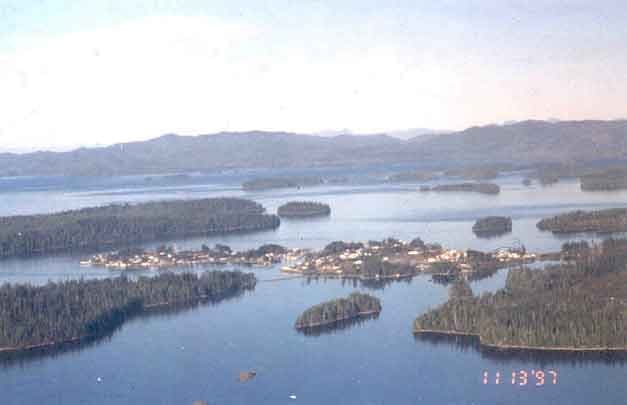
Photo: Wikipedia
Demographics of Craig, AK
Affluence Level in Craig, AK
A middle-class area roughly in line with national averages across income, home values, education, and employment.
People of Craig, AK
The people of Craig, Alaska, today form a tight-knit community of just over 1,000 residents, characterized by a predominantly white population (61.4%) with a notable Alaska Native presence and a small but growing Hispanic minority (5.4%). The city’s identity is rooted in commercial fishing and a rugged, self-reliant lifestyle, with a lower college attainment rate (20.9%) reflecting the value placed on trades and maritime skills over formal education. Craig is a place where family names and fishing boats are passed down through generations, creating a stable, insular social fabric that newcomers must earn their way into.
How the city was settled and grew
Craig’s human history begins with the Tlingit people, who used the area as a seasonal fishing camp long before permanent settlement. The modern town was founded in 1907 by Craig Millar, a Scottish immigrant who established a salmon saltery on the protected waters of Klawock Inlet. The original settlement clustered around what is now Waterfront District, where the first wooden docks and cannery buildings went up. The early 20th century brought a wave of Scandinavian fishermen—Norwegians, Swedes, and Finns—who built homes along Main Street and the adjacent Fish Creek neighborhood, drawn by the booming salmon industry. By the 1930s, a small but steady influx of white homesteaders from the Pacific Northwest filled in the area around Hillcrest, establishing the pattern of single-family homes on modest lots that still defines the town’s residential character. The population remained overwhelmingly white and Alaska Native through the mid-20th century, with the cannery workforce including a mix of local Tlingit families and seasonal Filipino laborers who did not settle permanently.
Modern era (post-1965)
The post-1965 era saw Craig’s population stabilize rather than explode, as the fishing industry consolidated and the Alaska Native Claims Settlement Act (1971) created new economic opportunities for indigenous residents. The Port of Craig area expanded with modern cold storage and processing facilities, drawing a small number of Hispanic workers from the Pacific Northwest and California—a trend that accelerated after 2000. Today, the Hispanic population stands at 5.4%, with families concentrated in the South End near the harbor, where affordable rental housing and proximity to fish plants make entry-level work accessible. The Asian population (2.4%) is almost entirely Filipino, descendants of cannery workers who settled permanently in the North End around the old schoolhouse. The white population, while still the majority at 61.4%, has aged slightly as younger adults leave for college or jobs in Ketchikan and Juneau. The foreign-born share (2.0%) is low, reflecting the town’s geographic isolation and limited economic diversity. No Indian-subcontinent population is recorded, and the Black population is negligible (0.2%).
The future
Craig’s population is slowly declining—down from a peak of roughly 1,200 in the 1990s—as the fishing industry faces pressure from climate change, salmon stock fluctuations, and global market competition. The town is not homogenizing into a single enclave; rather, it is maintaining distinct neighborhoods: Waterfront District remains the commercial and social heart, Hillcrest holds the older white families, and the South End is becoming a modestly more diverse working-class area. The Hispanic community is growing slowly but steadily, likely reaching 7-8% by 2035, while the white population will continue to shrink as young adults leave. The Alaska Native population, not separately tracked in the data but visibly present in local governance and culture, is stable. Craig is not tribalizing into ethnic enclaves—its small size prevents that—but it is becoming slightly more diverse at the margins while the core remains white and fishing-oriented.
For someone moving in now, Craig offers a place where community ties are strong but newcomers must respect the existing social order. The population is aging and slowly contracting, but the town’s identity as a working fishing port is unlikely to change. The low college attainment rate and high trade-skill focus mean that practical competence matters more than credentials. This is a place for those who value stability, self-reliance, and a close-knit, predominantly white community with a small but growing Hispanic presence at the edges.

* Values derived from national, state, county, city and local statistics and may differ in a specific area. Last updated: 2026-04-19T19:17:13.000Z
Narrative content on this page is AI-generated and may contain mistakes. Verify any details that matter before acting on them.
ReloMaps may earn a commission from affiliate links at no extra cost to you.

