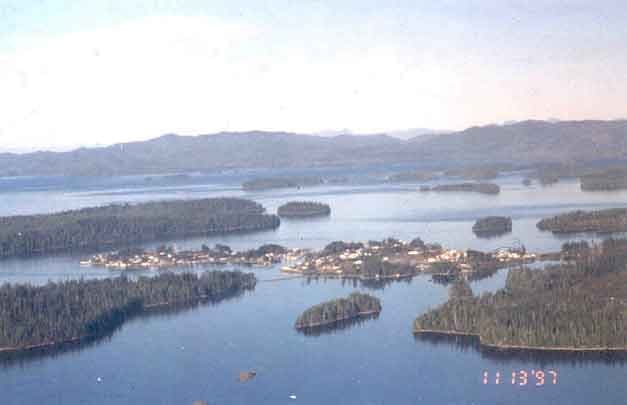
Photo: Wikipedia
Political ClimatePolitical Climate in Craig, AK
District shown is the primary district for this city’s centroid. Cities may span multiple districts.
Inherited from parent state — no local data available.
Local Political AnalysisPolitical Analysis of Craig, AK
Craig, Alaska, has long been a solidly conservative community, and that hasn't changed much, even as the rest of the state and country seem to be shifting under our feet. The Cook PVI of R+6 tells the story pretty well—this is a place where folks generally believe in minding their own business and keeping the government out of their lives. We’ve always leaned Republican, but it’s less about party labels and more about a deep-seated belief in personal responsibility and local control. You won’t find a lot of political hand-wringing here; most people are too busy fishing, logging, or just getting by in a place that demands self-reliance.
How it compares
If you drive up the road to Ketchikan, you’ll notice a different vibe. Ketchikan is more of a tourist hub and has a bit more of that progressive, coastal influence creeping in—more government jobs, more outside money, and a younger crowd that sometimes brings ideas that don’t sit well with us. Craig, on the other hand, is still a working-class fishing town. We’re closer to the old-school Alaska spirit. Petersburg and Wrangell are similar to us in their conservative lean, but even they’ve seen some drift toward the center. Here in Craig, the political climate is still pretty straightforward: people want lower taxes, fewer regulations on fishing and hunting, and they don’t appreciate being told how to live their lives by folks in Juneau or Washington D.C. The contrast with Ketchikan is stark—it’s like two different Alaskas in one region.
What this means for residents
For the people who live here, the political climate means a lot of practical freedom. You can own a firearm without a bunch of hoops, you can build a shed on your own property without a dozen permits, and you can generally live by the old rule: your rights end where mine begin. That’s not to say everything is perfect—there’s always some pressure from outside groups trying to restrict commercial fishing or limit access to public lands. But the local government here is still pretty hands-off. The city council meetings are short, and they don’t waste time on social issues that don’t matter to our daily lives. If you’re the kind of person who gets nervous when the government starts talking about “equity” or “sustainability” as a cover for more control, you’ll feel right at home. The biggest concern for most of us is that the state and federal governments keep trying to chip away at our way of life, whether it’s through stricter fishing quotas or land-use restrictions that make it harder to make a living.
One thing that sets Craig apart is the cultural resistance to the kind of top-down change you see in bigger towns. We don’t have a lot of transplants bringing big-city politics with them, and the ones who do come usually adapt pretty quick or move on. The local paper and the chatter at the grocery store are still focused on practical stuff—fish prices, road conditions, and who’s running for the borough assembly. There’s no real push for the kind of progressive policies you see in Anchorage or Juneau. If anything, the trend here is a quiet but firm pushback against any government overreach. Long-term, I see us staying the course, as long as we can keep the outside influence at bay. It’s a good place for folks who want to be left alone to live their lives, and that’s a rare thing these days.

State Political ClimatePolitical Climate in Alaska
State Political AnalysisPolitical Environment in the State
Alaska has long been a unique political outlier — a state where libertarian-leaning individualism, resource extraction, and a deep distrust of federal overreach create a conservative tilt that’s more about freedom than party loyalty. The state hasn’t voted for a Democrat for president since 1964, and in 2024, Donald Trump carried it by about 13 points. But don’t mistake that for a deep-red lockstep; Alaska’s politics are shaped by a fierce independent streak, with a strong third-party presence and a recent shift toward ranked-choice voting that has muddied the waters. Over the last 20 years, the biggest change has been the slow erosion of that libertarian consensus as urban Anchorage and the Mat-Su Valley have diverged — Anchorage drifting left, the Valley digging in right — while rural and Native villages remain swingy but increasingly skeptical of both parties.
Urban vs. rural divide
The political map of Alaska is essentially a three-way split. Anchorage, home to about 40% of the state’s population, is the battleground: its liberal-leaning core (downtown, midtown, and the Hillside) is offset by conservative suburbs like Eagle River and Chugiak. In 2022, Anchorage’s mayoral race saw a moderate conservative win by just 1,200 votes, but the city council has a progressive majority that has pushed zoning changes and police oversight measures. Fairbanks is more reliably conservative, anchored by Fort Wainwright and the University of Alaska, but its downtown has a small but vocal progressive bloc. The real red fortress is the Mat-Su Borough — Wasilla, Palmer, and the surrounding valley — which votes 65-70% Republican and is the epicenter of the state’s gun rights, anti-tax, and parental rights movements. Rural Alaska — places like Bethel, Nome, and the North Slope — is a wild card: Native communities lean Democratic on social spending but are deeply skeptical of federal land grabs and environmental regulations that threaten subsistence hunting and fishing. That rural independence is why Alaska’s congressional delegation, even when Republican, often bucks party orthodoxy on issues like the Permanent Fund dividend and federal land use.
Policy environment
Alaska’s policy landscape is defined by one word: freedom. There is no state income tax and no state sales tax — the state funds itself through oil revenue and the Permanent Fund, which pays an annual dividend to every resident (roughly $1,600 in 2024). That dividend is sacred; any politician who touches it faces immediate backlash. The regulatory posture is light — no state-level business licensing for most trades, minimal land-use restrictions outside of federal lands, and a right-to-work law that keeps unions weak. Education policy is a flashpoint: Alaska has no school choice program beyond a weak correspondence option, and the state’s education funding formula is notoriously underfunded, leading to a push for charter schools and education savings accounts that has stalled in the legislature. Healthcare is a mixed bag — the state expanded Medicaid under the ACA, but the system is strained by rural access issues and high costs. Election laws are where the real controversy lives: in 2020, voters passed a ranked-choice voting and open primary system (Ballot Measure 2), which has been blamed for electing a Democrat to the U.S. House in 2022 (Mary Peltola) and for creating confusion. A repeal effort is underway, and the legislature is considering a return to partisan primaries. For a conservative, the tax and regulatory environment is a dream, but the education and election systems are growing concerns.
Trajectory & freedom
Alaska is at a crossroads on personal liberty. On the positive side, gun rights are virtually unrestricted — no permit required for concealed carry, no magazine limits, and a state preemption law that blocks local gun control. In 2024, the legislature passed a bill (SB 89) expanding stand-your-ground protections and prohibiting any state enforcement of federal gun laws that violate the Second Amendment. Parental rights are strong: Alaska has a robust parental notification law for abortion (though the procedure remains legal up to viability), and in 2023, the state banned transgender procedures for minors (HB 105). Medical freedom is mixed — the state has no vaccine mandate for public employees, but it did not pass any broad medical autonomy legislation during COVID. The biggest threat to freedom is fiscal: the state’s reliance on oil revenue is volatile, and the Permanent Fund dividend has been cut repeatedly to balance budgets. That has led to a growing push for a state income tax, which would be a disaster for liberty-minded residents. Property rights are generally strong — no state-level zoning mandates — but federal land ownership (60% of the state) creates constant tension over resource extraction and development. The trajectory is toward more cultural conservatism (parental rights, gun rights) but more fiscal uncertainty, which could force a tax debate that no one wants.
Civil unrest & political movements
Alaska has a history of low-grade civil unrest, mostly around resource issues. The Arctic National Wildlife Refuge (ANWR) drilling debate has sparked protests in Anchorage and Fairbanks, with environmental activists clashing with oil workers. In 2021, the state saw a significant protest against ranked-choice voting, with thousands rallying at the capitol in Juneau. The Alaska Independence Party (AIP) remains active, pushing for a vote on secession — though it’s more a symbolic movement than a serious threat. Immigration politics are muted (Alaska has a tiny foreign-born population), but there’s a strong anti-sanctuary sentiment; the state passed a law in 2019 prohibiting sanctuary cities. Election integrity is a hot topic: the 2022 ranked-choice election saw a Republican (Nick Begich III) lose to a Democrat (Mary Peltola) despite winning the first-round vote, fueling accusations of a rigged system. A recall effort against the ranked-choice law is ongoing, and the state GOP has officially called for its repeal. The most visible flashpoint for a new resident would be the constant tension between the oil industry and environmental groups — you’ll see “Save the Arctic” bumper stickers next to “Drill Baby Drill” flags in the same parking lot.
Projection
Over the next 5-10 years, Alaska is likely to become more culturally conservative but fiscally precarious. The in-migration pattern is telling: people moving to Alaska tend to be retirees and remote workers seeking low taxes and wide-open spaces, which reinforces the libertarian-conservative tilt. But the state is losing young people to the Lower 48, and the Native population is growing, which could shift the balance on social spending. The ranked-choice voting system is probably doomed — a repeal initiative is likely to pass in 2026, returning to partisan primaries and single-vote general elections. That will help Republicans consolidate power, but it won’t solve the budget crisis. The Permanent Fund dividend will continue to be a battleground; expect it to be cut further or restructured, which could trigger a real push for an income tax. On cultural issues, expect more parental rights legislation (school choice, curriculum transparency) and continued gun rights expansion. The biggest wild card is federal land policy: if a future Democratic administration tightens restrictions on drilling and mining, Alaska’s economy could take a hit, fueling secessionist rhetoric. For someone moving in now, expect a state that is freer than most on taxes and guns, but where the political conversation is increasingly dominated by fights over the dividend, ranked-choice voting, and federal overreach.
Bottom line for a new resident: Alaska is a great fit if you value low taxes, gun rights, and personal autonomy — but you’ll need to be politically engaged to protect those things. The ranked-choice voting system is a headache, the dividend is shrinking, and the education options are weak. If you’re moving for freedom, you’ll find it, but you’ll also find a state that is constantly fighting to keep it. Anchorage is the only place with a real progressive presence; everywhere else — especially the Mat-Su Valley, Fairbanks, and the Kenai Peninsula — is solidly conservative. Just be ready for the cold, the darkness, and the constant debate over oil.
* Values derived from national, state, county, city and local statistics and may differ in a specific area. Last updated: 2026-04-19T19:17:13.000Z
Narrative content on this page is AI-generated and may contain mistakes. Verify any details that matter before acting on them.
ReloMaps may earn a commission from affiliate links at no extra cost to you.

