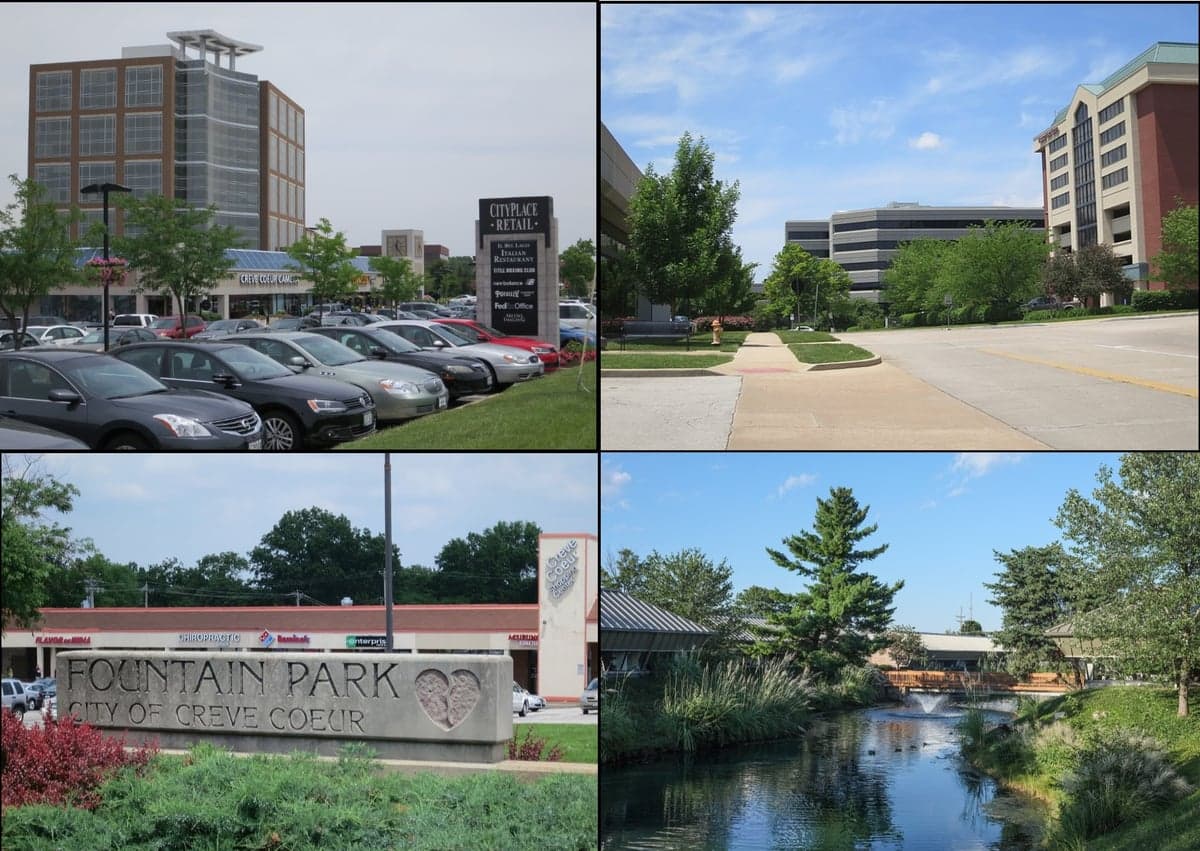
Photo: Wikipedia
Demographics of Creve Coeur, MO
Affluence Level in Creve Coeur, MO
An upper-middle-class area. Household wealth, education levels, and homeownership run ahead of national benchmarks.
People of Creve Coeur, MO
Today, Creve Coeur, Missouri, is a highly educated, majority-white suburb of St. Louis with a notable and growing Asian and Indian presence, home to 18,643 residents. The city is characterized by its 66.7% college-educated population, a 9.3% Black community, and a combined 11% Asian and Indian subcontinent population, making it one of the most demographically diverse inner-ring suburbs in the region. Its identity is shaped by a blend of established Midwestern families, upwardly mobile professionals drawn to the Parkway School District, and a significant concentration of South Asian and East Asian residents in neighborhoods like Lakewood and Bellerive Estates. The population is stable but slowly diversifying, with foreign-born residents making up 4.8% of the total.
How the city was settled and grew
Creve Coeur was not a colonial-era settlement; its development is almost entirely a 20th-century story. The area was originally farmland and rural estates, with the first major population wave arriving after World War II. The construction of Interstate 270 in the 1950s and 1960s opened the area to suburban development, drawing white, middle-class families from St. Louis city who sought larger lots and newer schools. The original subdivisions—Lakewood, Bellerive Estates, and Westwood—were built during this period, attracting a predominantly white, Protestant, and Catholic population of corporate managers, engineers, and small business owners. The city incorporated in 1957, formalizing its identity as a planned, low-density suburb. No significant immigrant wave arrived during this era; the population was nearly entirely native-born and white until the late 20th century.
Modern era (post-1965)
The 1965 Hart-Cellar Act began reshaping Creve Coeur’s demographics, but the most visible changes came after 1990. The city’s proximity to Washington University in St. Louis, Barnes-Jewish Hospital, and major corporate headquarters like Monsanto (now Bayer) and Reinsurance Group of America drew highly skilled immigrants, particularly from India and East Asia. The Indian subcontinent community (4.3% of the population) concentrated in neighborhoods like Lakewood and the newer Dielman Road corridor, drawn by the Parkway School District’s reputation for academic excellence. East/Southeast Asian residents (6.7%)—primarily Chinese, Korean, and Vietnamese—settled in Bellerive Estates and the Craigshire area near Olive Boulevard. The Black population (9.3%) grew more slowly, with many families moving into Westwood and the Ladue Estates area, reflecting broader regional patterns of suburban integration. The Hispanic population (2.5%) remains small and dispersed, with no single ethnic enclave. Notably, the white share declined from over 90% in 1980 to 71.1% today, driven almost entirely by Asian and Indian in-migration, not Black or Hispanic growth.
The future
Creve Coeur’s population is heading toward greater diversity, but the trajectory is one of assimilation rather than tribalization. The Asian and Indian communities are highly integrated, with second-generation children attending Parkway schools and entering professional fields. The city’s housing stock—largely single-family homes on half-acre lots—limits large-scale new construction, so future growth will likely come from redevelopment of older commercial corridors like Olive Boulevard and Ladue Road into higher-density townhomes and apartments. The foreign-born share (4.8%) is modest compared to suburbs like nearby Clayton or University City, suggesting Creve Coeur will remain a predominantly native-born, professional-class suburb. The white population is projected to continue a slow decline, while the Asian and Indian shares will likely rise to 12-15% combined over the next decade. The Black and Hispanic shares are expected to remain stable or grow only slightly, as the city’s high home prices and property taxes filter for higher-income buyers.
For a relocating professional or family, Creve Coeur offers a stable, low-crime, high-amenity environment with a population that is increasingly diverse but still culturally Midwestern and family-oriented. The city is not becoming a patchwork of ethnic enclaves but rather a melting pot of educated, affluent households who share a common focus on schools, safety, and property values. New arrivals will find a community that is welcoming but not rapidly changing, where the dominant culture remains rooted in the post-war suburban ideal.

* Values derived from national, state, county, city and local statistics and may differ in a specific area. Last updated: 2026-04-29T20:02:18.000Z
Narrative content on this page is AI-generated and may contain mistakes. Verify any details that matter before acting on them.
ReloMaps may earn a commission from affiliate links at no extra cost to you.

