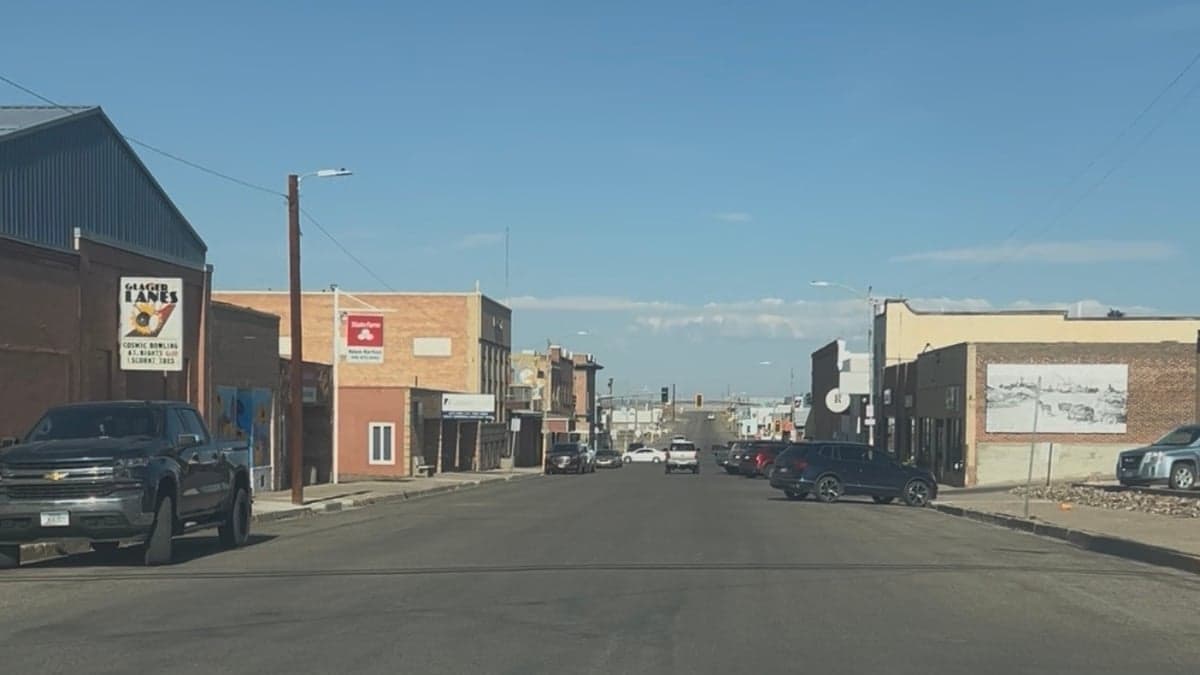
Photo: Wikipedia
Demographics of Cut Bank, MT
Affluence Level in Cut Bank, MT
A middle-class area roughly in line with national averages across income, home values, education, and employment.
People of Cut Bank, MT
The people of Cut Bank, Montana, today number 3,040, forming a predominantly white, working-class community with a distinctively low foreign-born share of just 0.5%. The city’s identity is rooted in its role as a railroad and oil-field service hub on the Blackfeet Indian Reservation’s edge, giving it a practical, self-reliant character. With 19.2% of adults holding a college degree, the population skews toward trades, agriculture, and energy-sector employment rather than professional or tech industries. The city remains overwhelmingly non-Hispanic white at 69.9%, with a Hispanic share of 1.8% and negligible Black, Asian, or Indian-subcontinent populations, reflecting minimal post-1965 immigration-driven change.
How the city was settled and grew
Cut Bank’s human history begins with the Blackfeet Nation, whose ancestral lands encompass the area, but the city itself was founded in 1891 as a railroad camp for the Great Northern Railway. The arrival of the railroad in 1891 drew a wave of Irish, German, and Scandinavian laborers who built the first permanent structures in what is now Old Town Cut Bank, the original commercial district along Central Avenue. These workers were followed by homesteaders after the 1909 Enlarged Homestead Act, which offered 320-acre parcels to settlers willing to farm the arid prairie. Many of these homesteaders, primarily of Northern European stock, established farms north of the railroad tracks in the area known today as North Cut Bank, a neighborhood still characterized by older single-family homes on larger lots. The discovery of the Cut Bank Oil Field in 1922 triggered a second major wave, bringing roughnecks and drillers from Oklahoma, Texas, and the Midwest. These oil workers settled in the Oil Camp District, a cluster of company-built houses and bunkhouses south of the railroad that remains a working-class enclave. By the 1930 census, Cut Bank’s population had reached roughly 1,500, almost entirely white and native-born, with a small number of Blackfeet individuals living in the adjacent reservation community of Browning rather than within city limits.
Modern era (post-1965)
The post-1965 period brought little demographic change to Cut Bank, as the city did not attract the immigrant flows that reshaped larger Montana cities like Billings or Missoula. The 1965 Hart-Cellar Act’s family-reunification provisions had negligible impact here; the foreign-born share has never exceeded 1% in any census since 1970. Domestic in-migration during the 1970s and 1980s came primarily from rural Montana and the Northern Plains, as farm consolidation pushed younger families into town for school and work. These new residents gravitated toward the East Cut Bank neighborhood, a post-war subdivision of ranch-style homes built along East Main Street that now houses many of the city’s oil-field and railroad employees. The Hispanic share, at 1.8%, is almost entirely Mexican-American families who arrived in the 1990s and 2000s to work in the oil fields or at the local sugar beet processing facility; they are concentrated in a small pocket of rental housing near the South Cut Bank industrial corridor. The Blackfeet population within city limits remains very small—likely under 2%—as most tribal members live on the reservation in Browning or in the unincorporated community of Blackfoot, five miles west. The Asian share of 0.5% represents a handful of Filipino and Vietnamese families who came to work at the Glacier County Medical Center in the 2000s, living scattered across the city with no distinct ethnic enclave.
The future
Cut Bank’s population is projected to remain stable or decline slightly over the next decade, mirroring Glacier County’s broader trend of rural outmigration among young adults. The city is not homogenizing or tribalizing into distinct enclaves—it is simply aging, with a median age of 41.5 and a net loss of residents aged 20–34 to larger Montana cities. The Hispanic share may grow modestly as oil-field and agricultural employers continue to recruit from Texas and the Southwest, but the foreign-born share is unlikely to rise above 2% given the lack of refugee resettlement or chain migration networks. The Blackfeet population may increase slightly if tribal housing programs expand into the West Cut Bank area, where vacant lots and older homes offer affordable entry points. However, the city’s low college attainment rate and limited white-collar employment base mean it will likely remain a blue-collar, predominantly white community with a small but stable Hispanic minority.
For someone moving in now, Cut Bank offers a straightforward, low-diversity environment where social networks revolve around work, church, and school rather than ethnic or cultural institutions. The city is becoming neither more cosmopolitan nor more fragmented—it is holding steady as a working-class service hub on the Hi-Line, with a population that values self-reliance and continuity over change. New residents should expect a community where nearly everyone shares a similar background and where the main dividing lines are between long-time locals and newcomers, not between racial or ethnic groups.

* Values derived from national, state, county, city and local statistics and may differ in a specific area. Last updated: 2026-04-29T21:59:09.000Z
Narrative content on this page is AI-generated and may contain mistakes. Verify any details that matter before acting on them.
ReloMaps may earn a commission from affiliate links at no extra cost to you.

