 Popular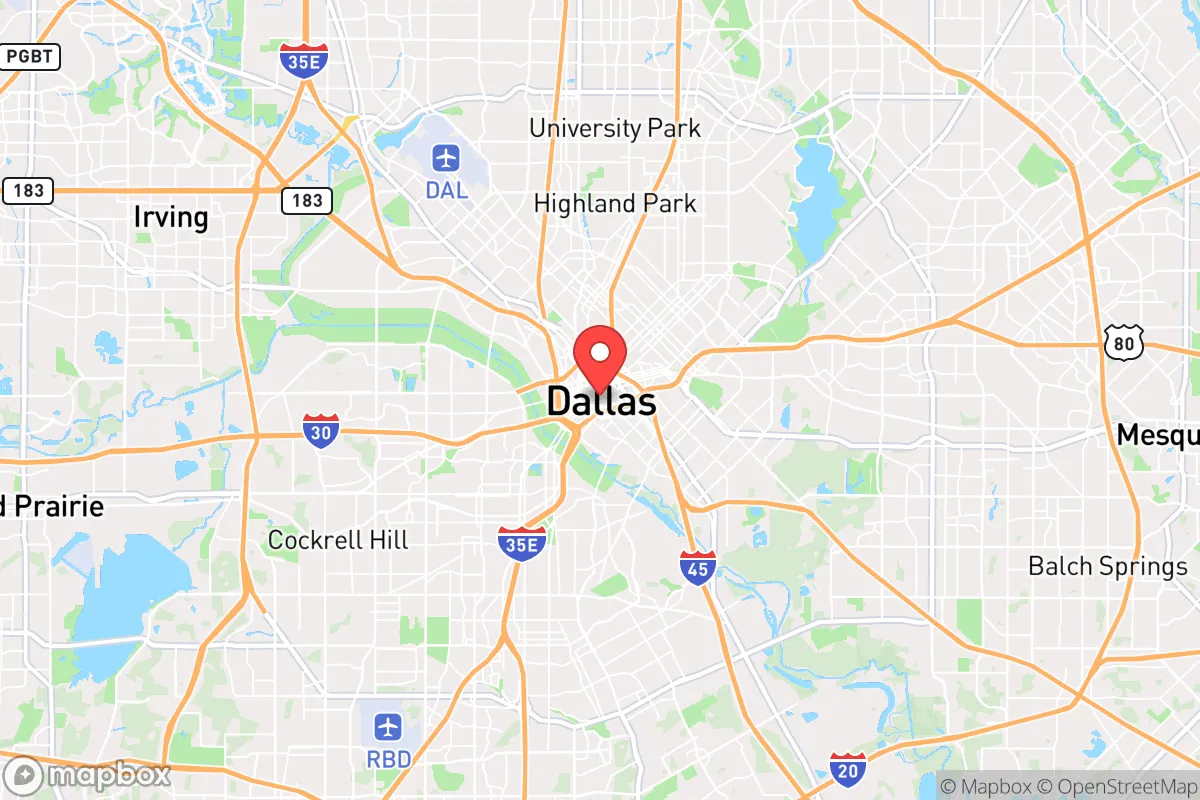
Photo by Ryan Duffy on Unsplash
Personal Sovereignty in Dallas, TX
Strong independent fundamentals that actively favor personal liberty and low regulation.
What does Personal Sovereignty tell us?
Personal Sovereignty measures your capacity for self-reliance and independence with minimal government friction. Higher scores mean fewer barriers between you and the way you want to live... but it assumes you have the space you need and good neighbors.
What does this tell us?
Personal Sovereignty measures your capacity for self-reliance and independence with minimal government friction. Higher scores mean fewer barriers between you and the way you want to live... but it assumes you have the space you need and good neighbors.
State Policy
Energy independence: Net exporter (220% of energy produced in-state)
Personal Liberty
Homesteading

Personal Liberty Analysis
Dallas, Texas, offers a personal sovereignty environment shaped by a state-level commitment to limited government, low taxation, and expansive individual rights, though the city itself introduces a layer of municipal regulation that residents must navigate. For those prioritizing autonomy—whether in financial decisions, self-defense, or lifestyle choices—Dallas provides a strong baseline of freedom, particularly when compared to coastal metros. The city’s regulatory posture is best described as moderately light-touch at the state level, with local ordinances that can feel more intrusive in specific areas like zoning and noise, but overall, the balance tilts decisively toward personal independence.
Tax burden and regulatory posture in Dallas compared to other major metros
Texas’s lack of a state income tax is the single most impactful factor for personal financial sovereignty in Dallas. Residents keep 100% of their earned income, with no state-level withholding, which directly increases disposable income and reduces dependency on government services. The property tax burden, however, is among the highest in the nation—Dallas County’s effective rate hovers around 2.3% of assessed value, compared to a national average of roughly 1.1%. This means a $400,000 home carries an annual tax bill near $9,200, a significant recurring cost that offsets some of the income tax benefit. Sales tax in Dallas is 8.25% (state 6.25% + city/county 2%), which is moderate for a major city but higher than suburban alternatives like Frisco or Plano. Regulatory posture in Dallas is mixed: occupational licensing is minimal for most trades, and there are no state-level business income taxes, making it a favorable environment for entrepreneurs and freelancers. However, the city enforces strict short-term rental regulations (e.g., requiring owner-occupancy for Airbnb permits) and has a relatively active code compliance department for property maintenance. Compared to Austin or Houston, Dallas’s regulatory touch is lighter on land use but heavier on property standards, meaning a homeowner has more freedom to modify their house but less freedom to let it deteriorate. For a relocation audience, the key takeaway is that Dallas offers strong financial autonomy through no income tax, but the property tax and sales tax structure requires careful budgeting.
Self-defense and gun law specifics in Dallas and Texas
Texas is a constitutional carry state as of September 2021, meaning any adult legally eligible to possess a firearm can carry it openly or concealed without a permit. This applies fully within Dallas city limits, though private property owners and businesses can post signage prohibiting firearms—and many do, particularly in downtown office towers and entertainment venues. Dallas itself has no city-level gun ordinances that exceed state law; the city cannot ban carry in parks or public spaces, as preemption laws prevent local governments from enacting stricter rules than the state. The Castle Doctrine and Stand Your Ground laws are in full effect: there is no duty to retreat in any place where a person has a legal right to be, and deadly force is presumed reasonable if an intruder unlawfully enters a residence or vehicle. For self-defense training, Dallas has numerous ranges and schools, including Elm Fork Shooting Sports and Dallas Pistol Club, which offer courses for both beginners and advanced shooters. One practical consideration: while carrying in a vehicle without a license is legal, the firearm must be in plain view or in a holster—not concealed in a glovebox—unless the carrier has a License to Carry (LTC). The LTC also provides reciprocity with 37 other states, which is valuable for frequent travelers. Overall, Dallas ranks among the most firearm-friendly major cities in the U.S., with legal protections that strongly favor the individual’s right to self-defense.
Self-reliance and homesteading viability in Dallas: lot sizes, zoning, and off-grid feasibility
True homesteading within Dallas city limits is challenging due to typical lot sizes and zoning restrictions. The median single-family lot in Dallas is around 7,000 to 8,000 square feet, which is small by suburban standards but can accommodate a substantial garden and small livestock like chickens (hens only, no roosters, per city ordinance). Backyard chickens are legal in Dallas, with a limit of six hens per property, and beekeeping is permitted with registration. However, larger livestock like goats or pigs are prohibited within the city, and zoning for agricultural use is essentially nonexistent in residential areas. Off-grid feasibility is low: Dallas requires connection to city water and sewer for any habitable structure, and solar panels are allowed but must comply with building codes and HOA rules if applicable. Rainwater harvesting is legal and even encouraged—Texas law allows collection from rooftops—but it cannot be the primary water source for a home connected to municipal supply. For those seeking more self-reliance, the outer suburbs and exurbs offer better options: areas like Kaufman County or Ellis County have 1- to 5-acre lots with fewer restrictions, and some allow horses and larger gardens. Within Dallas proper, the most viable path to self-reliance is intensive urban gardening, food preservation, and reducing utility dependence through energy-efficient upgrades, rather than full homesteading. The city’s climate (hot summers, mild winters) supports year-round growing, and community gardens like the Dallas County Master Gardener program provide resources for beginners.
Personal liberties in Dallas: parental rights, medical autonomy, speech, and property
Parental rights in Texas are strongly protected by state law. Parents have the legal authority to direct their child’s education, including homeschooling without state oversight (no notification or testing requirements), and to opt out of any school curriculum or activity they object to. Dallas ISD, the largest school district in the area, has a conservative-leaning school board that has resisted certain federal mandates, though parents should still review specific campus policies on library materials and sex education. Medical autonomy is a mixed picture: Texas has some of the most restrictive abortion laws in the nation (near-total ban), which aligns with a conservative audience’s values, but also has limited Medicaid expansion and a relatively low number of primary care providers per capita. Vaccine mandates are prohibited for private employers and government entities, and there is no state-level mask or vaccine requirement for schools. Free speech protections are robust, with no hate speech laws and broad protections for public expression, though Dallas has a permit requirement for large protests (over 50 people) on public property. Property rights are generally strong: Texas has no state-level property tax on business inventory or intangible assets, and eminent domain is limited to public use projects. However, Dallas’s historic preservation overlay districts can restrict exterior modifications to homes in certain neighborhoods like Munger Place or Swiss Avenue, which may frustrate owners wanting full control over their property. For a freedom-oriented reader, the key liberty strengths are parental rights, firearm access, and low income tax; the main friction points are property tax rates and local zoning overlays.
Overall, Dallas ranks as a high-sovereignty city within the United States, particularly for those who value financial independence, self-defense rights, and parental control. The combination of no state income tax, constitutional carry, and strong property rights places it well above cities like Chicago, Los Angeles, or New York in terms of personal autonomy. The trade-offs are real but manageable: higher property taxes and municipal regulations on land use and short-term rentals require strategic planning. For a conservative-leaning individual or family, Dallas offers a freedom-friendly environment where the state government largely stays out of personal decisions, and the city’s rules are predictable and navigable. It is not a libertarian utopia—no major city is—but it provides a solid foundation for self-reliant living that compares favorably to most other large metros in the country.

* Values derived from national, state, county, city and local statistics and may differ in a specific area. Last updated: 2026-09-23T21:08:41.000Z
Narrative content on this page is AI-generated and may contain mistakes. Verify any details that matter before acting on them.
ReloMaps may earn a commission from affiliate links at no extra cost to you.

