 Popular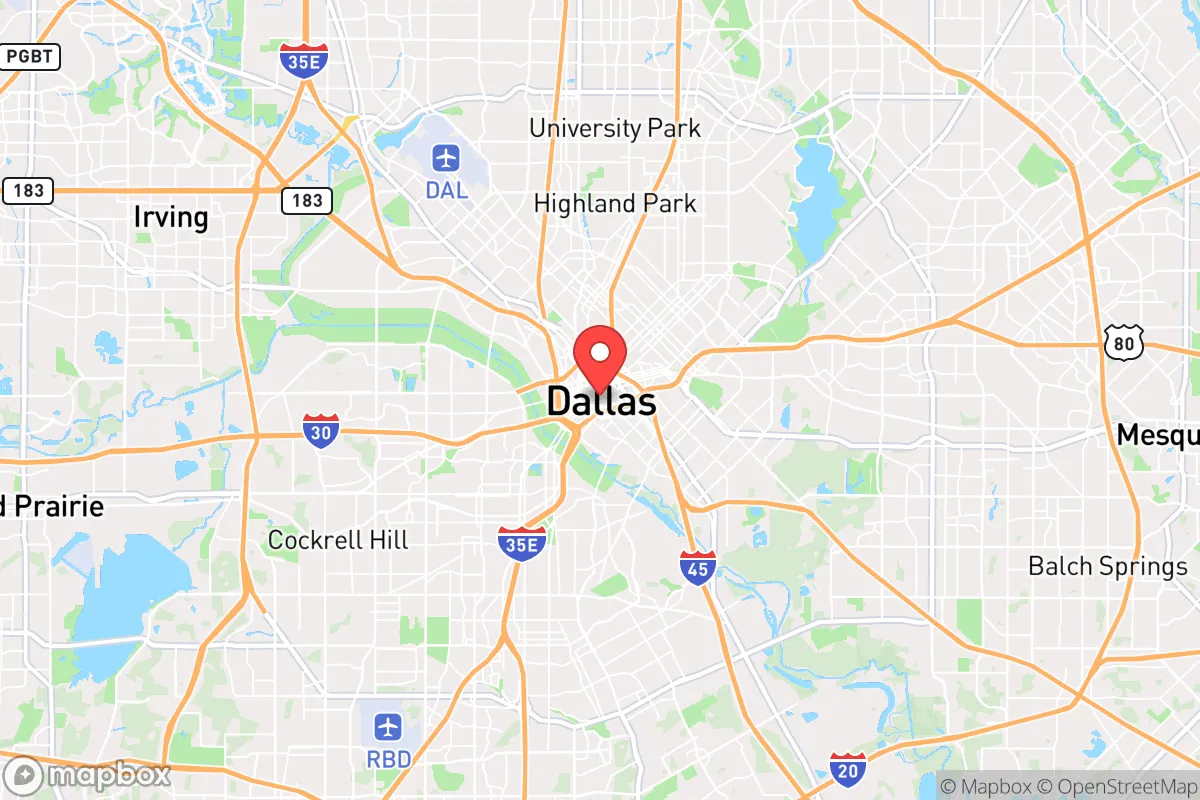
Photo by Ryan Duffy on Unsplash
Political ClimatePolitical Climate in Dallas, TX
District shown is the primary district for this city’s centroid. Cities may span multiple districts.
Local Political AnalysisPolitical Analysis of Dallas, TX
Dallas is a deep blue island in a sea of red, with a Cook Partisan Voting Index of D+19 that makes it one of the most reliably Democratic major cities in Texas. That number means the city votes about 19 points more Democratic than the national average, and in practice, Dallas County has not voted for a Republican presidential candidate since 2004. The city’s political trajectory has been steadily leftward for two decades, driven by rapid demographic shifts, an influx of younger and more diverse residents, and the growing political engagement of its large Hispanic and Black communities. While the surrounding suburbs like Plano, Frisco, and McKinney have also trended blue in recent cycles, they remain more competitive, and once you get past the suburban ring into places like Rockwall or Kaufman County, the political landscape flips hard to the right.
How it compares
Compared to Texas as a whole, Dallas is an outlier. The state’s Cook PVI is not publicly available in the same format, but statewide elections consistently show Texas leaning Republican by roughly 5 to 10 points in presidential years. That means a Dallas voter lives in a city that is about 25 to 30 points more Democratic than the state average. The practical effect is that Dallas often finds itself at odds with the state legislature in Austin on issues like abortion access, gun laws, and local control. For example, Dallas has a city ordinance banning no-knock warrants, a progressive police reform, while the state has passed laws preempting local governments from cutting police budgets. The contrast is stark: drive 30 minutes north to Allen or 45 minutes east to Forney, and you’ll find city councils and school boards that look and vote very differently from Dallas’s.
What this means for residents
For liberal residents, Dallas feels like a sanctuary within Texas. City policies on LGBTQ+ rights, environmental initiatives, and affordable housing are generally aligned with progressive values, and local elections are often decided in the Democratic primary rather than the general election. Conservative residents, however, are not marginalized in daily life. Many neighborhoods in North Dallas, Lake Highlands, and parts of East Dallas still have active Republican precinct chairs and conservative homeowner associations. The city’s business establishment, including major employers like AT&T, Texas Instruments, and Southwest Airlines, tends to lean pragmatic and pro-business rather than overtly partisan. What conservatives lose in local elections, they often gain in state representation: Dallas’s state house and senate districts are gerrymandered to dilute the city’s Democratic vote, meaning many Dallas residents live in districts represented by Republicans who are skeptical of the city’s agenda.
One cultural distinction that sets Dallas apart from much of Texas is its relationship with religion and politics. While the state’s political identity is heavily shaped by evangelical Christianity, Dallas’s political scene is more secular and pluralistic. The city has a large and visible Muslim community, a thriving Jewish population, and some of the most prominent megachurches in the country, but none of these groups dominate the political conversation the way the Southern Baptist Convention does in rural Texas. Another key difference is the city’s approach to growth and development: Dallas has a more interventionist zoning code than most Texas cities, with a focus on mixed-use development and transit-oriented projects, while the state’s default is laissez-faire. Over the next decade, expect Dallas to continue pulling left as its suburbs moderate, but the tension between city and state will likely intensify, especially on issues like property taxes, public school funding, and immigration enforcement.

State Political ClimatePolitical Climate in Texas
State Political AnalysisPolitical Environment in the State
Texas has been a reliably Republican state in presidential elections since 1980, but the margin has narrowed significantly over the past two decades. In 2024, Donald Trump carried the state by roughly 14 points, down from 19 points in 2016 and 16 points in 2020, driven by explosive growth in the Democratic-leaning suburbs of Houston, Dallas, and Austin. The dominant coalition remains conservative, anchored by rural and exurban voters, but the state is now a genuine battleground at the state and local level, with Democrats holding every major city and Republicans controlling the legislature and statewide offices.
Urban vs. rural divide
The political map of Texas is a stark checkerboard. The state’s five largest metros — Houston, Dallas-Fort Worth, San Antonio, Austin, and El Paso — are Democratic strongholds. Harris County (Houston) alone delivered nearly 1 million votes for Biden in 2020, while Dallas County and Bexar County (San Antonio) are similarly blue. Austin’s Travis County is the most liberal in the state, with a Democratic margin of over 50 points. Meanwhile, the vast rural and exurban counties — places like Collin County (north of Dallas), Montgomery County (north of Houston), and the entire Panhandle region around Lubbock and Amarillo — vote Republican by 30 to 60 points. The key battlegrounds are the fast-growing suburban “collar counties” like Denton, Fort Bend, and Williamson, which have shifted from solid red to purple or even light blue over the last decade. Fort Bend County, once a Republican stronghold, voted for Biden in 2020 and has become a national model of diverse suburban politics.
Policy environment
Texas operates under a conservative policy framework that has been largely stable for decades. There is no state income tax, funded instead by a reliance on property taxes and a 6.25% state sales tax (plus local add-ons). The regulatory posture is famously business-friendly, with limited zoning in many cities and a right-to-work law that prohibits union security agreements. Education policy is a flashpoint: the state funds public schools through a complex “Robin Hood” system that redistributes property tax revenue from wealthier districts, but per-pupil spending remains below the national average. School choice advocates have pushed for vouchers, but rural Republicans have blocked them in recent sessions. Healthcare is a major gap: Texas has the highest uninsured rate in the nation, having refused to expand Medicaid under the Affordable Care Act. Election laws have tightened since 2021 with Senate Bill 1, which restricted mail-in voting, added ID requirements, and limited drive-through and 24-hour voting options. Abortion is effectively banned after six weeks under the 2021 “heartbeat” law (SB 8) and a 2022 trigger law, with no exceptions for rape or incest.
Recent policy direction
The last five years have seen a sharp rightward shift on cultural and liberty issues, even as the state’s demographics trend left. On gun and self-defense law, Texas became a permitless carry state in 2021, allowing most adults to carry a handgun without a license or training. On parental and education rights, the 2023 session passed a school choice voucher-like program for special education students and banned “critical race theory” from public schools, while also requiring school libraries to remove books deemed “sexually explicit.” On speech and privacy, a 2021 law (HB 20) prohibits social media platforms from moderating content based on viewpoint, though it has been partially blocked in court. On medical and bodily autonomy, the abortion ban is the most restrictive in the nation, but the state has also expanded access to telemedicine for mental health and primary care. On property rights, the 2023 session passed a bill limiting the ability of cities to ban natural gas hookups in new construction, and a constitutional amendment (Proposition 4) increased the homestead exemption for school property taxes. On voting and ballot access, SB 1 (2021) made Texas one of the stricter states for mail-in voting, but early voting hours remain generous and voter registration is relatively easy online. The overall direction is toward more state preemption of local control, particularly on issues like policing, environmental regulation, and housing policy.
Civil unrest & political movements
Texas has a long history of political activism on both sides. The 2020 Black Lives Matter protests in Austin, Dallas, and Houston were among the largest in the country, with the Austin protests lasting for months and leading to a city council vote to cut the police budget by a third (later partially restored). On the right, the “constitutional sheriff” movement is strong in rural counties, and groups like the Texas Nationalist Movement advocate for secession, though it remains a fringe position. Immigration politics are a constant flashpoint: Governor Abbott’s “Operation Lone Star” has deployed state troopers and National Guard to the border, bused migrants to Democratic-led cities, and installed razor wire along the Rio Grande, leading to ongoing legal battles with the Biden administration. The state has also passed a law (SB 4, 2023) making illegal entry a state crime, which is currently blocked by the courts. Election integrity remains a live issue: the 2020 election saw no evidence of widespread fraud in Texas, but the legislature passed SB 1 anyway, and some counties (like Harris) have faced ongoing disputes over voting machine security and poll watcher access. A new resident would notice the heavy presence of state police and National Guard vehicles along the border in the Rio Grande Valley, and the occasional protest in front of the Capitol in Austin.
Projection
Over the next 5-10 years, Texas is likely to continue its slow drift toward competitiveness at the presidential level, driven by the in-migration of moderate and liberal voters from California and the Northeast into the suburbs of Dallas, Houston, and Austin. The state’s Hispanic population, which leans Democratic but is not monolithic, will grow as a share of the electorate, though recent trends show some movement toward Republicans among working-class Hispanic voters. The Republican Party will likely maintain control of the legislature and statewide offices through 2030 due to gerrymandering and the concentration of Democratic voters in cities, but the margin in statewide races (like the 2023 attorney general race) will continue to narrow. The policy environment will remain conservative on taxes, regulation, and cultural issues, but the pressure to expand Medicaid and address school funding will grow as the population ages and becomes more diverse. A new resident moving in now should expect a state that is still solidly red at the state level, but with a vibrant and growing Democratic opposition that will keep elections competitive and policy debates lively.
For a new resident, the bottom line is that Texas offers a low-tax, business-friendly environment with a strong conservative tilt on social and cultural issues, but the political reality varies dramatically by location. Living in Austin or Houston means being in a blue bubble with progressive city policies, while living in Lubbock or the suburbs of Fort Worth means a deeply conservative community. The state’s trajectory is toward more competition, not less, so expect the political climate to remain dynamic and occasionally contentious. If you value low taxes, limited regulation, and a strong gun rights culture, you’ll feel at home. If you prioritize abortion access, union rights, or expansive public services, you’ll find yourself in a constant fight at the state level, but with strong local allies in the major cities.
* Values derived from national, state, county, city and local statistics and may differ in a specific area. Last updated: 2026-09-23T21:08:41.000Z
Narrative content on this page is AI-generated and may contain mistakes. Verify any details that matter before acting on them.
ReloMaps may earn a commission from affiliate links at no extra cost to you.

