Photo: Wikipedia
Demographics of Danielson, CT
Affluence Level in Danielson, CT
A below-average socioeconomic profile. Incomes, home values, and educational attainment trail the U.S., with higher poverty and unemployment.
People of Danielson, CT
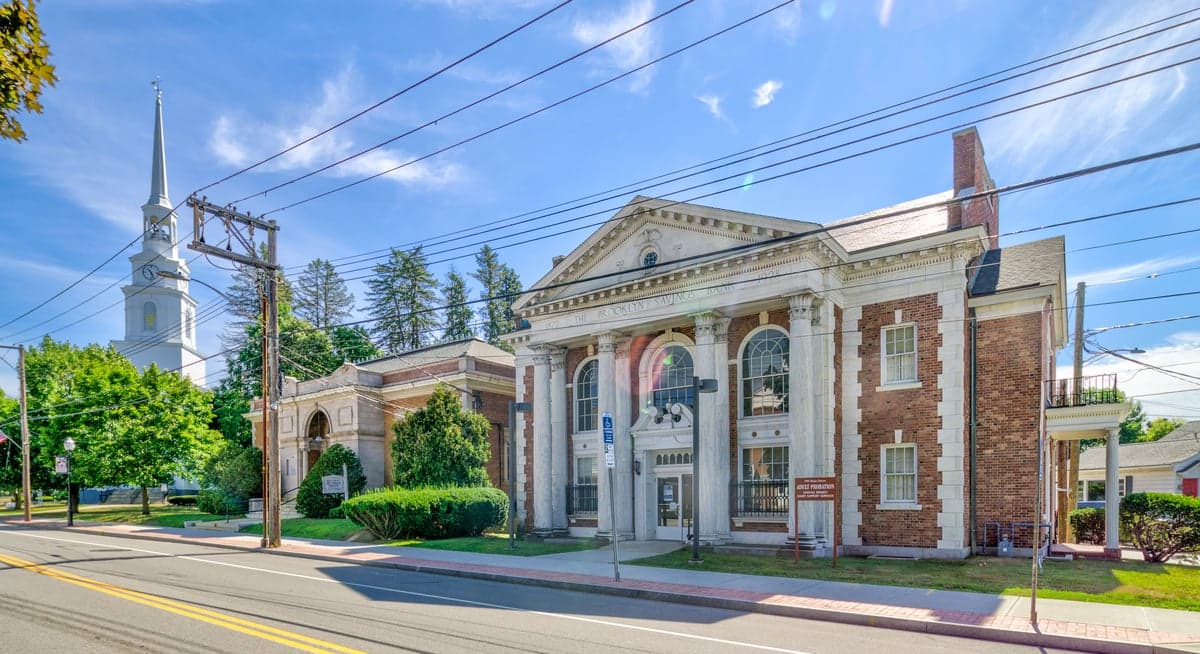
Danielson, Connecticut, is a small borough of 4,185 residents that serves as the commercial and civic hub of the town of Killingly. The population is predominantly white (79.9%) with a notable Hispanic minority (9.5%) and smaller Black (5.9%) and East/Southeast Asian (1.3%) communities. With only 2.0% foreign-born and a low college attainment rate of 14.2%, Danielson retains a working-class, native-born character that sets it apart from more cosmopolitan parts of eastern Connecticut.
How the city was settled and grew
Danielson’s population history begins with the establishment of a mill village along the Quinebaug River in the early 19th century. The borough was named after General James Danielson, a local landowner, but the real draw was water power. By the 1830s, the Danielsonville district (the original core around Main Street and Water Street) had attracted Yankee farmers’ sons and Irish immigrants to work in cotton and woolen mills. The arrival of the Norwich and Worcester Railroad in 1839 turned Danielson into a regional shipping point, and the Westfield neighborhood, west of the river, grew as a residential area for mill managers and skilled workers. A second wave of French-Canadian immigrants arrived between 1880 and 1910, settling in the South Main Street corridor and establishing St. James Church as their cultural anchor. These groups formed the backbone of Danielson’s population through the mid-20th century, with the borough’s economy tied tightly to textile manufacturing and later to the glass and plastics industries that replaced it.
Modern era (post-1965)
After the 1965 Hart-Cellar Act, Danielson saw only modest immigration compared to larger Connecticut cities. The foreign-born share remains low at 2.0%, and the borough did not experience the large-scale refugee or chain-migration flows seen in Hartford or New London. Instead, the post-1965 story is one of domestic in-migration and suburbanization. The Killingly Commons area, near the intersection of US-6 and CT-12, attracted white working-class families moving out of Providence and Worcester in the 1970s and 1980s, drawn by cheaper housing and proximity to manufacturing jobs at companies like Rogers Corporation and Frito-Lay. The Hispanic population, now 9.5%, began growing in the 1990s, with Puerto Rican and Dominican families settling in the Lower Main Street and Brookside neighborhoods, often in older mill housing converted to rentals. The Black population (5.9%) is largely concentrated in the Pleasant Street area, a historically integrated working-class district. East/Southeast Asian residents (1.3%) are a small but stable presence, with families often connected to the local healthcare and manufacturing sectors. Notably, the Indian-subcontinent population is 0.0%, reflecting Danielson’s lack of the tech or academic sectors that draw South Asian professionals to other parts of Connecticut.
The future
Danielson’s population is aging and slowly declining, mirroring trends across rural eastern Connecticut. The borough lost roughly 5% of its population between 2010 and 2020, and the school-age population in Killingly has shrunk by 12% over the same period. The Hispanic share is the only demographic segment showing clear growth, projected to reach 12-14% by 2035, driven by natural increase and continued migration from Puerto Rico and Central America. This growth is concentrated in the Lower Main Street and Westfield neighborhoods, where rental housing is most available. The white population is declining through out-migration of young adults and an aging base, with the median age now 42.3. The Black and East/Southeast Asian populations are stable but not growing, as Danielson lacks the job diversity to attract new arrivals. The borough is not tribalizing into distinct ethnic enclaves—neighborhoods remain mixed—but the Hispanic community is becoming more visible in local businesses and schools. The next decade will likely see Danielson become slightly more diverse but remain a predominantly white, working-class borough with a growing Hispanic minority and a very low foreign-born share.
For a conservative-leaning individual or family considering relocation, Danielson offers a stable, native-born community with modest diversity and a clear working-class identity. The population is not homogenizing into a monoculture, but the demographic shifts are gradual and unlikely to disrupt the borough’s established character. The key trend to watch is the aging of the white population and the slow growth of the Hispanic community, which will shape local schools, housing demand, and civic life over the next generation.

* Values derived from national, state, county, city and local statistics and may differ in a specific area. Last updated: 2026-04-29T19:22:56.000Z
Narrative content on this page is AI-generated and may contain mistakes. Verify any details that matter before acting on them.
ReloMaps may earn a commission from affiliate links at no extra cost to you.

