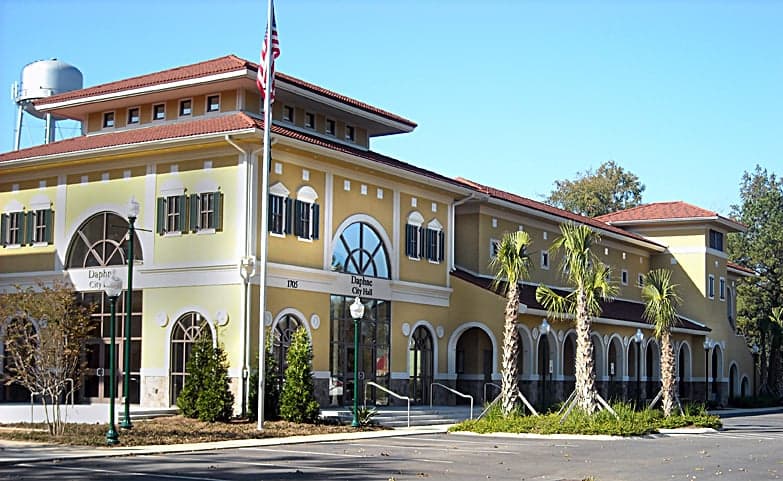
Photo: Wikipedia
Demographics of Daphne, AL
Affluence Level in Daphne, AL
An upper-middle-class area. Household wealth, education levels, and homeownership run ahead of national benchmarks.
People of Daphne, AL
Daphne, Alabama, is a predominantly white, family-oriented suburb of Mobile with a population of 28,673, where 76.1% of residents identify as white, 12.8% as Black, and 5.7% as Hispanic. The city is characterized by a highly educated populace—43.5% hold a college degree—and a very low foreign-born share of just 2.0%, giving it a notably native-born, culturally Southern character. Distinctive markers include a strong military and healthcare employment base, a reputation for top-rated public schools, and a landscape of master-planned subdivisions and historic waterfront homes that reflect its layered growth from a rural crossroads to a commuter suburb.
How the city was settled and grew
Daphne’s population history begins not with colonial settlement but with post-Civil War agricultural expansion. The area was originally part of the vast land grants awarded to French and Spanish colonists, but the first significant wave of permanent residents arrived in the 1870s and 1880s, drawn by timber and turpentine industries. These early settlers—mostly white yeoman farmers and a smaller number of freed Black families—established small homesteads along the eastern shore of Mobile Bay. The historic Olde Towne Daphne district, centered around Main Street, became the commercial and social hub for this first wave, with its modest wood-frame houses and churches dating to the 1890s. A second wave arrived in the 1910s and 1920s, when the Mobile and Ohio Railroad extended a spur line, enabling truck farming and strawberry cultivation. This period attracted a mix of white tenant farmers and a small number of Italian and Greek immigrant families who settled in the Belforest area, then a rural farming community. By 1950, Daphne remained a tiny village of fewer than 1,500 people, overwhelmingly native-born and white, with a Black population concentrated in the Lake Forest area, originally a separate African American settlement.
Modern era (post-1965)
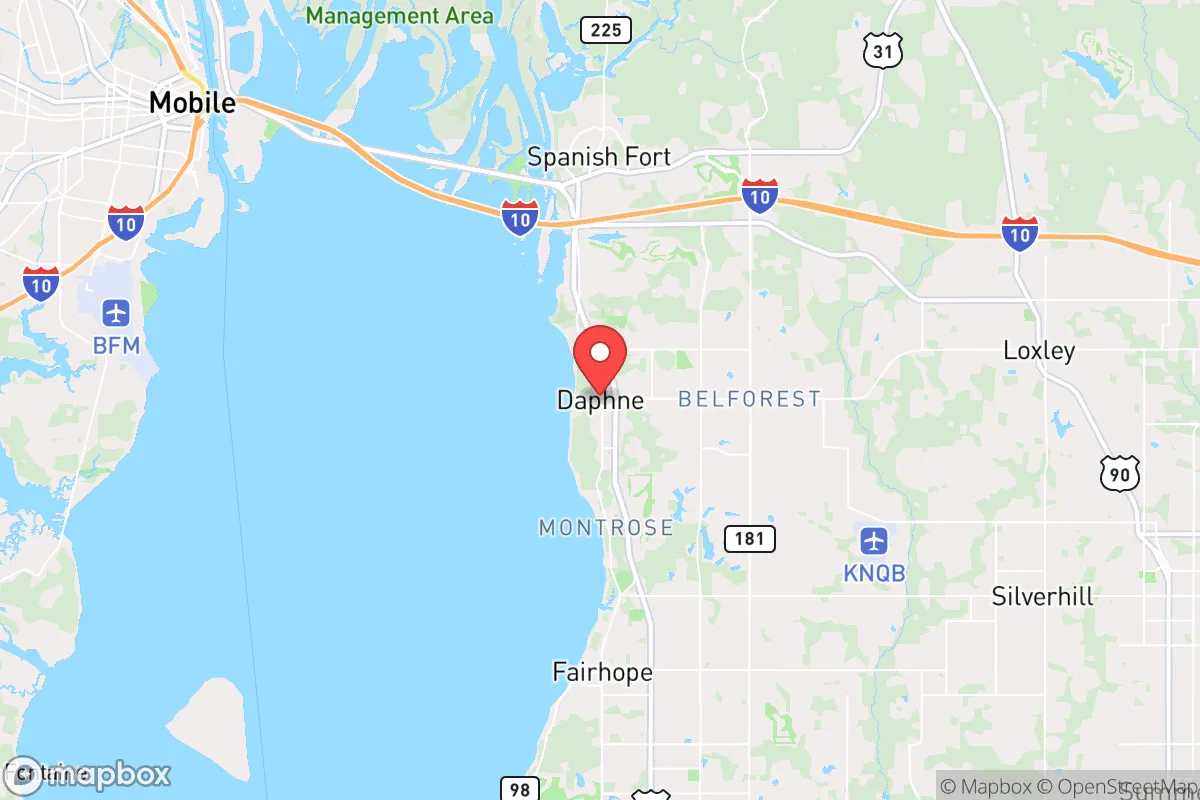
Daphne’s modern population boom began after the 1965 Immigration and Nationality Act, but unlike many Sun Belt suburbs, its growth was driven almost entirely by domestic in-migration rather than foreign immigration. The opening of the Battleship Parkway (US-98) causeway in the 1960s and the completion of the I-10 Bayway in the 1970s transformed Daphne from a sleepy bay town into a bedroom suburb of Mobile. White middle-class families—many from Mobile and other parts of Alabama—flooded into new subdivisions such as Lake Forest Estates, a large planned community developed in the 1970s and 1980s, and Devon Park, a cluster of ranch-style homes built for professionals. This wave was overwhelmingly white and native-born, and it cemented Daphne’s character as a predominantly white, conservative-leaning suburb. The Black population, which had been around 15-20% in the 1960s, declined proportionally as the white population surged, settling to the current 12.8%. The small Hispanic community (5.7%) began arriving in the 1990s and 2000s, primarily as service and construction workers, and is concentrated in the Daphne East area near the I-10 interchange. East and Southeast Asian residents (1.8%) are a recent, small cohort, mostly professionals in healthcare and engineering, living in newer subdivisions like Belforest Park. The Indian subcontinent population (0.1%) is negligible.
The future
Daphne’s population is heading toward continued, moderate growth driven by domestic migration from other parts of Alabama and the Gulf Coast, not by international immigration. The foreign-born share (2.0%) is far below the national average and shows no sign of rapid increase, as the city lacks the industrial or agricultural sectors that typically attract large immigrant workforces. The Hispanic share (5.7%) is growing slowly, mainly through births rather than new arrivals, and these families are assimilating into the broader suburban fabric rather than forming distinct ethnic enclaves. The Black population (12.8%) is stable, with some movement of middle-class Black families from Mobile into subdivisions like Lake Forest, which is becoming more integrated. The white share (76.1%) will likely remain dominant, though it may edge downward slightly as the area diversifies through natural increase. Daphne is not tribalizing into distinct enclaves; rather, it is homogenizing into a broadly white, middle-class, family-oriented suburb with modest diversity. The next 10-20 years will likely see continued infill development, more master-planned communities, and a population that remains overwhelmingly native-born, college-educated, and politically conservative.
For someone moving in now, Daphne is becoming an increasingly homogeneous, affluent, and family-centric suburb where demographic change is slow and incremental. The city offers a stable, low-crime environment with strong schools and a conservative social character, but little ethnic or cultural diversity. New residents should expect a community where the population is growing through domestic relocation, not immigration, and where the dominant identity remains white, Southern, and suburban.

* Values derived from national, state, county, city and local statistics and may differ in a specific area. Last updated: 2026-04-19T18:47:00.000Z
Narrative content on this page is AI-generated and may contain mistakes. Verify any details that matter before acting on them.
ReloMaps may earn a commission from affiliate links at no extra cost to you.

