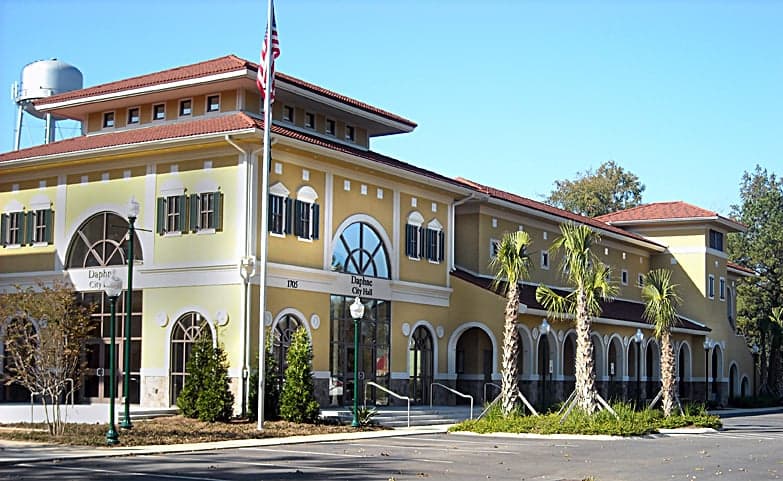
Photo: Wikipedia
Political ClimatePolitical Climate in Daphne, AL
District shown is the primary district for this city’s centroid. Cities may span multiple districts.
Local Political AnalysisPolitical Analysis of Daphne, AL
Daphne, Alabama, is about as solidly conservative as it gets on the Gulf Coast, and that’s not changing anytime soon. The Cook PVI clocks it at R+27, which means the area votes nearly 30 points more Republican than the national average—a number that’s held steady through the last few cycles. If you look at the actual ballot box results, Baldwin County as a whole hasn’t gone blue in a presidential race since 1976, and Daphne itself is the anchor of that trend. The local vibe is less about loud political rallies and more about a quiet, consistent belief that government should stay out of your business, your wallet, and your family’s life. That’s the baseline here, and it’s not budging.
How it compares
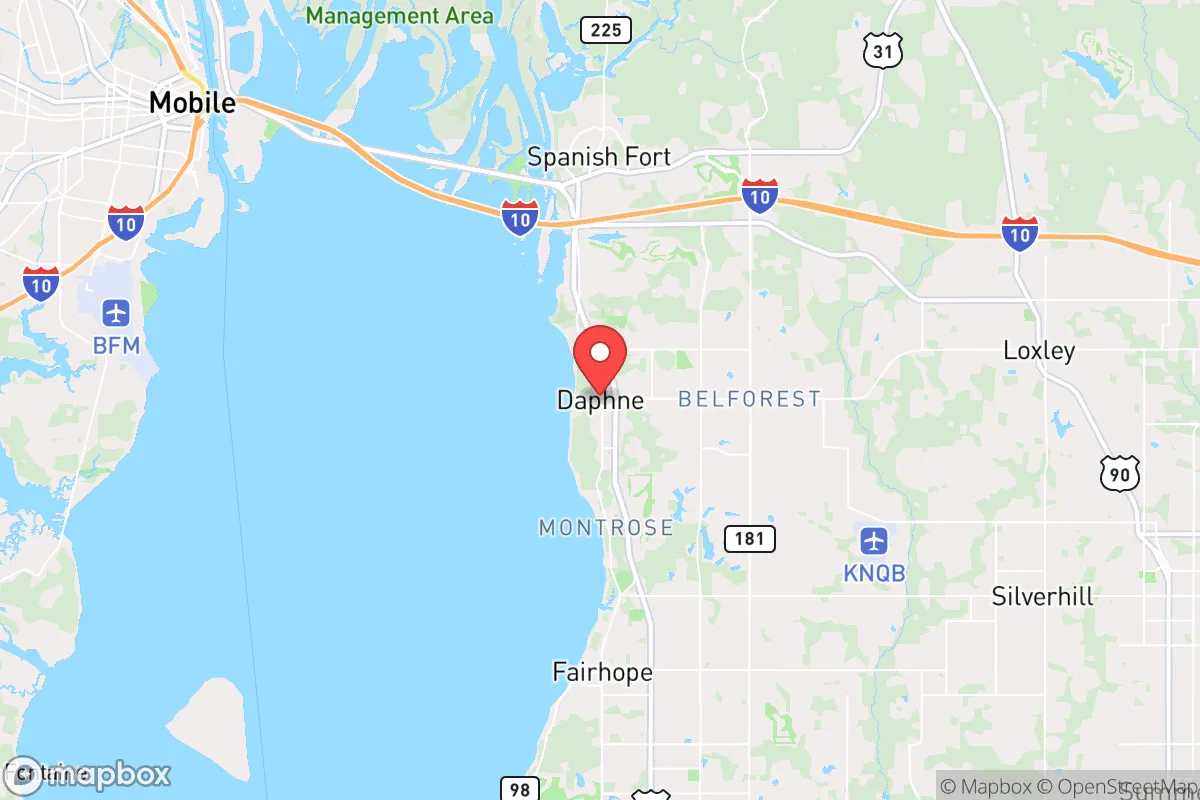
Drive ten miles west into Mobile, and you’ll hit a different world—Mobile County leans more purple, with pockets of progressive energy around the university and downtown areas. Fairhope, just south of Daphne, is also conservative but has a slightly more artsy, libertarian-leaning streak; you’ll see more “Keep Your Laws Off My Body” signs mixed in with the Trump flags. Daphne, by contrast, is the steady, family-oriented conservative hub. It’s less flashy than Fairhope’s boutique politics and more reliably red than the rural stretches of Loxley or Robertsdale, which can swing populist. The real contrast is with the city of Mobile itself, where you’ll find city council debates over sanctuary policies and public housing that would never fly in Daphne’s city hall. That R+27 rating isn’t just a number—it’s a firewall against the kind of coastal progressive drift you see in places like Gulf Shores or Orange Beach, which are more transient and tourism-driven.
What this means for residents
For someone living here, the political climate translates into a pretty straightforward daily reality: low taxes, minimal zoning fuss, and a school system that isn’t being used as a social experiment. The Baldwin County school board has held the line on curriculum battles, keeping critical race theory and gender ideology out of elementary classrooms, which is a big deal for families who moved here specifically to avoid that nonsense. Property taxes are among the lowest in the state, and there’s no city income tax—just a modest sales tax that funds basic services. The flip side is that if you’re hoping for big government programs or rapid transit expansions, you’ll be disappointed. The local attitude is “we’ll handle it ourselves,” which works fine until a hurricane hits and you’re waiting on FEMA. But most residents would rather deal with that than hand over more control to Montgomery or Washington. The long-term concern is that as Daphne grows—and it is growing fast, with new subdivisions and retail popping up—there’s pressure to adopt more “modern” policies like impact fees or affordable housing mandates. So far, the city council has resisted, but it’s something to keep an eye on.
Culturally, Daphne still feels like a small town that happens to have a Target and a decent sushi place. The biggest policy distinction is the strong Second Amendment culture—you can carry openly without a permit in Alabama, and nobody blinks. There’s also a noticeable resistance to mask mandates or vaccine passports; during COVID, the city never imposed any, and businesses largely set their own rules. That hands-off approach is exactly why people move here from places like California or Illinois. The trajectory is stable for now, but if the county keeps attracting out-of-state transplants, you might see a slow creep toward more progressive positions on housing and environmental regulation. For now, though, Daphne remains a place where the government’s main job is to pick up the trash and keep the roads paved—and that’s how folks like it.

State Political ClimatePolitical Climate in Alabama
State Political AnalysisPolitical Environment in the State
Alabama is a deeply conservative state, with Republicans holding every statewide elected office and supermajorities in both legislative chambers, a reality that has solidified over the past 20 years. The state has not voted for a Democratic presidential candidate since 1976, and in 2024, Donald Trump carried it by roughly 30 points. This partisan lean is driven by a coalition of rural, evangelical, and working-class voters, but the state’s political landscape is more nuanced than a simple red-state label, with significant urban-rural divides and a growing tension between traditional conservatism and newer libertarian-leaning influences.
Urban vs. rural divide
The political map of Alabama is starkly divided between its few urban centers and the vast rural expanse. The metro areas of Birmingham (Jefferson County) and Montgomery (Montgomery County) are the state’s Democratic strongholds, consistently voting blue by double digits. In 2024, Jefferson County went for Kamala Harris by about 15 points, while Montgomery County gave her a 20-point margin. These cities are home to large Black populations, universities, and a growing professional class that leans left. In contrast, the rural Black Belt counties—like Greene, Sumter, and Macon—also vote heavily Democratic, but their populations are shrinking and aging, reducing their statewide influence. The rest of the state, from the Tennessee Valley in the north to the Gulf Coast in the south, is overwhelmingly Republican. Mobile and Baldwin counties on the coast are reliably red, with Baldwin County (home to Fairhope and Gulf Shores) being one of the fastest-growing and most conservative areas in the state. The Auburn-Opelika area (Lee County) is a notable swing zone, with the university population moderating its politics, but it still leans Republican. The real political energy, however, is in the exurbs and small towns—places like Madison (north of Huntsville) and Vestavia Hills (suburban Birmingham)—where growth is driven by families and retirees seeking lower taxes and less government intrusion.
Policy environment
Alabama’s policy environment is a textbook example of conservative governance, with low taxes and minimal regulation. The state has no personal property tax on vehicles or boats, and the combined state and local sales tax can reach 10% or more in some areas, but there is no state income tax on retirement income. The corporate income tax is a flat 6.5%, and the state’s regulatory climate is ranked among the most business-friendly in the nation by groups like the Tax Foundation. On education, the state passed the Alabama CHOICE Act in 2024, creating a universal school choice program that allows parents to use state funds for private school tuition, homeschooling, or other educational expenses—a major win for parental rights. Healthcare policy is mixed: the state refused Medicaid expansion under the Affordable Care Act, keeping the program lean, but this has left many rural hospitals struggling financially. Election laws are strict: Alabama requires a photo ID to vote, has no early voting (though absentee voting is available with an excuse), and in 2024 passed a law banning ballot drop boxes and limiting curbside voting. These measures are framed as election integrity safeguards, but critics argue they suppress turnout. The state also has a near-total abortion ban, with no exceptions for rape or incest, passed in 2019 as the Human Life Protection Act.
Trajectory & freedom
Alabama is moving in a direction that expands personal freedom in several key areas, but with some concerning caveats. On gun rights, the state is a constitutional carry state (permitless carry for adults 19 and older) since 2022, and in 2024, it passed a law prohibiting local governments from enforcing federal gun laws—a direct challenge to federal overreach. Property rights were strengthened in 2023 with the Alabama Landowner Protection Act, which limits the ability of local governments to impose zoning restrictions that devalue private property. On medical freedom, the state passed a law in 2023 banning COVID-19 vaccine mandates by private employers and government entities, a clear stand against federal overreach. However, there are worrying trends: the state’s medical marijuana program, passed in 2021, remains stalled due to legal challenges and bureaucratic infighting, leaving patients without access. Additionally, the state’s tax burden on low-income families is regressive, with high sales taxes on groceries and essentials. The biggest threat to freedom in Alabama is the growing influence of federal dollars and mandates tied to infrastructure and education funding, which could force the state to adopt progressive policies in exchange for cash. The Alabama Freedom Caucus, a group of hardline conservatives in the legislature, is actively fighting this trend, pushing for further tax cuts and school choice expansion.
Civil unrest & political movements
Alabama has a relatively low level of visible civil unrest compared to states like Oregon or New York, but there are flashpoints. The Black Lives Matter protests in 2020 were significant in Birmingham and Montgomery, with some property damage and clashes with police, but they were smaller and shorter-lived than in other states. The state’s political movements are dominated by grassroots conservative activism. The Alabama Citizens for Life and Eagle Forum are powerful forces, regularly mobilizing against abortion and critical race theory in schools. Immigration politics are less heated than in border states, but there is a growing concern about illegal immigration in the construction and agriculture sectors, particularly in Baldwin County and the Huntsville area. The state has no sanctuary cities, and in 2024, the legislature passed a law requiring local law enforcement to cooperate with federal immigration authorities. Election integrity remains a hot-button issue: the 2022 and 2024 cycles saw no major scandals, but the state’s Republican leadership continues to push for stricter voter ID laws and purges of voter rolls. The most visible political movement is the Moms for Liberty chapter in Madison County, which has successfully pushed for book bans and curriculum transparency in local school boards.
Projection
Over the next 5-10 years, Alabama is likely to become even more conservative, driven by in-migration from blue states and the continued growth of its exurban and rural areas. The Huntsville metro area, fueled by defense and aerospace jobs, is expected to grow by 15-20% by 2030, bringing in a mix of tech workers who are generally more libertarian than traditional conservatives. This could create a tension between the old guard (socially conservative, pro-business) and the new arrivals (fiscally conservative, but more skeptical of government overreach on issues like marijuana and zoning). The Black Belt will continue to lose population, reducing the Democratic base. The biggest wildcard is the federal government: if the Supreme Court overturns or weakens the Alabama Human Life Protection Act, the state could see a backlash from its evangelical base, but it’s more likely the law will be upheld or replaced with an even stricter version. The school choice movement will expand, with the CHOICE Act likely being expanded to include more funding for homeschooling and micro-schools. The state’s tax structure will likely shift toward a flat income tax or further reductions in property taxes, but the reliance on sales tax will remain a burden on the poor. A new resident moving in now should expect a state that is fiercely independent, with a government that is generally on their side on most cultural issues, but with a growing libertarian streak that could challenge the old Republican establishment.
Bottom line for a new resident: If you’re moving to Alabama, you’re choosing a state where your personal freedoms—especially on guns, school choice, and medical mandates—are protected by law and culture. You’ll find a government that is generally hands-off in your daily life, but you’ll also need to navigate a regressive tax system and a healthcare landscape that can be thin in rural areas. The political climate is stable and conservative, but it’s not monolithic: the urban-rural divide means you’ll get very different experiences in Birmingham versus Fairhope. For families and individuals seeking a low-regulation, high-freedom environment, Alabama is a solid bet, but keep an eye on the growing influence of federal money and the ongoing battle between traditional conservatives and the new libertarian wave.
* Values derived from national, state, county, city and local statistics and may differ in a specific area. Last updated: 2026-04-19T18:47:00.000Z
Narrative content on this page is AI-generated and may contain mistakes. Verify any details that matter before acting on them.
ReloMaps may earn a commission from affiliate links at no extra cost to you.

