Photo: Wikipedia
Demographics of Davenport, IA
Affluence Level in Davenport, IA
A middle-class area roughly in line with national averages across income, home values, education, and employment.
People of Davenport, IA
The people of Davenport, Iowa, today number roughly 101,000, forming a predominantly white (71.7%) but increasingly diverse Midwestern river city. The population is notably less foreign-born than the national average (just 2.0%), yet it hosts significant Black (10.9%) and Hispanic (9.1%) communities, alongside smaller East/Southeast Asian (1.6%) and Indian-subcontinent (0.3%) populations. With 30.0% holding a college degree, Davenport’s character is blue-collar and family-oriented, shaped by its Mississippi River location and a history of industrial booms and demographic shifts that have left distinct ethnic enclaves across its neighborhoods.
How the city was settled and grew
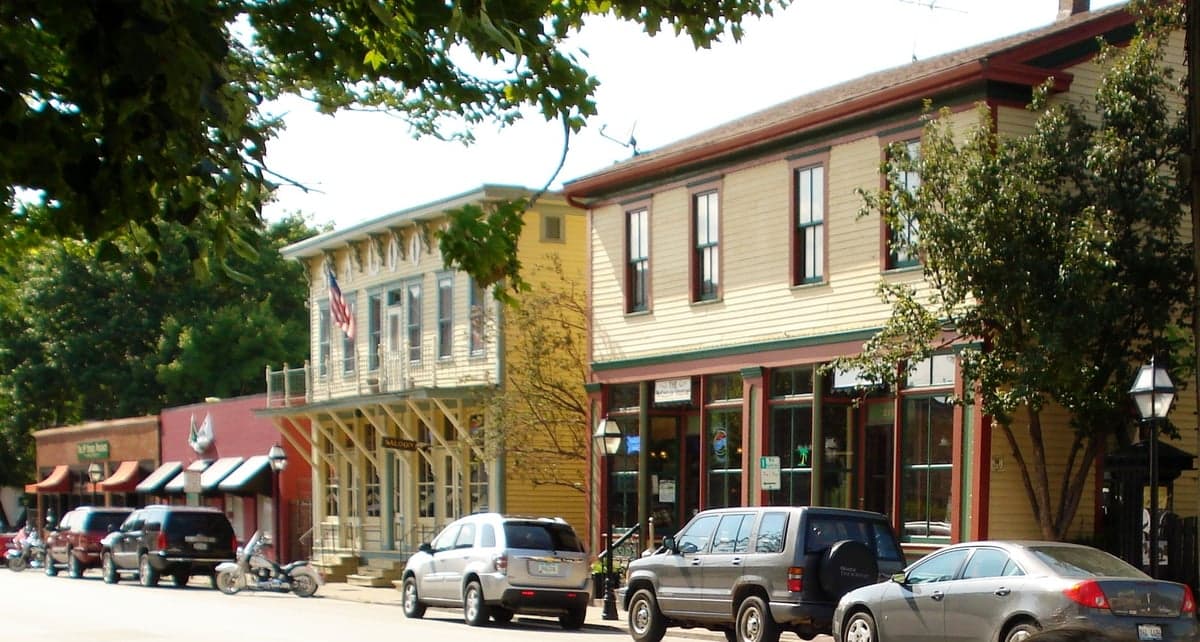
Davenport was founded in 1836 by Colonel George Davenport, a fur trader, on land that had been home to the Sauk and Meskwaki tribes. The city’s early growth was driven by its position as a Mississippi River port and a terminus for the first railroad bridge across the river (1856). The original white settlers were largely Yankee and German immigrants drawn by land speculation, lumber, and manufacturing. By the 1850s, German Catholics and Irish laborers had built the Village of East Davenport (now the East Village), a historic district of brick storefronts and working-class homes. A second major wave came with the 1880s-1920s industrial expansion: Swedish and Danish immigrants settled in the Golder’s Point and McClellan Heights areas, working in the Rock Island Arsenal and farm-equipment factories. The city’s Black population, initially small, grew during the Great Migration (1910-1940), with families concentrating in the West End near the railroad yards and the Goose Hollow neighborhood, where they found work in meatpacking and railroad maintenance.
Modern era (post-1965)
The post-1965 era brought significant demographic change. The 1965 Hart-Cellar Act opened immigration from Latin America and Asia, though Davenport’s foreign-born share remained low compared to coastal cities. The Hispanic population grew steadily from the 1970s onward, driven by Mexican and Central American migrants working in agriculture, construction, and the Quad Cities’ manufacturing plants. Today, the West End and Florence Heights neighborhoods have the highest concentrations of Hispanic residents, with Spanish-language storefronts and Catholic parishes serving the community. The Black population, which had been stable at around 5-6% through the 1970s, rose to 10.9% by 2020, largely through domestic in-migration from Chicago and other Midwestern cities. Black families have settled primarily in the Central City and West End areas, though suburbanization has also spread them into the Bettendorf border neighborhoods. The East/Southeast Asian community (1.6%) is small but visible, with Vietnamese and Lao families arriving as refugees after 1975, clustering near the Village of East Davenport and the Hilltop area. The Indian-subcontinent population (0.3%) is tiny and dispersed, largely professionals in healthcare and engineering at Genesis Health System and Deere & Company. Suburbanization after 1970 hollowed out some older neighborhoods, with white families moving to Bettendorf and Pleasant Valley, leaving Davenport’s core more diverse but also poorer.
The future
Davenport’s population is slowly aging and slightly declining (down from 102,157 in 2020). The Hispanic share is the fastest-growing segment, projected to reach 12-14% by 2035, driven by both immigration and higher birth rates. The Black population is plateauing, with little new in-migration from Chicago. The East/Southeast Asian community is stable but not growing, as younger generations move to larger metro areas. The white population is shrinking, both through out-migration to suburbs and an aging demographic. The city is not tribalizing into stark enclaves—neighborhoods like the West End and Central City are becoming more mixed, with Hispanic and Black families living alongside older white residents. However, the McClellan Heights and Golder’s Point areas remain overwhelmingly white and affluent, while the West End is increasingly Hispanic and lower-income. The next decade will likely see continued Hispanic growth, a stable Black population, and a gradual whitening of the suburbs, leaving Davenport’s core as a working-class, multi-ethnic city with a modest but real diversity.
For someone moving in now, Davenport is becoming a more Hispanic and multi-ethnic city, but at a slow pace. The population is aging and slightly shrinking, with most growth coming from Hispanic families. The city offers affordable housing and a strong sense of community, but economic opportunities are tied to manufacturing and healthcare, not tech or finance. New residents should expect a place that is quietly diversifying, not rapidly transforming, and where neighborhood character still reflects the industrial waves of the 19th and 20th centuries.

* Values derived from national, state, county, city and local statistics and may differ in a specific area. Last updated: 2026-04-22T23:51:42.000Z
Narrative content on this page is AI-generated and may contain mistakes. Verify any details that matter before acting on them.
ReloMaps may earn a commission from affiliate links at no extra cost to you.

