Photo: Wikipedia
Demographics of Decatur, TX
Affluence Level in Decatur, TX
A middle-class area roughly in line with national averages across income, home values, education, and employment.
People of Decatur, TX
Decatur, Texas, is a small city of 7,087 residents where the population is overwhelmingly native-born (91.9%) and politically conservative, with a strong ranching and oil heritage that still shapes daily life. The city’s character is defined by a white majority (64.2%) and a large Hispanic minority (34.5%), a demographic split that reflects distinct settlement waves rather than recent immigration. With only 23.2% of adults holding a college degree, Decatur remains a working-class community where family ties and local churches anchor social life, and where newcomers are typically drawn by affordable housing and proximity to the Dallas-Fort Worth metroplex.
How the city was settled and grew
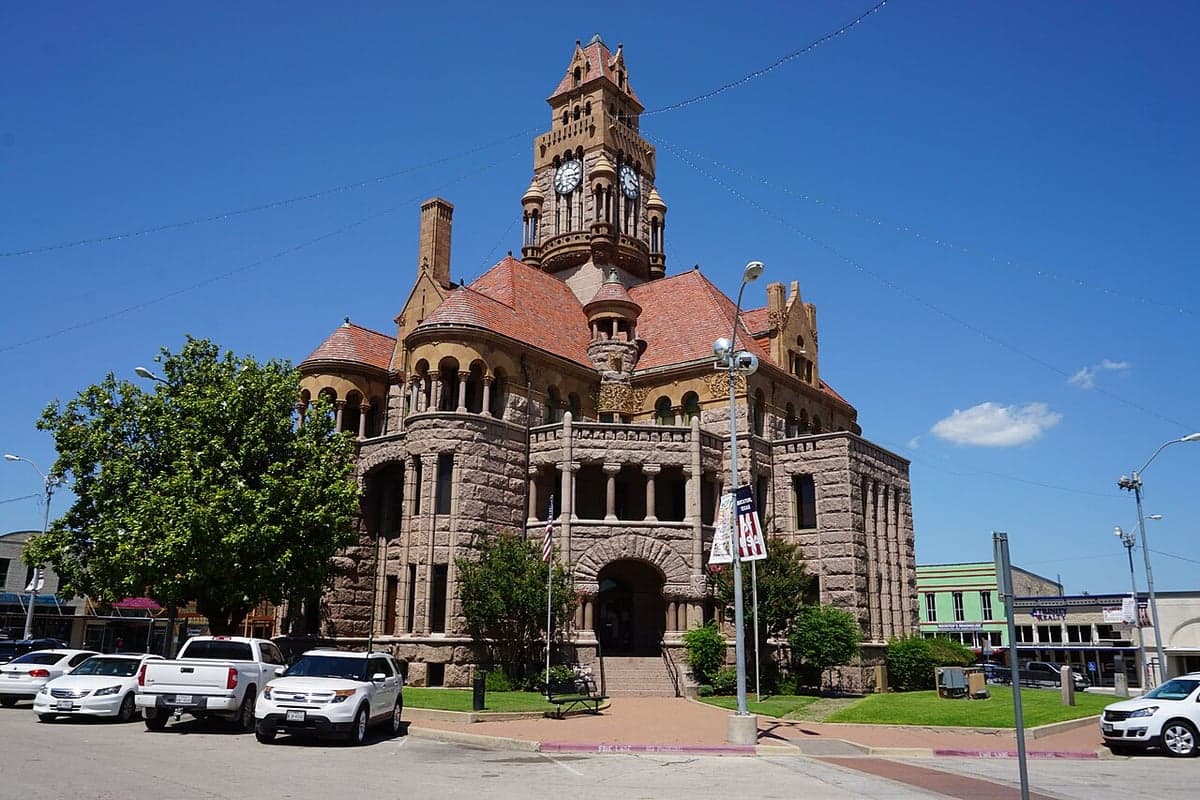
Decatur was founded in 1856 as the Wise County seat, named after U.S. Navy Commodore Stephen Decatur. The original settlers were Anglo-American farmers and ranchers from the Upper South—primarily Tennessee, Kentucky, and Missouri—who arrived via the Peters Colony land grant system. These families claimed land along the Trinity River bottoms and established cotton and cattle operations. The historic Courthouse Square district became the commercial and social hub, with the limestone courthouse (built 1896) as its anchor. By the 1880s, the arrival of the Fort Worth and Denver Railway spurred a second wave: German and Czech immigrants who bought smaller farms north of town, settling what is now the Northside neighborhood around Walnut Street. These families built St. John’s Lutheran Church (1881) and introduced dairy farming to the local economy. A third wave came during the 1920s oil boom, when wildcatters and roughnecks—mostly white Protestants from Oklahoma and East Texas—flooded into makeshift camps south of the railroad tracks, an area still called Oil Camp Addition. By 1950, Decatur’s population was 3,563 and nearly entirely white, with a small Mexican-American community clustered near the South Side along Business 287, where railroad workers and cotton pickers had settled.
Modern era (post-1965)
The post-1965 period brought two major demographic shifts. First, the Immigration and Nationality Act of 1965 opened the door for Mexican-American families already in Texas to sponsor relatives, and Decatur’s Hispanic population grew from a negligible share to 34.5% by 2026. These families concentrated in the Southside Addition and along FM 730 south of town, where newer subdivisions like Heritage Estates (platted in the 1990s) became majority-Hispanic. Second, domestic in-migration accelerated after 2000 as Dallas-Fort Worth suburban sprawl pushed north along US 81/287. White professionals and retirees from Tarrant County bought homes in master-planned communities like Woodland Hills (developed 2005), a gated subdivision with larger lots and a country-club feel. This created a visible economic and cultural divide: Woodland Hills and the Preserve at Decatur (built 2015) are overwhelmingly white and college-educated, while Southside Addition and Heritage Estates are working-class Hispanic neighborhoods where Spanish is commonly heard. The Black population remains at 0.0%, a figure that reflects both historical exclusion and the absence of any post-1965 Black in-migration; Decatur never attracted the industrial jobs or affordable housing that drew Black families to other North Texas towns like Denton or Gainesville. East/Southeast Asian residents (0.3%) and Indian-subcontinent residents (0.6%) are present in tiny numbers, mostly as professionals in healthcare or oilfield services, and live scattered across newer subdivisions rather than in any ethnic enclave.
The future
Decatur’s population is projected to grow to roughly 9,500 by 2035, driven entirely by domestic migration from the DFW metroplex. The Hispanic share is likely to stabilize or decline slightly as white suburbanites continue to move in, while the foreign-born share (8.1%) may plateau because most Hispanic residents are now U.S.-born second or third generation. The city is not tribalizing into hostile camps, but it is spatially sorting: new subdivisions on the north and east sides are overwhelmingly white and higher-income, while the south side remains Hispanic and working-class. No new immigrant communities are forming—the tiny Asian and Indian populations are too small to create institutions or neighborhoods. The next decade will likely see Decatur become more homogenized in terms of income and education as DFW commuters push out lower-cost housing, but the Hispanic-white cultural divide will persist along geographic lines. For a conservative-leaning newcomer, Decatur offers a stable, family-oriented environment where church and school are the main social institutions, but where the south-side Hispanic community remains largely separate in daily life. The city is becoming a bedroom suburb, not a melting pot.

* Values derived from national, state, county, city and local statistics and may differ in a specific area. Last updated: 2026-04-28T21:27:44.000Z
Narrative content on this page is AI-generated and may contain mistakes. Verify any details that matter before acting on them.
ReloMaps may earn a commission from affiliate links at no extra cost to you.

