Photo: Wikipedia
Demographics of Delaware, OH
Affluence Level in Delaware, OH
A middle-class area roughly in line with national averages across income, home values, education, and employment.
People of Delaware, OH
The people of Delaware, Ohio today form a predominantly white, college-educated community of 43,168, with a notably high 45.6% holding a bachelor’s degree or higher, driven by the presence of Ohio Wesleyan University and the city’s role as a growing outer-ring suburb of Columbus. The population is 79.7% white, with a small but diverse minority presence: 5.4% Hispanic, 4.6% Black, 3.2% Indian (subcontinent), 2.4% East/Southeast Asian, and just 3.4% foreign-born overall. This is a community that blends small-town Midwestern roots with an increasingly professional, commuter-oriented character, where historic neighborhoods near downtown coexist with newer subdivisions filling in former farmland. The city’s identity is shaped by a conservative-leaning political culture, a strong sense of local history, and a population that is growing steadily but remains far less diverse than the Columbus metro as a whole.
How the city was settled and grew
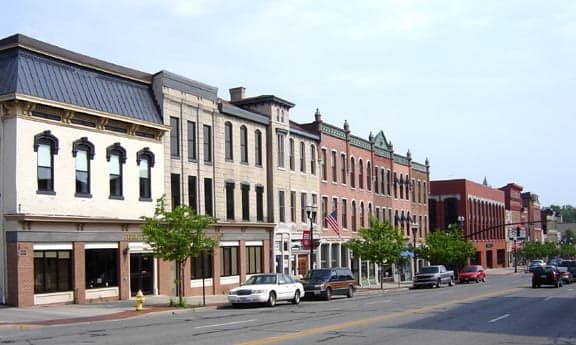
Delaware was founded in 1808 on the Olentangy River, with the first white settlers arriving from Kentucky, Pennsylvania, and New England via the Ohio River and overland trails. The original population was almost entirely of English, Scots-Irish, and German stock, drawn by the availability of cheap land under the U.S. land survey system and the promise of fertile river-bottom soil. The city’s early economy revolved around agriculture, milling, and later the railroad, which arrived in the 1850s and connected Delaware to the national market. The historic Downtown Delaware district, centered on Sandusky and Winter Streets, was built by these early settlers and remains the city’s commercial and civic core, with many 19th-century brick storefronts still standing. A second wave of German immigrants arrived in the mid-19th century, settling in the West Side neighborhood near the railroad tracks, where they established churches, breweries, and small businesses. The founding of Ohio Wesleyan University in 1842 brought a small but influential population of faculty and students from the Northeast, creating a lasting intellectual and cultural anchor in the University District around South Sandusky Street. By 1900, Delaware’s population was nearly 100% white and native-born, with a small Black community concentrated in the East Side neighborhood near the river, many of whom worked as domestic servants or laborers.
Modern era (post-1965)
The post-1965 era brought gradual demographic change, driven less by international immigration and more by domestic in-migration from Columbus and other parts of Ohio. The completion of U.S. Route 23 and later State Route 315 turned Delaware into a viable commuter suburb, attracting white-collar families seeking larger lots and lower taxes than Franklin County. The Stratford neighborhood, developed in the 1970s and 1980s on the city’s south side, became the primary destination for these new arrivals—mostly white, college-educated professionals working at Ohio State University, Nationwide Insurance, or JPMorgan Chase in Columbus. The city’s Black population grew modestly from under 2% in 1970 to 4.6% today, with most Black residents living in the East Side and Northwest Delaware areas, though the community remains small and not highly concentrated. The Hispanic population, now 5.4%, began growing in the 1990s, driven by Mexican and Central American immigrants working in construction, landscaping, and the poultry processing plant in nearby Plain City; they are dispersed across the city but have a visible presence in the South Sandusky Street corridor. The Indian-subcontinent population (3.2%) and East/Southeast Asian population (2.4%) are almost entirely post-2000 arrivals, drawn by professional jobs in Columbus’s tech and healthcare sectors; they tend to settle in newer subdivisions like Bunty Station and West Central Delaware, where housing stock is newer and schools are highly rated. The foreign-born share remains low at 3.4%, reflecting the city’s limited role as a primary immigrant destination compared to Columbus proper.
The future
Delaware’s population is projected to continue growing at a moderate pace, likely reaching 50,000 by 2040, driven by continued spillover from Columbus and the expansion of the Intel semiconductor plant in nearby Licking County. The city is not homogenizing into a single demographic block; instead, it is tribalizing into distinct enclaves based on income, housing age, and lifestyle. The historic downtown and University District are becoming more expensive and attracting empty-nesters and young professionals, while the newer subdivisions on the south and west sides draw families with children. The immigrant communities—Indian, East/Southeast Asian, and Hispanic—are growing slowly but steadily, with second-generation children assimilating into the broader suburban culture while maintaining ethnic ties through Columbus-based religious and cultural institutions. The Black population is likely to remain stable or grow slightly, but Delaware is not expected to become a major destination for Black in-migration given the lack of existing community infrastructure. The next 10-20 years will likely see a continued whitening of the city’s political and social leadership, even as the minority share inches upward, because the white population is also growing through domestic in-migration. The city will remain a predominantly white, conservative-leaning, family-oriented suburb with a small but stable minority presence—a place where newcomers are welcomed but expected to adapt to the existing cultural norms.
For someone moving in now, Delaware offers a safe, well-educated, and growing community with strong schools and a clear sense of place, but it is not a diverse or cosmopolitan environment. The population is becoming more professional and more connected to Columbus, but the city’s social fabric remains rooted in its Midwestern, small-town origins. New residents, especially those from outside Ohio, should expect a community that values tradition, self-reliance, and neighborly familiarity—and one where demographic change happens slowly, if at all.

* Values derived from national, state, county, city and local statistics and may differ in a specific area. Last updated: 2026-04-21T19:15:25.000Z
Narrative content on this page is AI-generated and may contain mistakes. Verify any details that matter before acting on them.
ReloMaps may earn a commission from affiliate links at no extra cost to you.

