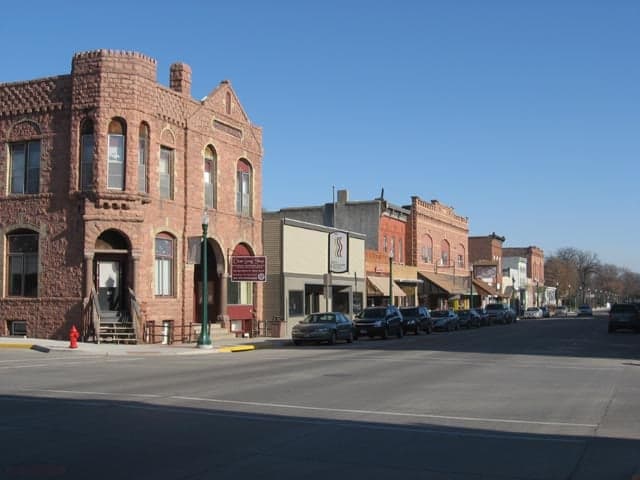
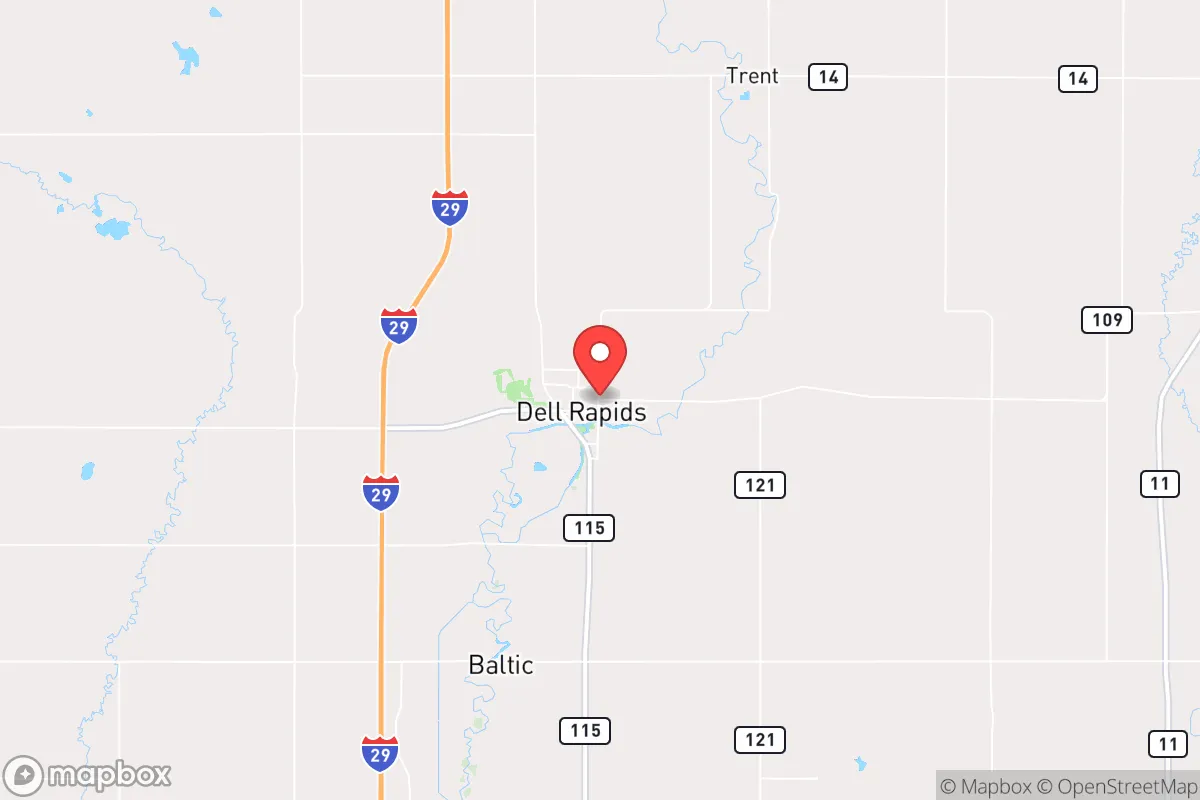
Photo: Wikipedia
Demographics of Dell Rapids, SD
Affluence Level in Dell Rapids, SD
An upper-middle-class area. Household wealth, education levels, and homeownership run ahead of national benchmarks.
People of Dell Rapids, SD
Dell Rapids, South Dakota, is a predominantly white, family-oriented community of 3,947 residents where 92.0% of the population identifies as non-Hispanic white and only 0.3% are foreign-born. The city’s character is shaped by its historic role as a mill town and its current identity as a quiet, affordable bedroom community for Sioux Falls workers. With a college-educated rate of 36.2%—slightly above the national average—the population skews toward skilled trades, small business owners, and remote professionals who value low taxes and a slower pace of life. The city’s human history is one of sequential waves of European-origin settlers, followed by a long period of demographic stability that continues today.
How the city was settled and grew
Dell Rapids was founded in the 1870s along the Big Sioux River, where water power attracted the first permanent settlers—primarily Norwegian, German, and Irish immigrants seeking farmland and mill work. The original platted area, now known as Old Town Dell Rapids (centered around Main Street and 4th Street), was built by these groups, who constructed the city’s iconic quartzite stone buildings and the first flour mills. A second wave arrived between 1890 and 1910, drawn by the expansion of the Chicago, Milwaukee & St. Paul Railroad, which established a depot just south of the original settlement. This spurred development of the Railroad Addition neighborhood, a working-class district where Irish and German laborers built modest frame houses. By 1920, the population had reached roughly 1,200, and the city’s ethnic composition was nearly entirely Northern and Western European, a pattern that persisted through the mid-20th century. The West Side (west of the river) developed later, after World War II, as returning veterans and their families built ranch-style homes on larger lots, reinforcing the city’s homogeneous character.
Modern era (post-1965)
After the 1965 Immigration and Nationality Act reshaped U.S. demographics nationally, Dell Rapids experienced virtually no change in its ethnic makeup. The foreign-born share has remained below 1% for decades, and the city’s Hispanic population—currently 4.5%—is the only non-white group of measurable size, consisting largely of families who moved from rural Nebraska and Iowa for agricultural or construction work. These households have concentrated in the Southview Addition (south of 10th Street), a newer subdivision developed in the 1990s and 2000s. No East/Southeast Asian, Black, or Indian-subcontinent communities have formed in Dell Rapids; the 0.0% figures for these groups reflect a complete absence of settlement. The city’s growth since 1965 has come entirely from domestic in-migration—primarily white families from the Upper Midwest seeking lower housing costs and better schools than Sioux Falls. The Prairie Hills subdivision (northeast of the city center) absorbed much of this influx after 2000, with its large-lot homes attracting professionals commuting to Sanford Health and other Sioux Falls employers. Dell Rapids has not experienced the suburban diversification seen in larger metros; it remains a culturally and ethnically stable enclave.
The future
Dell Rapids’ population is projected to grow modestly—likely reaching 4,200–4,500 by 2035—driven entirely by white domestic migration from within South Dakota and neighboring states. The city is not homogenizing further (it is already near-maximally homogeneous), nor is it tribalizing into distinct ethnic enclaves, as no immigrant community has established a foothold. The Hispanic share may rise to 6–7% over the next decade, but these families are assimilating residentially into existing subdivisions like Sunset Ridge (west of Highway 77) rather than forming a separate district. The 0.3% foreign-born rate is unlikely to increase significantly, as Dell Rapids lacks the rental housing stock, entry-level jobs, and social-service infrastructure that attract international migrants. The city’s future is one of slow, stable growth among a population that is older (median age ~39) and more educated than the state average, with no signs of the rapid diversification seen in Sioux Falls or Rapid City.
For a conservative-leaning mover, Dell Rapids represents a place where the demographic trajectory is clear: it will remain a predominantly white, family-centered community with low crime, strong schools, and minimal cultural flux. The city is not becoming more diverse or cosmopolitan; it is doubling down on its historic identity as a quiet, affordable, and ethnically stable small town. Anyone moving in should expect a population that values continuity over change, and a social environment where nearly everyone shares a similar background and worldview.

* Values derived from national, state, county, city and local statistics and may differ in a specific area. Last updated: 2026-04-19T04:54:00.000Z
Narrative content on this page is AI-generated and may contain mistakes. Verify any details that matter before acting on them.
ReloMaps may earn a commission from affiliate links at no extra cost to you.

