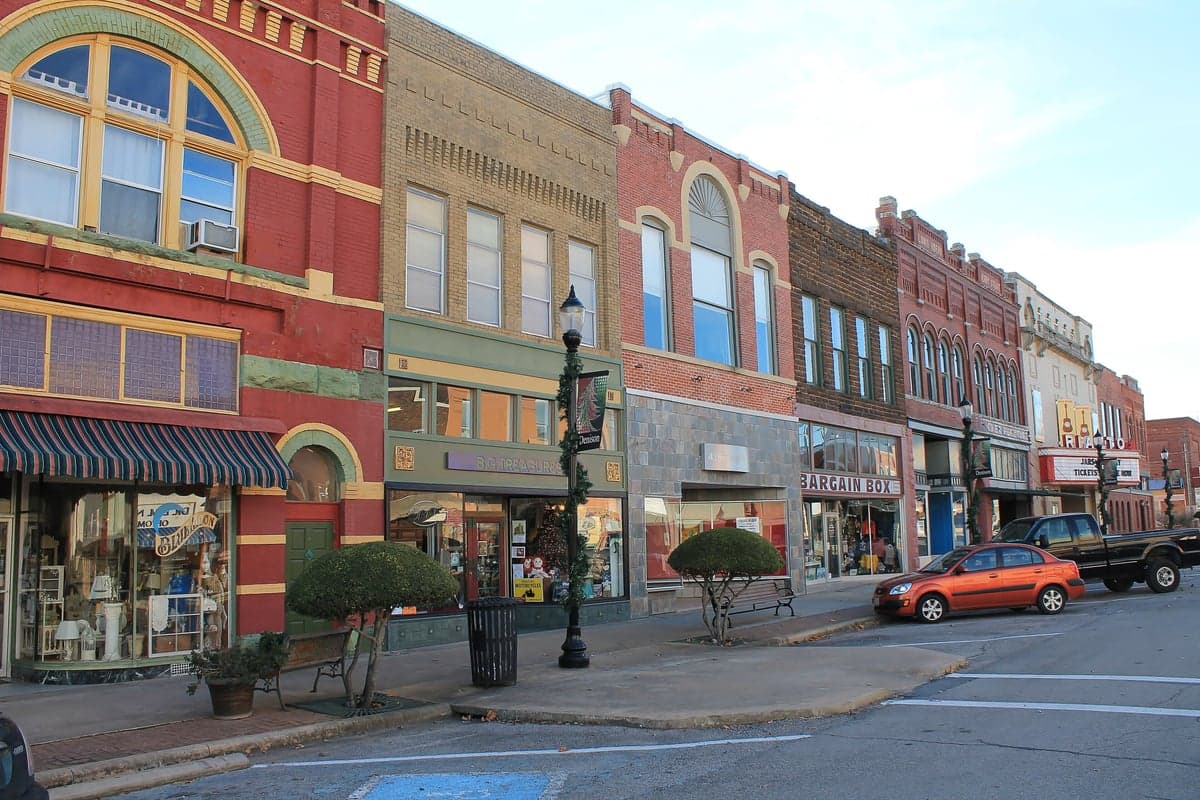
Photo: Wikipedia
Demographics of Denison, TX
Affluence Level in Denison, TX
A below-average socioeconomic profile. Incomes, home values, and educational attainment trail the U.S., with higher poverty and unemployment.
People of Denison, TX
The people of Denison, Texas, today number 25,347, forming a community that is predominantly white (71.8%) with a notable Hispanic minority (13.4%) and smaller Black (6.6%) and East/Southeast Asian (0.5%) populations. The city’s foreign-born share is just 3.2%, well below the national average, and only 18.5% of adults hold a college degree, reflecting a historically working-class, blue-collar character rooted in its railroad and industrial origins. Denison’s identity is shaped by its position as a small manufacturing and logistics hub in North Texas, with a population that is older and more rooted than the fast-growing suburbs south of the Red River.
How the city was settled and grew
Denison was founded in 1872 as a railroad town, created specifically as a stop on the Missouri-Kansas-Texas Railroad (the Katy). The original population was drawn by railroad construction and maintenance jobs, with the first wave consisting of Anglo-American laborers, engineers, and merchants from the Upper South and Midwest. The city’s earliest neighborhoods, such as Old Town Denison (the original plat around Main Street and the depot) and West Hill (the bluff-top area west of the tracks), were built by these railroad families. A second wave arrived in the 1880s and 1890s as the Katy expanded and Denison became a regional cotton and grain shipping center. This period brought a small number of German and Irish immigrants, who settled in the South Side district near the rail yards. By 1900, Denison’s population was overwhelmingly native-born white, with a tiny Black community concentrated in the East End neighborhood along the railroad corridor. The city’s growth plateaued after World War I, as the railroad industry mechanized and the cotton economy declined, leaving Denison with a stable, insular population through the mid-20th century.
Modern era (post-1965)
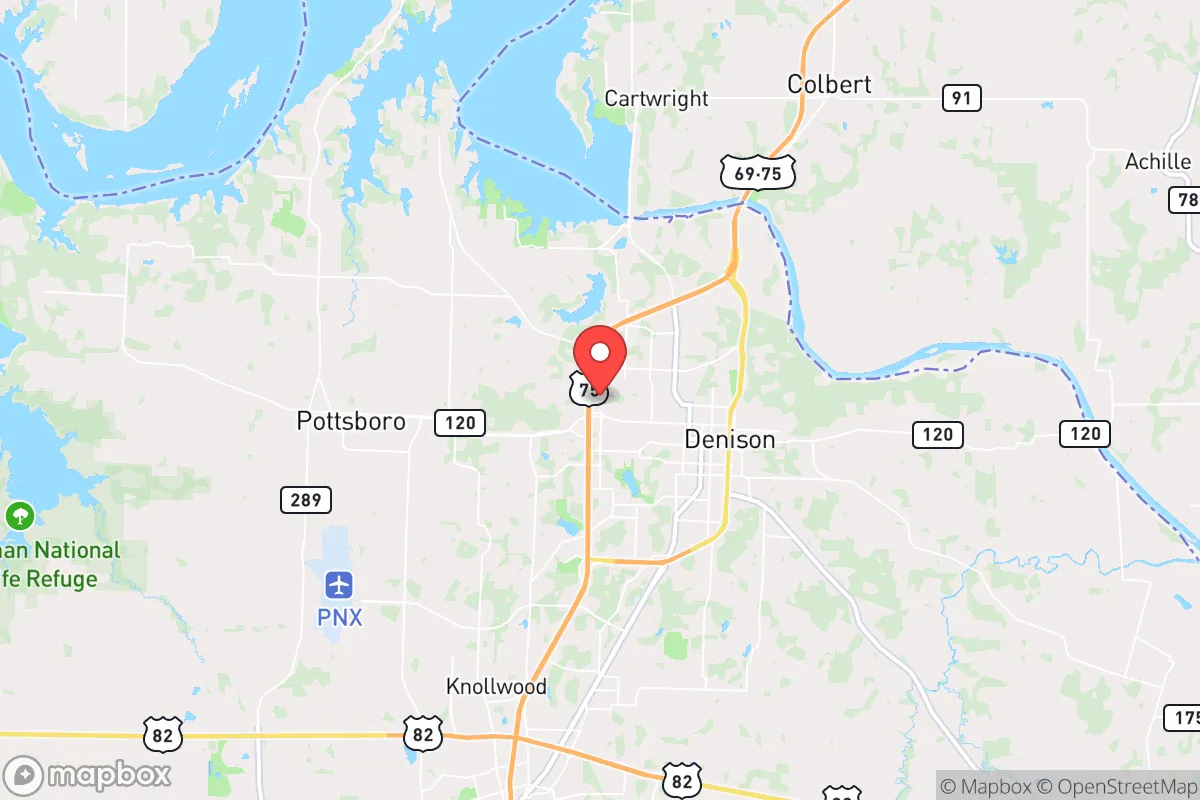
The post-1965 period brought modest demographic change to Denison, driven less by immigration reform than by domestic migration patterns. The city’s foreign-born population remains very low (3.2%), and the small East/Southeast Asian community (0.5%) and Indian subcontinent community (0.5%) are largely professionals drawn by the nearby Texoma Medical Center and the Perrin Air Force Base (closed in 1971 but redeveloped as an industrial park). These families settled in the North Denison area, near the hospital and newer subdivisions. The Hispanic population grew from negligible levels in 1970 to 13.4% today, driven by Mexican-American families moving from South Texas and the Rio Grande Valley for construction and service jobs. This community is concentrated in the South Denison corridor along U.S. Highway 75, particularly around the Loy Lake neighborhood, where newer apartment complexes and mobile home parks have absorbed most of the growth. The Black population, at 6.6%, has remained stable since the 1970s, with families still centered in the East End historic district, though some have moved to newer subdivisions in West Denison. The white population, while still the majority, has aged in place, with younger white families often leaving for the Dallas-Fort Worth suburbs, contributing to Denison’s slow overall growth.
The future
Denison’s population is heading toward a gradual diversification, but at a slower pace than the broader Texas trend. The Hispanic share is likely to continue rising, potentially reaching 18-20% by 2040, as families in the South Denison corridor grow and new arrivals from the Rio Grande Valley are drawn by relatively affordable housing. The East/Southeast Asian and Indian communities are expected to remain small, as the city lacks the high-tech employment base that attracts these groups to Plano or Frisco. The white population will likely continue to shrink as a share, driven by out-migration of younger adults and low birth rates among the older cohort. Denison is not tribalizing into distinct enclaves; rather, the Hispanic growth is concentrated in a few neighborhoods, while the rest of the city remains predominantly white and older. The city’s low college attainment rate (18.5%) and limited professional job growth suggest it will remain a working-class community, with population growth of 0.5-1% annually, mostly from Hispanic in-migration and natural increase.
For a prospective resident, Denison offers a stable, low-cost, and predominantly native-born community with a strong sense of local history. The city is becoming slightly more Hispanic and slightly less white, but the pace of change is slow, and the overall character remains that of a traditional North Texas railroad town. New arrivals should expect a place where most residents have deep local roots, where the foreign-born presence is minimal, and where the economy is anchored by manufacturing, logistics, and healthcare rather than the tech-driven growth seen further south.

* Values derived from national, state, county, city and local statistics and may differ in a specific area. Last updated: 2026-05-11T16:10:35.000Z
Narrative content on this page is AI-generated and may contain mistakes. Verify any details that matter before acting on them.
ReloMaps may earn a commission from affiliate links at no extra cost to you.

