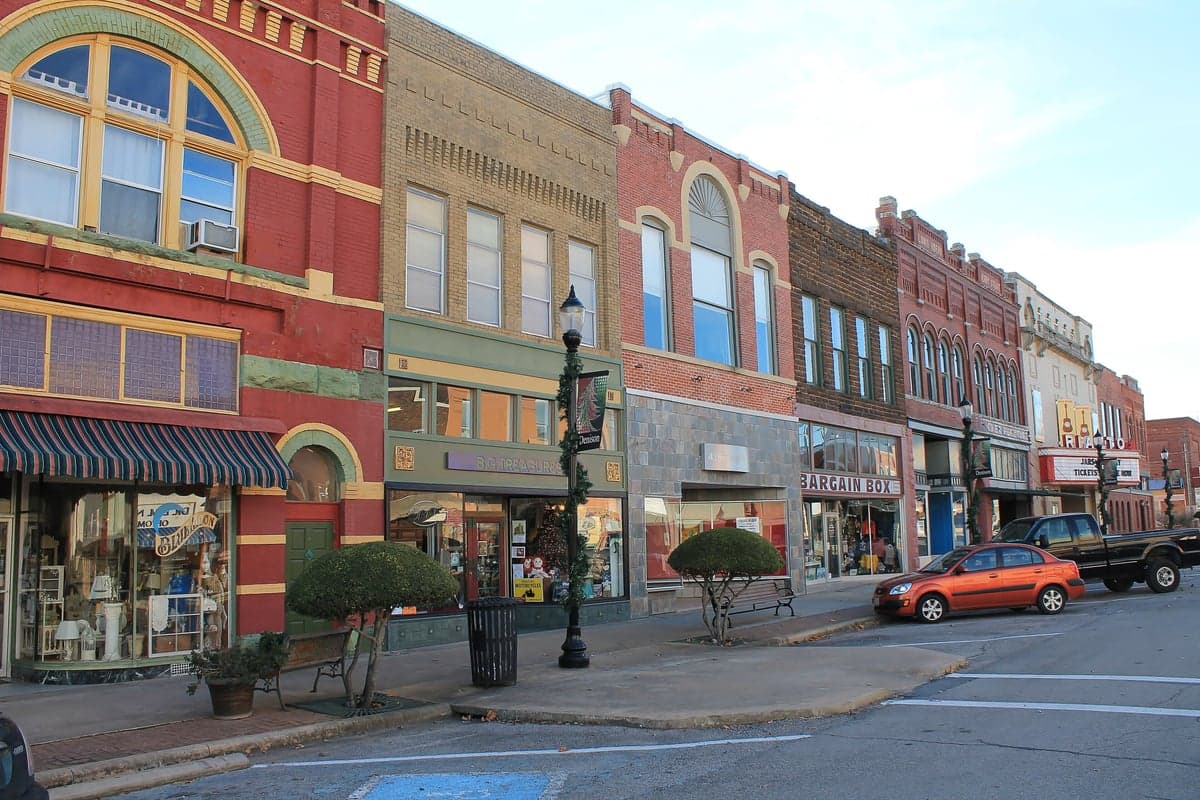
Photo: Wikipedia
Strategic Assessment of Denison, TX
Meaningful friction. Expect exposure to either population pressure, blast zones, or natural disaster risk. Consider buying a retreat property.
What does the Strategic Assessment tell us?
Our Strategic Assessment grades tactical survivability of an area. Major population centers, military targets, fallout zones, natural disasters, and border exposure all drive risk — lower exposure means a more defensible position in a crisis.
This is heavily inspired by Joel Skousen's Strategic Relocation book. Highly recommended you checkout the book ($)What does this tell us?
Our Strategic Assessment grades tactical survivability of an area. Major population centers, military targets, fallout zones, natural disasters, and border exposure all drive risk — lower exposure means a more defensible position in a crisis.
This is heavily inspired by Joel Skousen's Strategic Relocation book. Highly recommended you checkout the book ($)Strategic Pillars

Key Distances
Regional Safe Places
Below is our recommended "safe zones" in Texas and the surrounding area based on our strategic heuristics. For most people, it's unrealistic to live in a “safe zone” full-time due to work, family or other personal reasons. They tend to be more rural. However, many of these areas are perfect for second homes and retreat properties that double as a vacation home or even a short-term rental.

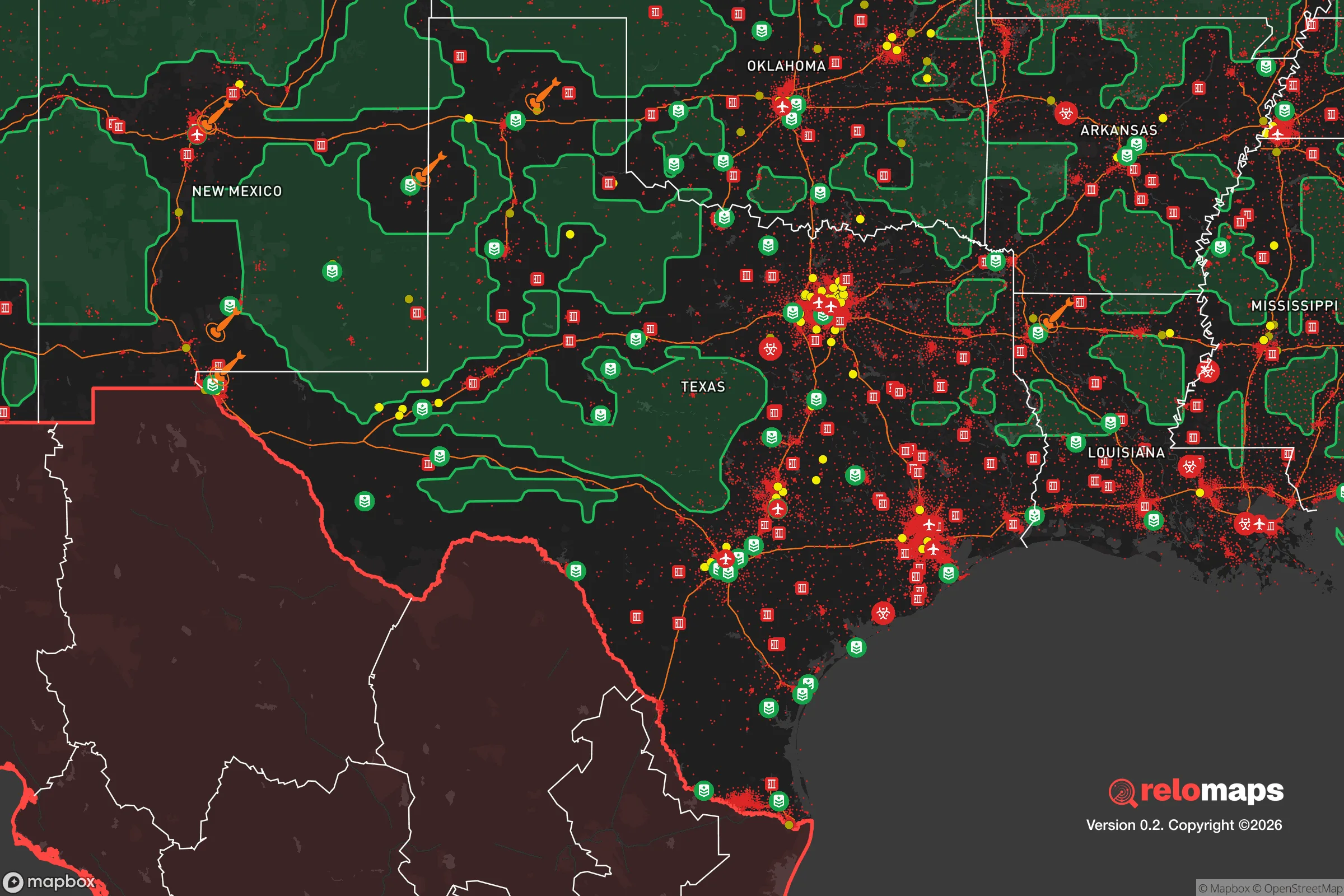


Important Note: For informational purposes only. This does not mean nothing bad ever happens in the green zones. Please use common sense. This is based on public data and modeled with AI. We tried to take a conservative approach but mistakes happen. We update this regularly as new information becomes available.
Solar Generator Recommendations
Backup power matters more here than in safer locations. We've picked three solar generators across budgets and capacity tiers — start with the budget unit if you only need a few essentials, or step up if you want to run a fridge and HVAC for days at a time.

Jackery Portable Power Station Explorer 300
Budget OptionPower on the Go: Weighing only 11 lbs, it's convenient to set up and store with book-sized foldable solar panels

BLUETTI Portable Power Station AC180
Designed for both indoor and outdoor scenarios, AC180 is highly capable as it has a robost capacity and continuous output power.

EF ECOFLOW DELTA Pro Ultra Power Station
Upgraded PickEcoFlow DELTA Pro Ultra is a whole-home energy system designed to grow with your family. Integrated with the Smart Home Panel 2, it scales to meet your evolving energy needs — keeping your home powered, intelligent, and secure through every stage of life.
We earn a commission, at no additional cost to you.
Strategic Assessment Analysis
Denison, Texas, sits in a strategic sweet spot that few relocators fully appreciate: close enough to the economic engine of the Dallas-Fort Worth metroplex to access jobs and supply chains, yet far enough north—tucked against the Red River and the Oklahoma border—to offer genuine geographic buffer from the worst-case scenarios of urban collapse, civil unrest, or a major disaster. This isn't a bug-out bunker in the middle of nowhere; it's a functioning small city (population roughly 25,000) with a historic downtown, a growing industrial base, and a layout that gives a prepared individual or family real options for self-sufficiency without forcing them into total isolation. For a conservative-leaning audience thinking about where to plant roots when the world gets shaky, Denison deserves a hard look—not as a fantasy retreat, but as a defensible, resource-rich position with manageable risks.
Geographic position and natural advantages: why this corner of Texas works
Denison’s location at the northern tip of the Texoma region is its primary strategic asset. The city sits on the southern shore of Lake Texoma, one of the largest reservoirs in the United States, holding over 2.5 million acre-feet of water. That’s not just a recreation amenity—it’s a reliable, long-term freshwater source that most of North Texas would kill for in a prolonged drought or infrastructure failure. The Red River forms the northern boundary, and while it’s not drinkable without treatment, it adds another layer of water security. The surrounding terrain is rolling hills and mixed hardwood forest, not flat prairie—meaning better natural cover, more wood for fuel or construction, and less exposure to tornadoes than areas further west. The climate is humid subtropical, with hot summers and cold winters, but the growing season runs about 230 days, long enough for serious gardening or small-scale farming. For a prepper, this is land that can actually produce food, not just store it.
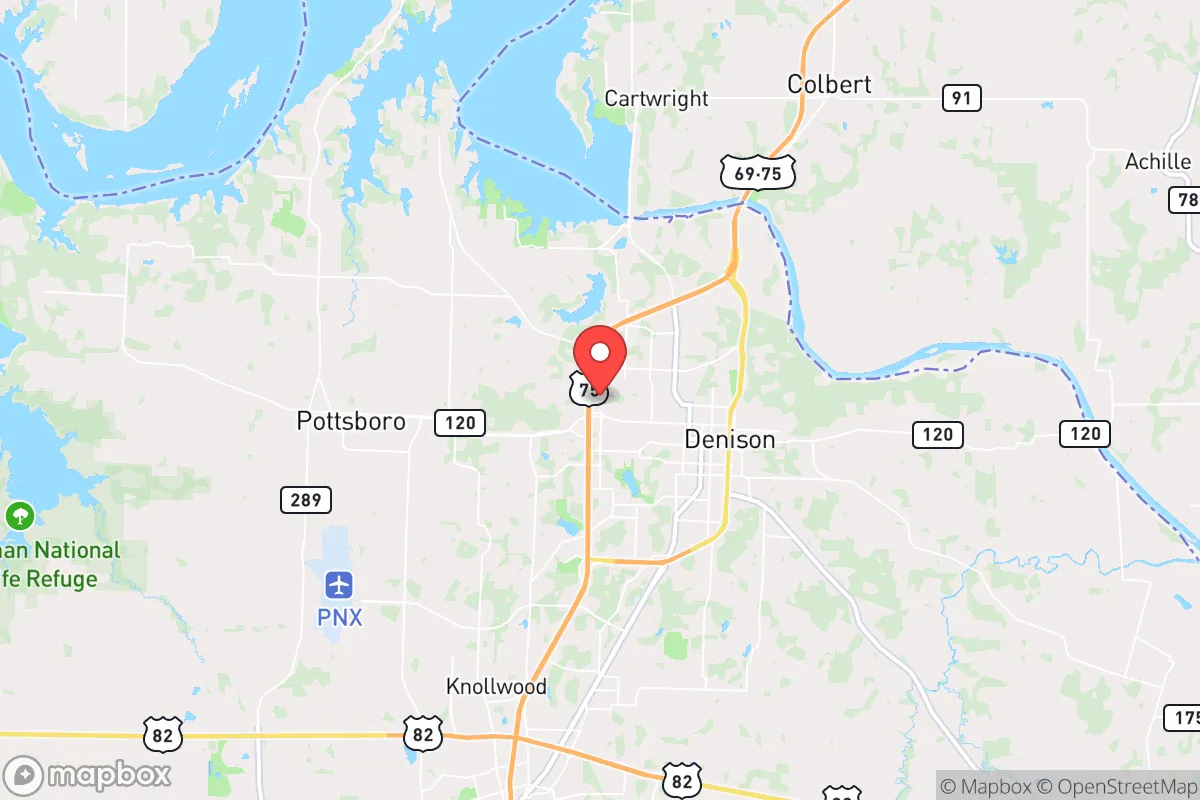
The city itself is laid out on a grid around a historic downtown, with residential neighborhoods spreading outward into rural subdivisions and acreage properties. U.S. Highway 75 runs straight through town, connecting Denison to Sherman (10 minutes south) and the Dallas metroplex (about 75 minutes south). That’s close enough for a supply run or a medical evacuation, but far enough that a riot in Dallas won’t spill into your front yard. The Denison Dam, which impounds Lake Texoma, is a critical piece of infrastructure—it generates hydroelectric power and controls flood flows, but it’s also a potential target. More on that below.
Risks, exposures, and proximity to fallout-relevant landmarks
No location is risk-free, and Denison has some hard realities a relocator must face. The most obvious is proximity to the Dallas-Fort Worth metroplex, a population center of over 7 million people. In a major civil unrest scenario—think widespread blackouts, food shortages, or a coordinated attack—that mass of humanity could become a desperate, mobile threat. Denison is far enough north to avoid the immediate crush, but it’s still within a day’s drive for anyone with a full tank of gas. The I-35 and US-75 corridors are natural chokepoints; a prepared individual should have a plan to monitor or block those routes if things go sideways.
More concerning is the proximity to critical infrastructure that could become fallout targets. The Denison Dam is a high-profile piece of critical infrastructure—if deliberately breached or sabotaged, it could release a catastrophic flood wave downstream, though Denison itself sits above the dam and would be largely unaffected. The real worry is the Pantex Plant near Amarillo (about 300 miles west), which assembles and disassembles nuclear weapons. That’s outside the immediate blast radius, but a major incident there could send a plume across the Texas Panhandle. Closer to home, the commercial airports in Dallas-Fort Worth and the rail yards in Sherman are potential targets for a coordinated attack. Denison is not in a primary target zone, but it’s within the secondary fallout footprint for a major event in the metroplex. A radiation detector and a supply of potassium iodide are not paranoid purchases here—they’re prudent.
Natural disaster risks are moderate. Tornadoes are a real threat, though the area is less active than Tornado Alley proper. The 2015 tornado that hit nearby Cisco is a reminder that severe weather can strike anywhere. Flooding is localized around creeks and the lake shoreline. The biggest natural risk is probably extreme heat and drought, which can stress water supplies and agriculture. Lake Texoma’s massive volume mitigates this, but a multi-year drought could still create tension.
Practical resilience for a relocator: food, water, energy, and defensibility
For a family or individual serious about self-reliance, Denison offers a workable foundation. Water is the strongest card. Lake Texoma is a near-infinite supply, but you need a way to access it—a well on your property, a rainwater catchment system, or a permit to draw from the lake. The city’s municipal water comes from the lake, so a grid-down scenario would still leave you with a few days of pressure before pumps stop. A hand pump or generator-powered well is a smart investment. The Red River is also available, but its high salt and silt content make treatment more difficult—plan for reverse osmosis or distillation if you rely on it.
Food production is viable. The soil in Grayson County is a mix of sandy loam and clay, workable for gardens if amended. The growing season is long enough for two crop cycles of warm-season vegetables. Local farmers’ markets and co-ops exist, but a serious prepper should plan to grow their own staples—corn, beans, squash, and potatoes. Deer and wild turkey are abundant in the surrounding woods; hunting is a realistic protein source with a license. The Red River Valley also supports some small-scale livestock operations; chickens, goats, or a milk cow are feasible on 5-10 acres.
Energy resilience is mixed. The grid here is part of the Texas Interconnection, which is isolated from the rest of the country—a vulnerability that became obvious during the 2021 winter storm. Denison experienced rolling blackouts then, and it could happen again. Solar is a strong option: the area gets about 220 sunny days per year, enough for a decent off-grid array. Natural gas is available in town, but rural properties often rely on propane. A backup generator with stored fuel is almost mandatory. The Denison Dam’s hydroelectric plant is a local asset, but it’s grid-tied and not a personal backup.
Defensibility is about positioning, not walls. Denison’s layout—with the lake to the north, open farmland to the east and west, and the highway corridor to the south—means a prepared group could establish a perimeter if needed. The city itself is not a fortress, but rural acreage outside town offers natural chokepoints: narrow roads, creek crossings, and wooded ridges. A property with a good view of approach routes and a well-stocked armory is the ideal. The local Grayson County Sheriff’s Office and Denison Police Department are professional but small; in a widespread crisis, you cannot rely on them for protection. Community self-defense networks, like those forming in some rural Texas counties, are worth exploring.
The overall strategic picture for Denison as a relocation destination
Denison is not a prepper paradise—it’s a real town with real trade-offs. The proximity to the Dallas metroplex is both its greatest strength (access to jobs, healthcare, and supplies) and its greatest vulnerability (population pressure in a crisis). The water security from Lake Texoma is a genuine advantage that few inland locations can match. The risks from infrastructure targets are real but manageable with basic preparation. For a conservative-leaning individual or family who wants to be ready for the worst without dropping off the grid entirely, Denison offers a balanced position: defensible, resource-rich, and connected enough to function in normal times. The key is to buy property with a well, a garden plot, and a good view of the road—and to build relationships with neighbors who share your mindset. In a world that feels increasingly fragile, that’s about as solid as it gets.

* Values derived from national, state, county, city and local statistics and may differ in a specific area. Last updated: 2026-05-11T16:10:35.000Z
Narrative content on this page is AI-generated and may contain mistakes. Verify any details that matter before acting on them.
ReloMaps may earn a commission from affiliate links at no extra cost to you.

