 Popular
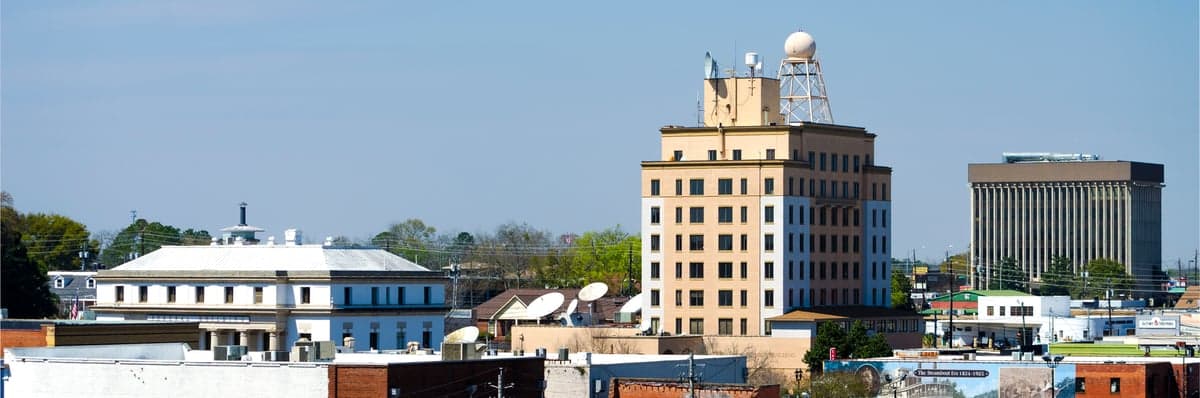
Photo: Wikipedia
Demographics of Dothan, AL
Affluence Level in Dothan, AL
A below-average socioeconomic profile. Incomes, home values, and educational attainment trail the U.S., with higher poverty and unemployment.
People of Dothan, AL
The people of Dothan, Alabama, today number 71,118, forming a city that is majority White (55.0%) with a substantial Black population (35.5%) and small but growing Hispanic (4.6%), East/Southeast Asian (0.9%), and Indian subcontinent (0.5%) communities. The foreign-born share is just 2.0%, well below the national average, giving Dothan a distinctly native-born, Southern character. With 27.3% of adults holding a college degree, the city sits below the national average in educational attainment, reflecting its historical roots in agriculture and manufacturing rather than a knowledge-economy base. Dothan’s identity is shaped by its role as the commercial hub of the Wiregrass region, a place where old-family roots run deep and newcomers are still a distinct minority.
How the city was settled and grew
Dothan was founded in 1885 as a railroad town, emerging from the intersection of the Alabama Midland Railway and the Vicksburg and Brunswick Railroad. The original population was overwhelmingly White settlers of English, Scots-Irish, and German descent who came from older Southern states—Georgia, the Carolinas, and Tennessee—drawn by cheap land for cotton farming and timber. The city was incorporated in 1898 and grew slowly as a trading center for the surrounding Wiregrass region, named for the tough native grass that supported cattle grazing. The first Black residents arrived as sharecroppers and domestic laborers during the post-Reconstruction era, settling in what became the Westgate and Dale County Line areas, neighborhoods that remain predominantly Black today. By 1900, the population was roughly 70% White and 30% Black, a ratio that held steady through the early 20th century as the city became a peanut-processing hub—earning the nickname “Peanut Capital of the World.” The Downtown Historic District was built by White merchants and professionals, while Black workers and their families concentrated in East Dothan, near the rail yards and peanut warehouses. No significant immigrant wave arrived during this period; Dothan remained almost entirely native-born White and Black until the late 20th century.
Modern era (post-1965)
The post-1965 era brought two major demographic shifts: the suburbanization of White residents and the slow diversification of the city’s ethnic makeup. After the Civil Rights Act and the end of legal segregation, White families began moving to newly developed subdivisions on the city’s west and south sides, particularly in West Dothan and the Houston County School District areas, leaving older central neighborhoods like Westgate and East Dothan increasingly Black. This pattern accelerated through the 1980s and 1990s, driven by school desegregation and the construction of the Ross Clark Circle, which opened new land for development. The Black population share rose from roughly 30% in 1970 to 35.5% today, reflecting both White out-migration to unincorporated areas and natural increase. The Hispanic population, now 4.6%, began arriving in the 1990s, primarily from Mexico and Central America, drawn by agricultural work in peanuts and cotton and later by construction and poultry processing. They settled mostly in East Dothan and along the Ross Clark Circle corridor, where affordable rental housing is concentrated. The East/Southeast Asian community (0.9%) is small and largely professional, with Vietnamese and Filipino families arriving after 2000, often employed in healthcare at Southeast Health Medical Center. The Indian subcontinent population (0.5%) is even smaller, composed mainly of doctors and engineers who settled near the hospital and in West Dothan subdivisions. The foreign-born share remains low at 2.0%, meaning nearly all growth has come from domestic migration—mostly White retirees from the Midwest and Black families from other parts of Alabama and Georgia.
The future
Dothan’s population is likely to continue growing slowly, driven by domestic in-migration rather than international immigration. The city is not homogenizing into a single melting pot; instead, it is tribalizing along geographic and racial lines. White residents are increasingly concentrated in West Dothan and the unincorporated areas beyond the Ross Clark Circle, while Black residents remain anchored in Westgate, East Dothan, and central neighborhoods. The Hispanic community is growing but from a small base, and its members are dispersing into existing Black and White neighborhoods rather than forming a distinct ethnic enclave. The East/Southeast Asian and Indian communities are too small to create visible ethnic neighborhoods and are likely to assimilate into the professional class. Over the next 10-20 years, Dothan will remain a predominantly native-born, biracial Southern city with a thin layer of ethnic diversity. The college-educated share may rise slowly as the medical and aerospace sectors expand, but the city will not transform into a cosmopolitan hub. For a newcomer, Dothan offers a stable, family-oriented environment where community ties are strong but where racial and economic divisions remain visible in the geography of the city.
Dothan is becoming a more suburban, car-dependent city where old-line families and new arrivals coexist in separate spheres. For a conservative-leaning individual or parent, this means a place with low crime in the western suburbs, good public schools in the Houston County system, and a social fabric that values church, family, and tradition. The city’s demographic future is one of slow, steady growth with little disruption—a safe bet for those seeking a predictable Southern lifestyle.

* Values derived from national, state, county, city and local statistics and may differ in a specific area. Last updated: 2026-04-19T18:48:30.000Z
Narrative content on this page is AI-generated and may contain mistakes. Verify any details that matter before acting on them.
ReloMaps may earn a commission from affiliate links at no extra cost to you.

