 Popular
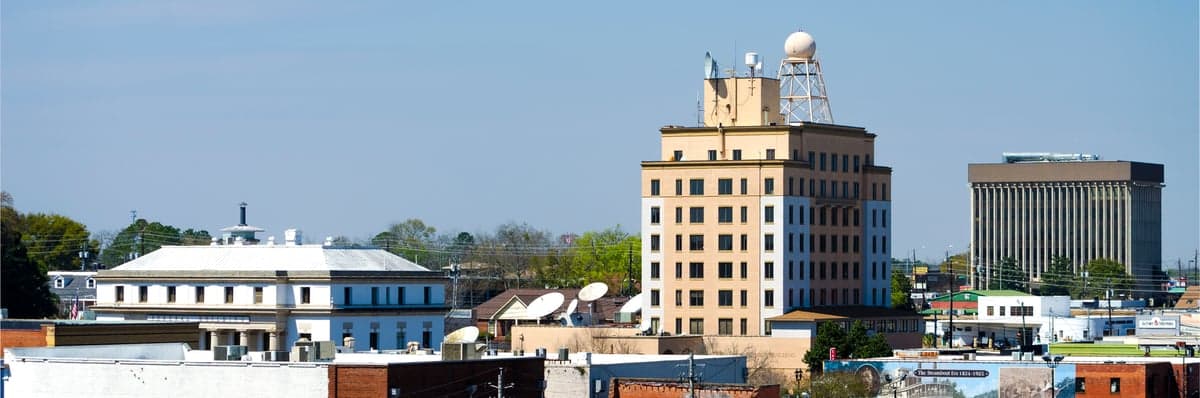
Photo: Wikipedia
Personal Sovereignty in Dothan, AL
Viable for self-reliance. Generally workable, though some barriers may limit total independence.
What does Personal Sovereignty tell us?
Personal Sovereignty measures your capacity for self-reliance and independence with minimal government friction. Higher scores mean fewer barriers between you and the way you want to live... but it assumes you have the space you need and good neighbors.
What does this tell us?
Personal Sovereignty measures your capacity for self-reliance and independence with minimal government friction. Higher scores mean fewer barriers between you and the way you want to live... but it assumes you have the space you need and good neighbors.
State Policy
Energy independence: Importer (45% of energy produced in-state)
Personal Liberty
Homesteading

Personal Liberty Analysis
For the individual or family prioritizing personal sovereignty—meaning the maximum possible control over your own life, property, and decisions—Dothan, Alabama, offers a notably favorable environment compared to most of the country. Nestled in the southeastern corner of the state, this city of roughly 71,000 operates under Alabama’s strong constitutional protections and a political culture that generally resists federal and state overreach. While no location is a libertarian utopia, Dothan’s combination of low taxes, permissive gun laws, minimal zoning, and a deeply rooted self-reliance ethos makes it a serious contender for those who view government expansion as a threat to individual freedom. The key is understanding where the rubber meets the road—where state law, local enforcement, and practical daily life intersect.
Tax burden and regulatory posture: How Alabama’s policies affect your wallet and autonomy
Alabama’s tax structure is designed to keep government’s hand out of your pocket as much as possible, and Dothan benefits directly. The state has no tax on Social Security benefits and offers a full deduction on retirement income for those 65 and older, which matters for preppers planning a long-term, low-tax retirement. The state income tax is a flat 5%, but the real win is property taxes: Alabama’s average effective property tax rate is just 0.33% of assessed home value, among the lowest in the nation. In Dothan, that means a $250,000 home carries an annual tax bill around $825. Compare that to states like Texas (1.6%) or New York (1.7%), and the difference over a decade is tens of thousands of dollars—money that stays in your hands for land, supplies, or investments. Sales tax in Dothan is 10% (state + local), which is high, but you can mitigate that by buying major prepper gear online or in bulk from out-of-state suppliers. On the regulatory side, Alabama is a “right-to-work” state with minimal business licensing requirements, and Dothan’s local government is generally hands-off. There are no city-level income taxes, no rent control, and no aggressive environmental regulations that would prevent you from building a workshop, storing fuel, or keeping livestock on your property. The state’s regulatory climate is consistently ranked in the top 10 for business freedom by the Mercatus Center, which translates to fewer bureaucratic hurdles for anyone wanting to start a side hustle, run a small farm, or operate a home-based defense training business.
Self-defense and gun law specifics: What Alabama’s permitless carry means for personal security
For those who view the Second Amendment as the bedrock of personal sovereignty, Dothan is a stronghold. Alabama is a constitutional carry state—no permit required to carry a concealed firearm for anyone 19 or older (18 for military members). This went into full effect in 2022 with the passage of HB 272, and local law enforcement in Dothan and Houston County generally respects this right. There are no magazine capacity restrictions, no “assault weapon” bans, and no red flag laws on the books. The state also has a “Stand Your Ground” law with no duty to retreat, which is critical for anyone serious about home defense or vehicle carry. Dothan’s gun culture is robust: there are multiple gun shops, indoor and outdoor ranges within a 30-minute drive, and a strong community of competitive shooters and hunters. The local sheriff’s office issues permits for those who still want one for reciprocity (Alabama honors permits from most states), but it’s not required for daily carry. For preppers, this means you can legally stockpile firearms and ammunition, train on your own land, and defend your property without worrying about arbitrary state-level restrictions. The only real limitation is that you cannot carry in a few specific places (courthouses, prisons, schools with posted signs), but these are standard exceptions. If your personal sovereignty model includes the ability to resist government overreach through armed self-defense, Dothan’s legal framework is about as permissive as you’ll find in the continental U.S.
Self-reliance and homesteading viability: Lot sizes, zoning, and off-grid feasibility in Dothan
True sovereignty often means reducing dependence on centralized systems—water, power, food supply chains. Dothan’s zoning and land-use policies make this more achievable than in most metro areas. Within the city limits, residential lots typically range from 0.25 to 1 acre, and many older neighborhoods have no HOA restrictions, allowing for vegetable gardens, chicken coops, and even small livestock like goats or rabbits (check local ordinances, but many areas allow it). Outside the city, in Houston County or neighboring Dale and Geneva counties, you can find 5- to 40-acre parcels for $3,000–$8,000 per acre—a fraction of what similar land costs in Florida or Georgia. Zoning in unincorporated areas is minimal: no building permits for agricultural structures under 1,000 square feet, no restrictions on rainwater collection, and no bans on composting toilets or septic systems. Off-grid solar is legal and encouraged; Alabama has net metering for grid-tied systems, but you can also go fully independent without penalty. The main challenge is water: Dothan sits on the Floridan Aquifer, which provides abundant groundwater, but drilling a well costs $5,000–$10,000. That said, many rural properties already have wells. For the serious prepper, you can buy a 10-acre plot with a well, septic, and a small house for under $150,000—then add solar panels, a wood stove, and a root cellar without any government interference. The local climate (mild winters, long growing season) supports year-round food production, and there are active farmers’ markets and seed exchanges that reduce reliance on grocery stores. The only regulatory hurdle is that Houston County does enforce some building codes for new construction, but they are less restrictive than in coastal or urban Alabama counties.
Personal liberties: Parental rights, medical autonomy, speech, and property protections
Alabama has become a national leader in protecting parental rights and medical autonomy, which directly impacts sovereignty. The state’s Parental Rights in Education Act (2022) ensures that parents have access to all school curricula and can opt their children out of any instruction they find objectionable. Dothan City Schools and Houston County Schools both have conservative school boards that generally defer to parental authority. On medical autonomy, Alabama has some of the strongest protections against vaccine mandates in the country—state law prohibits employers from requiring COVID-19 vaccines, and there is no state-level vaccine passport system. For those concerned about medical privacy, Alabama’s health information laws are aligned with HIPAA but with additional state-level protections against sharing data with federal agencies. Free speech is robust: there are no hate speech laws that criminalize political or religious expression, and the state has a “Right to Farm” law that protects agricultural activities from nuisance lawsuits—important if you plan to raise animals or run a small farm. Property rights are protected by Alabama’s strong eminent domain laws; the state cannot take your land for private economic development (a common abuse in other states). The main downside for the sovereignty-minded is that Alabama does have a state sales tax on groceries (4%), which feels like a regressive intrusion, but you can offset this by growing your own food. Also, the state’s medical marijuana program is very limited (only for a few conditions), so if you rely on cannabis for medical autonomy, you’ll need to consider the legal risks—though local enforcement in Dothan is generally lax on small amounts.
When you stack Dothan against other relocation options for the sovereignty-focused, it holds its own against Texas (higher property taxes, more urban sprawl), Tennessee (higher sales tax, more restrictive gun laws in some cities), and Florida (skyrocketing property insurance, more HOA restrictions). The main trade-offs are the high sales tax and the need to drive 90 minutes to the Gulf Coast for major medical specialists or international travel. But for the prepper or survivalist who wants a low-tax, low-regulation base where you can own guns, grow food, and raise a family without constant government interference, Dothan is a legitimate top-tier choice. The local culture—friendly but independent, religious but not theocratic—supports the kind of live-and-let-live attitude that personal sovereignty requires. Just be prepared for the humidity and the fact that you’ll need to drive to get anything done. That’s the price of freedom in the Wiregrass.

* Values derived from national, state, county, city and local statistics and may differ in a specific area. Last updated: 2026-04-19T18:48:30.000Z
Narrative content on this page is AI-generated and may contain mistakes. Verify any details that matter before acting on them.
ReloMaps may earn a commission from affiliate links at no extra cost to you.

