Photo: Wikipedia
Demographics of Douglas, AZ
Affluence Level in Douglas, AZ
A low-income area with significant economic hardship. Household wealth and educational attainment are well below national averages.
People of Douglas, AZ
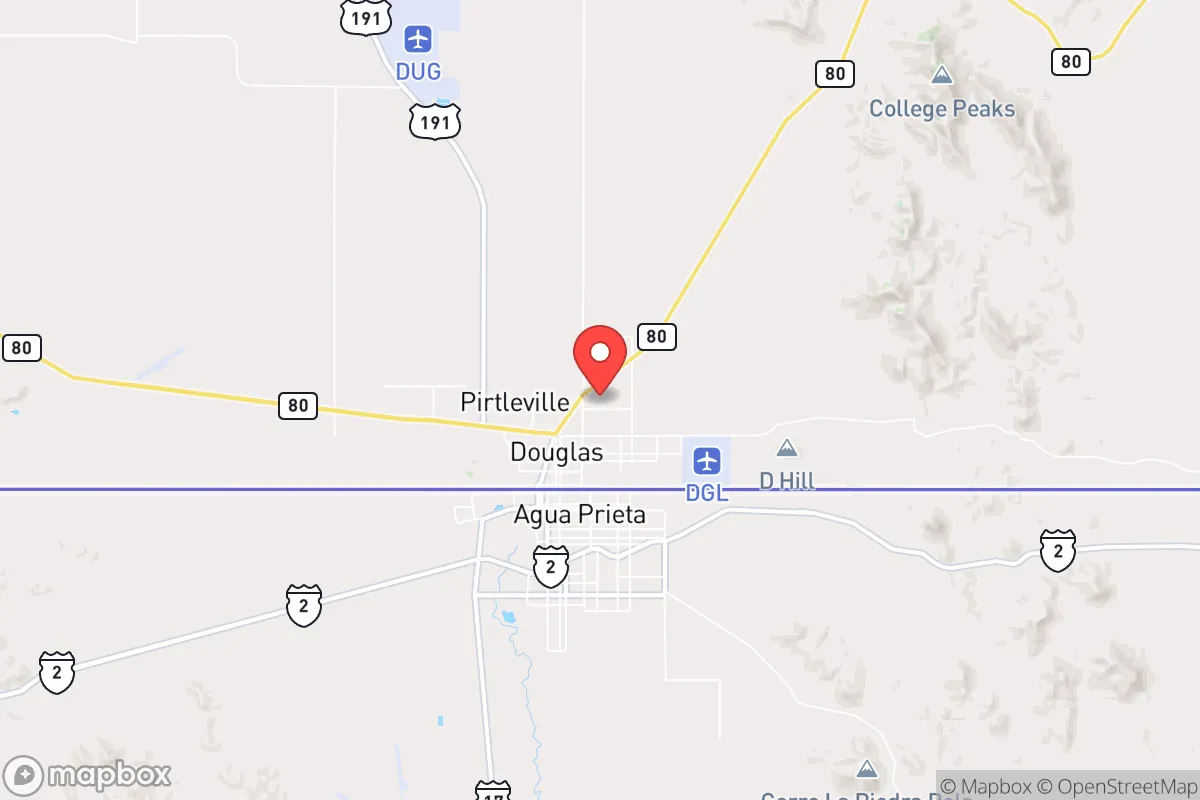
The people of Douglas, Arizona, today form a predominantly Hispanic community of 16,118 residents, with 83.5% identifying as Hispanic or Latino, 10.8% as White alone, and 2.8% as Black. The city is characterized by a strong binational identity, given its direct border with Agua Prieta, Sonora, and a relatively low foreign-born share of 10.0%—suggesting a population that is largely U.S.-born but deeply rooted in Mexican-American heritage. With only 11.3% of adults holding a college degree, Douglas remains a working-class border town where family ties, cross-border commerce, and a sense of historical continuity define daily life more than rapid demographic change.
How the city was settled and grew
Douglas was founded in 1900 as a company town for the Phelps Dodge Corporation’s copper smelter, which drew the first major wave of settlers: Mexican laborers recruited to work the smelter and nearby mines. These workers established the Chacón neighborhood, just south of the original townsite, as a densely packed barrio of adobe and wood-frame homes. A second wave arrived during the Mexican Revolution (1910–1920), when refugees fleeing violence crossed into Douglas and settled in Barrio Libre, a district that became a hub for Mexican exiles, political organizers, and working-class families. The smelter’s expansion through the 1920s brought Anglo-American managers and skilled tradesmen, who built homes in the Smeltertown area north of the railroad tracks—a physically separate enclave with larger lots and better infrastructure. By 1930, Douglas had grown to roughly 10,000 residents, with the Mexican-born population concentrated in Chacón and Barrio Libre, while Anglo families dominated Smeltertown and the newer North Douglas subdivision. The post-World War II era saw a third wave: Mexican-American veterans returning from service used GI Bill benefits to buy homes in South Douglas, a modest middle-class neighborhood that bridged the historic divide between the barrios and the Anglo north side.
Modern era (post-1965)
The 1965 Hart-Cellar Act ended the national-origins quota system, but Douglas’s population growth after 1965 came less from new immigration and more from natural increase and the gradual assimilation of existing Mexican-American families. The smelter’s closure in 1987 triggered an economic shock that accelerated out-migration among Anglo families, many of whom left for Sierra Vista or Tucson. This departure reshaped the city’s racial composition: the White share fell from roughly 40% in 1970 to 10.8% today, while the Hispanic share rose from about 55% to 83.5%. The neighborhoods that absorbed this shift were the older barrios—Chacón and Barrio Libre—which densified as extended families doubled up in existing homes, and the former Anglo stronghold of North Douglas, which saw an influx of Hispanic homebuyers seeking larger lots and newer housing stock. The Black population, at 2.8%, is small but stable, concentrated in a few blocks near the old railroad depot. The East/Southeast Asian share is 0.0%, and the Indian-subcontinent share is 0.2%, reflecting Douglas’s lack of the professional-class immigration that has diversified other Arizona cities. The foreign-born share (10.0%) is lower than the national average, indicating that the Hispanic population is overwhelmingly U.S.-born and English-proficient, with cross-border ties maintained through daily shopping and family visits to Agua Prieta rather than through new migration.
The future
Douglas’s population is likely to remain overwhelmingly Hispanic and working-class for the foreseeable future. The city is not homogenizing into a single enclave; rather, the historic neighborhood distinctions are fading as the Anglo population has largely left and the remaining White residents are scattered across North Douglas and the newer Douglas Heights subdivision, a small development of custom homes built since 2010. The immigrant community is plateauing: the foreign-born share has held steady at 9–11% for the past two decades, suggesting that new arrivals from Mexico are not replacing the aging first generation at a high rate. The college-educated share (11.3%) is low and unlikely to rise quickly, as the local economy—anchored by border trade, logistics, and a small hospital—does not attract knowledge workers. The next 10–20 years will likely see slow population growth (0.5–1% annually), continued out-migration of young adults to Tucson or Phoenix for better jobs, and a gradual aging of the population as the post-war generation retires in place. No significant Asian, Indian, or Arab influx is visible in the data, and the Black population is expected to remain a small minority.
Douglas is becoming a stable, culturally cohesive border town where the population is more rooted than transient. For someone moving in now, this means a community with deep family networks, low housing costs, and a slower pace of change—but also limited economic mobility, a small pool of college-educated peers, and a social environment where Spanish-language fluency and Mexican-American heritage are the norm. The city’s demographic future is one of continuity, not transformation.

* Values derived from national, state, county, city and local statistics and may differ in a specific area. Last updated: 2026-05-01T04:05:36.000Z
Narrative content on this page is AI-generated and may contain mistakes. Verify any details that matter before acting on them.
ReloMaps may earn a commission from affiliate links at no extra cost to you.

