
Photo: Wikipedia
Political ClimatePolitical Climate in Douglas, AZ
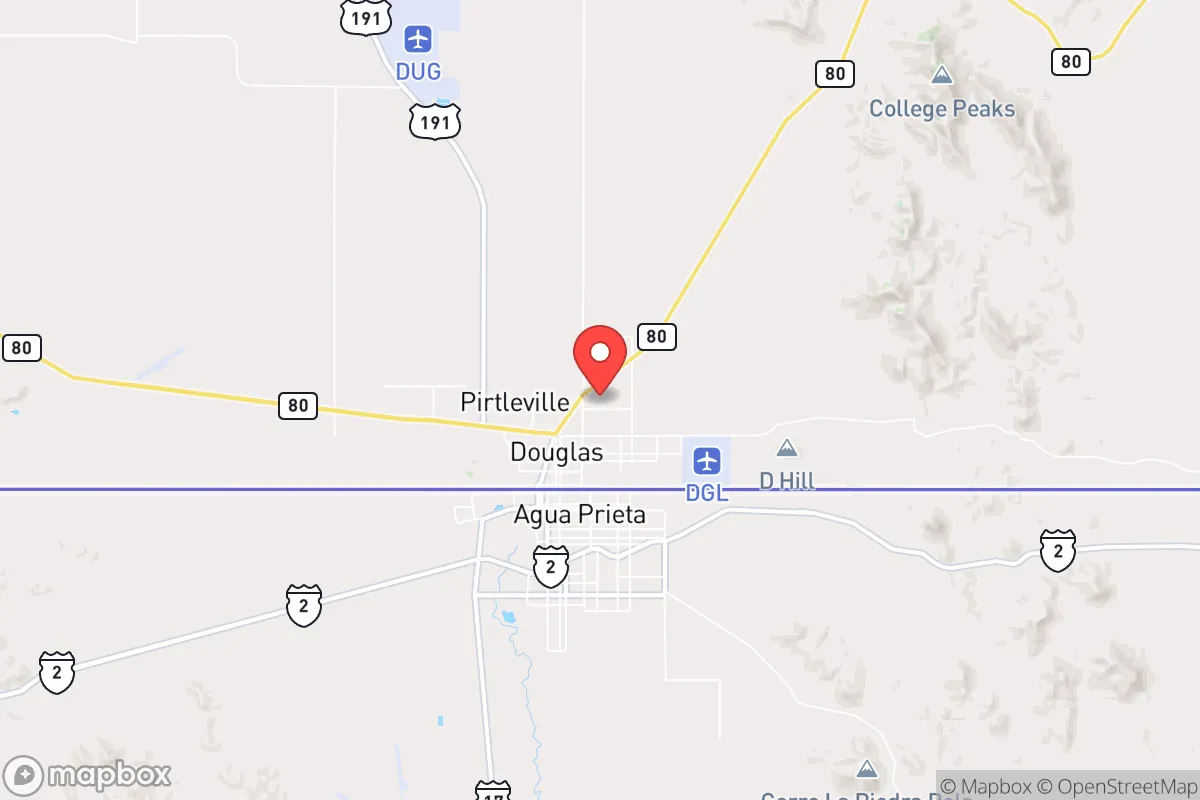
District shown is the primary district for this city’s centroid. Cities may span multiple districts.
Local Political AnalysisPolitical Analysis of Douglas, AZ
Look, I've been around Douglas my whole life, and I'll tell you straight: this town leans hard blue, with a Cook PVI of D+13, and it's been that way for a long time. But that doesn't mean it's the same place it was twenty years ago. Back then, you had a mix of old-school conservative Democrats and a strong ranching and mining crowd that kept things balanced. Now, the political winds are shifting, and not in a way that sits well with folks who value personal freedom and limited government. The local machine has gotten more progressive, and you can feel it in everything from zoning rules to how the schools talk to your kids.
How it compares
Drive twenty minutes north to Sierra Vista, and you're in a different world entirely. That town leans more Republican, with a strong military presence from Fort Huachuca that keeps things grounded in traditional values. Bisbee, just west of us, is even more liberal than Douglas, but in a different way—more artsy, more activist. Here in Douglas, the border reality keeps things practical, but the politics are still dominated by a party that seems to think more government is the answer to every problem. The contrast is stark: you can cross the street in some neighborhoods and feel like you're in two different countries politically.
What this means for residents
For a guy like me who just wants to be left alone, the growing progressive tilt is a real concern. You see it in the city council meetings where they talk about "equity" initiatives that sound a lot like picking winners and losers. Property taxes have crept up, and there's a push for more regulations on small businesses—things like mandatory paid leave and stricter building codes that hit mom-and-pop shops harder than the big chains. The school board has gotten more vocal about social issues, and parents who speak up are often dismissed as out of touch. If you value your Second Amendment rights or want to run a business without a dozen permits, you're going to feel the squeeze. The local government isn't hostile, exactly, but it's definitely not on your side.
On the flip side, the strong Democratic lean means federal and state funding flows here more easily than to redder areas. Infrastructure projects, healthcare clinics, and social programs get prioritized. But that comes with strings attached—more oversight, more mandates, more bureaucracy. It's a trade-off, and whether it's worth it depends on how much you trust the people in charge. I don't trust them much, and I've seen enough to know that once government gets a foothold, it rarely lets go.
What makes Douglas different
One thing that still sets Douglas apart is the border culture. We live with the reality of customs, immigration enforcement, and cross-border commerce every day. That keeps things grounded in practical concerns—jobs, safety, trade—rather than abstract ideology. But even that is changing. The old bipartisan consensus on border security has fractured. Now you've got local leaders pushing for more "sanctuary" policies, which worries folks who remember when the town was safer and more orderly. The cultural shift is subtle but real: less neighborly trust, more government programs, and a feeling that the people making decisions don't live like we do. If you're thinking of moving here, just know what you're getting into. It's not the Douglas I grew up in, and I'm not sure it's heading in a direction that respects the freedoms that made this country great.

State Political ClimatePolitical Climate in Arizona
State Political AnalysisPolitical Environment in the State
Arizona has transformed from a reliably Republican stronghold into a genuine battleground state over the past two decades, with its partisan lean shifting from a solid +8-point GOP advantage in 2004 to a razor-thin margin where Joe Biden won by just 10,457 votes in 2020 and Donald Trump reclaimed it by roughly 5 points in 2024. The state’s political landscape is now defined by a three-way tug-of-war between a growing conservative base in the exurbs and rural areas, a rapidly expanding progressive coalition anchored in Maricopa County’s urban core, and a shrinking but still influential moderate Republican bloc in places like Scottsdale and Paradise Valley. For a conservative considering relocation, the key takeaway is that Arizona is no longer a safe bet for red policies — it’s a state where every election feels like a knife fight, and the outcome depends heavily on which side turns out and which way the fast-growing Latino and transplant populations break.
Urban vs. rural divide
The political map of Arizona is essentially a tale of two worlds. Maricopa County, home to Phoenix, Mesa, Chandler, Gilbert, and Scottsdale, contains about 60% of the state’s population and has become the epicenter of the state’s swing-voter drama. The city of Phoenix itself leans left, with Democratic mayors and city council majorities since 2012, while the southeastern suburbs like Gilbert and Chandler have trended purple — Gilbert voted for Trump in 2024 but by a much narrower margin than a decade ago. Meanwhile, Pima County, anchored by Tucson, is a reliably blue stronghold where progressive activism runs deep, especially around the University of Arizona. The real red meat of Arizona conservatism lives in the rural counties: Yavapai (Prescott), Mohave (Kingman, Lake Havasu City), and Cochise (Sierra Vista) routinely vote 65-75% Republican. Pinal County, once solidly red, has become a fascinating bellwether — it flipped from +21 Trump in 2016 to +8 Trump in 2020, then back to +12 in 2024, reflecting the volatility of fast-growing exurban communities like Casa Grande and Maricopa. The divide isn’t just urban vs. rural — it’s also about transplants: California refugees often bring their politics with them, and while many move to conservative areas like Prescott Valley, a significant number settle in Phoenix’s central neighborhoods and tilt the balance leftward.
Policy environment
Arizona’s policy environment is a mixed bag for conservatives. On the plus side, the state has a flat income tax rate of 2.5% (down from 4.5% in 2021 thanks to Republican-led tax cuts), no state estate tax, and a right-to-work law that keeps unions weak. Property taxes are relatively low, with an effective rate around 0.62% of home value. The regulatory posture is generally business-friendly, especially compared to California, but local zoning battles in Phoenix and Tucson have become increasingly contentious over housing density and short-term rentals. Education policy is a flashpoint: Arizona was a pioneer in school choice with its Empowerment Scholarship Account program, which lets parents use state funds for private school or homeschooling — a huge win for parental rights. However, the state also saw a major teachers’ strike in 2018 (#RedForEd) that forced a 20% pay raise and has kept education funding debates alive. Healthcare is a mixed bag: Arizona expanded Medicaid under Obamacare (a sore point for many conservatives), but the state has also passed laws restricting abortion to 15 weeks (2022) and banning gender-affirming care for minors (2024). Election laws have been a rollercoaster: the state passed voter ID requirements and tightened mail-in ballot rules in 2022, but also has permanent early voting lists that make voting-by-mail the norm — something many conservatives distrust. The bottom line: Arizona is a state where conservatives have won some big battles (tax cuts, school choice, parental rights) but lost others (Medicaid expansion, permanent mail-in voting), and the fight over election integrity remains raw.
Trajectory & freedom
On the freedom front, Arizona has been a mixed bag trending in a concerning direction for conservatives. The good news: the state passed a constitutional carry law in 2010, meaning no permit is needed to carry a concealed firearm — that’s still intact and popular. The 2024 ban on gender-affirming care for minors was a major win for parental rights and medical freedom. Property rights are generally strong, with no state-level rent control and relatively weak homeowners’ association powers compared to California. But the trajectory is worrying. The 2022 “Clean Elections” commission remains active, and the state’s independent redistricting commission (created by voters in 2000) has drawn maps that have helped Democrats flip several legislative seats. The biggest freedom concern is the erosion of election integrity: despite the 2022 reforms, many conservatives remain skeptical of the permanent early voting list and the use of drop boxes, especially after the 2020 audit controversy in Maricopa County. Additionally, the state’s energy policy has shifted — the Arizona Corporation Commission, once reliably Republican, has flipped to a 3-2 Democratic majority, leading to accelerated renewable energy mandates that critics say will drive up electricity costs. The trend line is clear: Arizona is becoming less reliably free-market and more interventionist, especially on energy and election administration, and the pace of change is accelerating with each election cycle.
Civil unrest & political movements
Arizona has seen its share of political heat. The 2020 election aftermath was particularly intense in Maricopa County, where the Republican-led state Senate conducted a controversial “audit” of the county’s ballots that dragged on for months and became a national flashpoint for election integrity debates. Protests have been a recurring feature: the 2018 #RedForEd teacher walkout shut down schools for six days and drew thousands to the state capitol, while the 2020 Black Lives Matter protests in Phoenix turned violent on several occasions, with property damage and clashes with police. Immigration politics remain a defining issue — Arizona passed SB 1070 in 2010, the infamous “show me your papers” law, and while parts were struck down, the state remains a frontline in the border debate. The border crisis has fueled a resurgence of conservative activism in Cochise and Santa Cruz counties, with groups like the Arizona Border Patrol and local ranchers organizing patrols and reporting illegal crossings. On the left, the progressive group LUCHA (Living United for Change in Arizona) has been highly effective at voter registration and mobilization, particularly among Latino and young voters. There’s also a growing secessionist sentiment in rural counties — in 2021, the Cochise County Board of Supervisors voted to explore seceding from Arizona to join New Mexico or form a new state, though it was largely symbolic. The bottom line: Arizona is a state where political passions run hot, and newcomers should expect to see visible activism from both sides, especially around election time and the border.
Projection
Looking ahead 5-10 years, the trajectory for Arizona is concerning for conservatives. The state’s population growth is being driven disproportionately by Maricopa County’s urban and suburban areas, which are trending leftward as younger, more diverse, and more transplant-heavy populations move in. The Latino population, now about 32% of the state, is growing faster than any other demographic and leans Democratic by roughly 2-to-1. Meanwhile, the rural counties that anchor the GOP base are losing population or growing slowly. The 2024 election showed that Trump can still win Arizona, but the margin is thin and the demographic winds are blowing against the GOP. The state’s independent redistricting commission will likely continue to draw competitive maps, and the permanent early voting system is unlikely to be repealed. The most realistic projection is that Arizona remains a swing state for the next decade, but with a slow, steady drift toward the left — think of it as a slightly redder version of Nevada or Colorado. For a conservative moving in now, the expectation should be that your vote will matter more than ever, but the political environment will become increasingly hostile to traditional conservative values on issues like energy regulation, education curriculum, and election administration. The state is not yet lost, but it’s a battlefield, not a safe haven.
For a conservative considering relocation, Arizona offers a mixed bag: low taxes, strong gun rights, and school choice are real draws, but the political climate is volatile and trending leftward. You’ll find like-minded communities in Prescott, Kingman, and the rural exurbs, but you’ll also encounter aggressive progressive activism in Phoenix and Tucson. The practical takeaway is that Arizona is a state where your vote and your voice matter — but you’ll need to stay engaged, because the fight over the state’s direction is far from over. If you’re looking for a place where conservative values are deeply entrenched and unlikely to change, Arizona may disappoint. But if you’re willing to be part of the fight to keep it from sliding further left, it’s a state where you can make a real difference.
* Values derived from national, state, county, city and local statistics and may differ in a specific area. Last updated: 2026-05-01T04:05:36.000Z
Narrative content on this page is AI-generated and may contain mistakes. Verify any details that matter before acting on them.
ReloMaps may earn a commission from affiliate links at no extra cost to you.

