
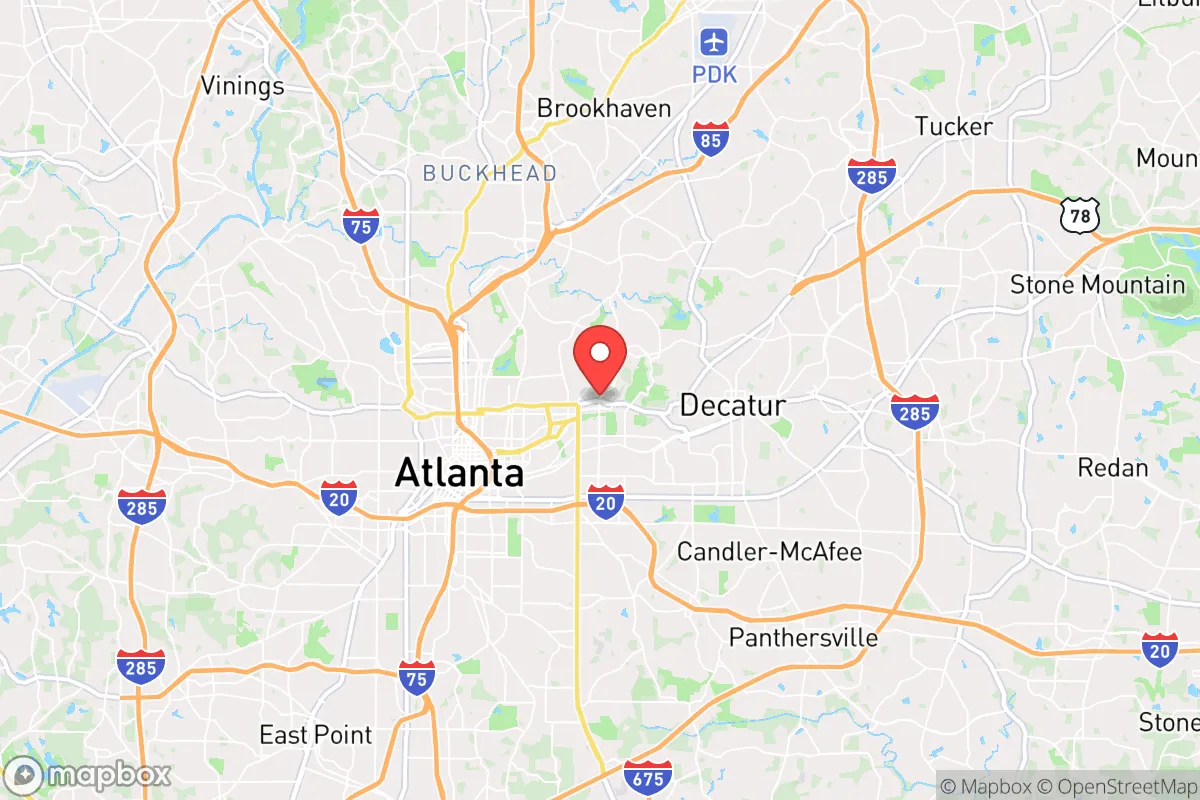
Photo: Wikipedia
Personal Sovereignty in Druid Hills, GA
Viable for self-reliance. Generally workable, though some barriers may limit total independence.
What does Personal Sovereignty tell us?
Personal Sovereignty measures your capacity for self-reliance and independence with minimal government friction. Higher scores mean fewer barriers between you and the way you want to live... but it assumes you have the space you need and good neighbors.
What does this tell us?
Personal Sovereignty measures your capacity for self-reliance and independence with minimal government friction. Higher scores mean fewer barriers between you and the way you want to live... but it assumes you have the space you need and good neighbors.
State Policy
Energy independence: Importer (12% of energy produced in-state)
Personal Liberty
Homesteading

Personal Liberty Analysis
Druid Hills, Georgia, offers a mixed bag for those prioritizing personal sovereignty, with the state’s generally pro-liberty legal framework clashing against the realities of a densely populated, historically progressive DeKalb County enclave. While Georgia’s constitutional carry law and low state income tax provide a baseline of autonomy, residents must navigate local zoning codes, a relatively high property tax burden, and the cultural and political pressures of a metro-Atlanta suburb. For the survivalist or prepper, Druid Hills is less a fortress of self-reliance and more a strategic compromise—close to resources but requiring constant vigilance against creeping government overreach and neighborhood association restrictions.
Tax burden and regulatory posture in DeKalb County
Georgia’s state-level posture is favorable for sovereignty-minded individuals: the state income tax is a flat 5.49% (as of 2026), and there is no state-level property tax on vehicles or intangible assets. However, DeKalb County imposes a combined property tax rate of roughly 1.4% to 1.6% of assessed value, which is among the highest in metro Atlanta. For a $500,000 home in Druid Hills, that translates to $7,000–$8,000 annually—a significant recurring cost that funds a county government many conservatives view as bloated and progressive. The regulatory environment is similarly double-edged: Georgia’s state preemption laws limit local governments from enacting stricter building codes or environmental regulations than the state baseline, but DeKalb County still enforces its own zoning ordinances, tree protection rules, and stormwater management fees. For the prepper, this means no county-level bans on rainwater collection or backyard chickens (both legal in unincorporated DeKalb), but you will face permitting hurdles for any major structural modifications like adding a root cellar or installing a large solar array. The county’s business license fees and occupational taxes are moderate, but the overall regulatory climate leans toward compliance rather than laissez-faire—expect paperwork, not outright prohibition.
Self-defense rights and gun law specifics in Druid Hills
Georgia is a constitutional carry state as of 2022, meaning any legal resident 21 or older can carry a concealed firearm without a permit. This is a bedrock advantage for personal sovereignty in Druid Hills. There is no state-level red flag law, no firearm registration, and no magazine capacity restrictions. However, DeKalb County is a blue jurisdiction with a district attorney (Sherry Boston, as of 2026) who has publicly emphasized “progressive prosecution” policies. While she cannot override state preemption on gun laws, local law enforcement may be less sympathetic to self-defense claims in ambiguous situations—such as a defensive display of a firearm during a property dispute. The county also has a history of high property crime rates (roughly 30% above the national average in the Druid Hills zip code 30307), which makes carrying a firearm a practical necessity for many residents. Stand-your-ground laws apply statewide, but the practical reality is that a self-defense shooting in DeKalb will face intense scrutiny from a DA’s office that has declined to prosecute certain non-violent offenses. For the prepper, the legal framework is solid on paper, but the local political climate demands careful documentation and avoidance of any confrontation that could be twisted into “aggression.”
Self-reliance and homesteading viability: lot sizes, zoning, and off-grid feasibility
Druid Hills is an older, established neighborhood with lot sizes typically ranging from 0.25 to 0.5 acres—enough for a substantial vegetable garden and a few fruit trees, but not for any meaningful livestock or long-term off-grid living. Zoning is primarily R-75 (residential, 7,500 sq ft minimum lot size), which permits chickens (hens only, no roosters) and beekeeping with a county permit, but prohibits pigs, goats, or cattle. The tree canopy ordinance in DeKalb County restricts removal of trees over 6 inches in diameter without a permit, which can complicate solar panel placement or the construction of a greenhouse. Off-grid feasibility is low: the area is fully serviced by Georgia Power, DeKalb County water and sewer, and natural gas lines. Disconnecting from the grid would require expensive battery storage and solar arrays that violate HOA covenants in many Druid Hills subdivisions. Rainwater collection is legal but limited to 500 gallons of storage without a permit, and the county’s stormwater utility fee (around $50–$100/year) discourages large-scale cistern systems. For the serious homesteader, Druid Hills is a compromise—you can grow your own tomatoes and keep a few hens, but you will remain dependent on municipal infrastructure and subject to HOA rules that often ban clotheslines, compost piles, and visible security cameras. The area is better suited for a “suburban prepper” who prioritizes community networking and food storage over true self-sufficiency.
Personal liberties: parental rights, medical autonomy, speech, and property
Georgia’s state-level protections for parental rights are strong: the Parental Bill of Rights (HB 1178, 2022) affirms that parents have the fundamental right to direct their children’s education, healthcare, and religious upbringing. This means Druid Hills parents can opt their children out of any school curriculum they find objectionable, including sex education or critical race theory content, without penalty. Homeschooling is straightforward—submit a declaration of intent to the county superintendent, teach 180 days a year, and maintain a portfolio. Medical autonomy is more contested: Georgia has no state-level vaccine mandate for adults, but DeKalb County schools and some private employers may require COVID-19 or other vaccinations as a condition of attendance or employment. The Right to Try Act and medical cannabis laws (limited to low-THC oil for specific conditions) exist but are narrow. Free speech protections are robust under the Georgia Constitution, and Druid Hills residents can display political signs, flags, or religious symbols on their property without county interference—though HOAs may impose restrictions on size and placement. Property rights are generally strong, but the county’s eminent domain authority has been used aggressively for transportation projects (e.g., the I-85 widening and the Clifton Corridor transit plan), and homeowners near proposed transit lines face the risk of condemnation. For the prepper, the key vulnerability is the HOA: many Druid Hills subdivisions have covenants that restrict everything from fence height to the color of your front door, and violations can lead to fines or liens. If you value absolute control over your property, look for a non-HOA lot—but those are rare and often more expensive.
Overall, Druid Hills offers a moderate level of personal sovereignty compared to other metro Atlanta suburbs. It is far more liberty-friendly than a city like San Francisco or Portland, but significantly less so than rural Georgia counties like Gilmer or Union, where property taxes are half as high, zoning is nearly nonexistent, and you can own 10 acres without an HOA. The trade-off is access: Druid Hills is 15 minutes from downtown Atlanta, with top-tier medical facilities (Emory University Hospital), a strong job market, and a community of like-minded individuals who value preparedness. For the strategic relocator, the calculus is clear: you gain Georgia’s constitutional carry, low state income tax, and parental rights, but you accept DeKalb County’s high property taxes, progressive local governance, and HOA restrictions. If your sovereignty requirements are absolute—off-grid living, no property taxes, no zoning—look elsewhere. If you want a defensible suburban base with legal protections and a network of fellow preppers, Druid Hills can work, provided you choose your specific lot and HOA carefully.

* Values derived from national, state, county, city and local statistics and may differ in a specific area. Last updated: 2026-04-23T05:05:30.000Z
Narrative content on this page is AI-generated and may contain mistakes. Verify any details that matter before acting on them.
ReloMaps may earn a commission from affiliate links at no extra cost to you.

