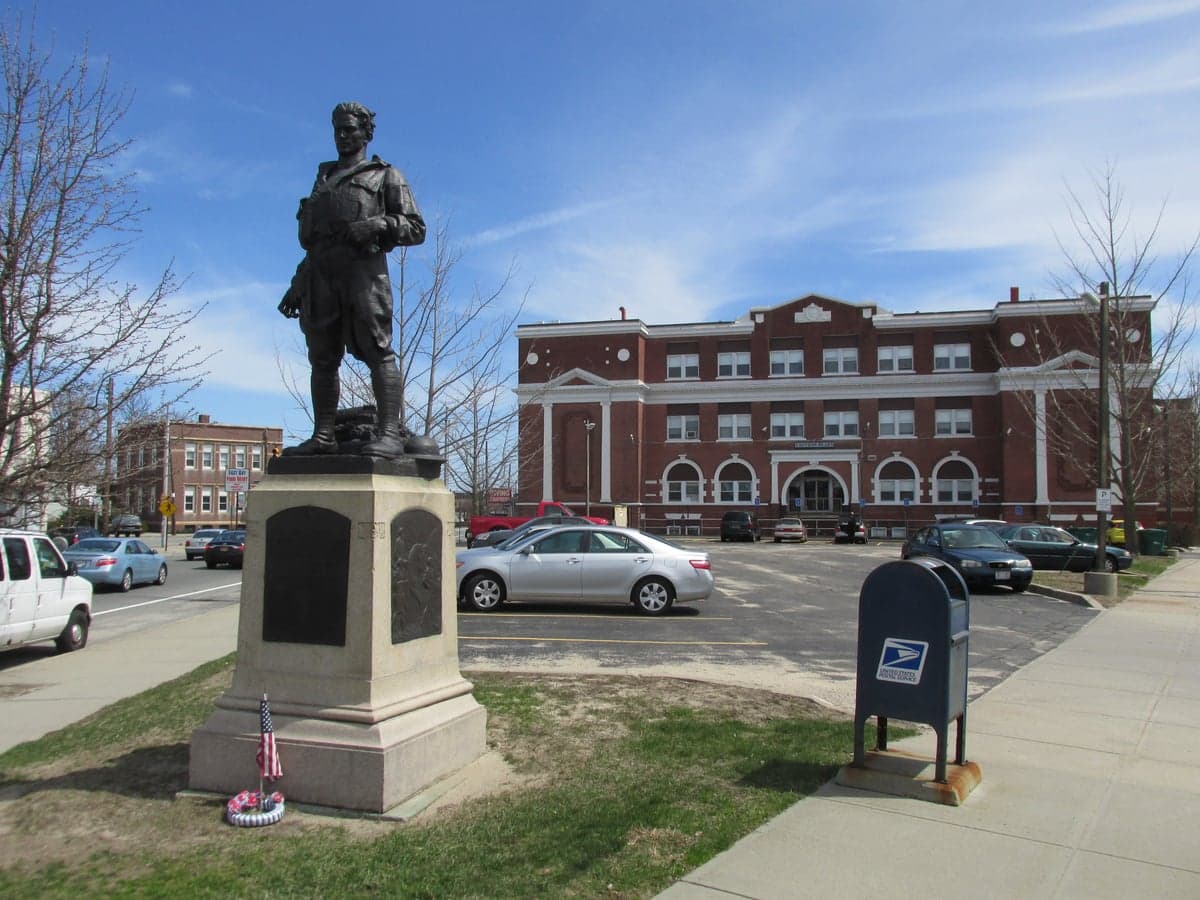
Photo: Wikipedia
Personal Sovereignty in East Providence, RI
Viable for self-reliance. Generally workable, though some barriers may limit total independence.
What does Personal Sovereignty tell us?
Personal Sovereignty measures your capacity for self-reliance and independence with minimal government friction. Higher scores mean fewer barriers between you and the way you want to live... but it assumes you have the space you need and good neighbors.
What does this tell us?
Personal Sovereignty measures your capacity for self-reliance and independence with minimal government friction. Higher scores mean fewer barriers between you and the way you want to live... but it assumes you have the space you need and good neighbors.
State Policy
Energy independence: Importer (1% of energy produced in-state)
Personal Liberty
Homesteading

Personal Liberty Analysis
East Providence, Rhode Island, presents a mixed picture for those prioritizing personal sovereignty, where the state’s historically progressive governance often clashes with individual autonomy. While the city offers proximity to Massachusetts and a lower cost of entry than Boston, residents must navigate a regulatory environment that leans heavily on state-level mandates, particularly in taxation, self-defense, and land use. For a survivalist or prepper mindset, the key question is whether the trade-offs—lower property taxes versus higher income taxes, or access to coastal resources versus restrictive gun laws—tip the scales toward or against self-reliance. The reality is that East Providence sits within a state that ranks among the most restrictive in the nation for personal freedoms, making it a location where strategic adaptation is essential rather than a natural fit for liberty-minded individuals.
Tax burden and regulatory posture: what it costs to live autonomously
Rhode Island’s tax structure is a significant drag on personal sovereignty, with the state imposing a progressive income tax rate that tops out at 5.99% on income over $155,050 (as of 2025), plus a flat 7% sales tax on most goods. East Providence’s property tax rate is roughly $16.50 per $1,000 of assessed value, which is moderate by Rhode Island standards but still higher than neighboring Massachusetts towns like Seekonk. For a prepper focused on financial independence, this means every dollar earned or spent is subject to multiple layers of state extraction. The regulatory posture is equally burdensome: Rhode Island has some of the strictest environmental and building codes in New England, particularly around coastal development and wetland buffers. This limits the ability to modify property without state permits—a direct constraint on self-reliance. The state also mandates a minimum wage of $15.00 per hour (2025) and requires paid family leave, which, while socially oriented, adds compliance costs for small businesses and side hustles that sovereignty-minded individuals often rely on. In short, East Providence’s tax and regulatory climate is a net negative for those seeking to minimize government entanglement.
Self-defense and gun law specifics: navigating a restrictive state
Rhode Island is a shall-issue state for concealed carry, but the process is far from straightforward. Applicants must complete a state-approved firearms safety course, submit fingerprints, and pass a background check that includes a mental health records review. The state also bans “assault weapons” under a 2022 law that defines them by feature (e.g., pistol grips, flash suppressors) and limits magazine capacity to 10 rounds for long guns and 10 rounds for handguns. This directly impacts preppers who value standard-capacity magazines for defensive or survival scenarios. East Providence itself has no additional local gun ordinances beyond state law, but the city’s police department has discretion in issuing the “blue card” required for firearm purchases—a process that can take weeks. Stand-your-ground laws do not exist in Rhode Island; instead, the state imposes a duty to retreat in public spaces before using deadly force, even if you are lawfully carrying. For home defense, the Castle Doctrine applies, but only if you are not the initial aggressor. These restrictions mean that self-defense planning in East Providence requires careful legal compliance, and any stockpiling of firearms or ammunition must account for state-imposed limits. For a survivalist, this is a significant downgrade from free states like New Hampshire or Texas.
Self-reliance and homesteading viability: lot sizes, zoning, and off-grid feasibility
East Providence is a densely developed suburban city with an average lot size of 0.15 to 0.25 acres in most residential zones, making large-scale homesteading impractical. Zoning codes restrict livestock to chickens only (hens, no roosters) on lots under one acre, and even then, you need a permit and must maintain a coop at least 25 feet from any dwelling. Off-grid living is essentially illegal: the city requires connection to municipal water and sewer systems, and solar panels must be grid-tied with net metering approval from National Grid. Rainwater collection is allowed but limited to 100 gallons per property without a permit, and composting toilets are not permitted as a primary sanitation method. For a prepper looking to reduce dependency on utilities, these regulations are a hard barrier. The city’s Community Development Department actively enforces property maintenance codes, meaning you cannot let your yard go “wild” for food production or privacy without risking fines. The silver lining is that East Providence has several community gardens and a farmers’ market, but these are communal solutions, not sovereign ones. If self-reliance means growing your own food, harvesting rainwater, and generating your own power, East Providence is a poor fit—you’d need to look to rural Rhode Island towns like Foster or Scituate for that.
Personal liberties: parental rights, medical autonomy, speech, and property
Rhode Island’s stance on parental rights is mixed. The state has a mandatory vaccination law for school attendance (with medical exemptions only, no religious or philosophical exemptions), which directly impacts parents who want to make independent health decisions for their children. Homeschooling is legal but requires annual notification to the local school district and submission of a curriculum plan—a level of oversight that some see as government overreach. On medical autonomy, Rhode Island has legalized recreational marijuana (since 2022) and allows medical aid-in-dying, but it also mandates COVID-19 vaccine requirements for healthcare workers and has broad public health emergency powers that were used to enforce lockdowns and mask mandates. Free speech is protected under the First Amendment, but the state has a “bias-motivated crime” statute that can be applied to speech deemed threatening or harassing, which some critics argue chills political expression. Property rights are constrained by the state’s Redevelopment Agency powers, which allow eminent domain for blight removal—a tool that has been used in East Providence for waterfront redevelopment projects. For a conservative-leaning individual, these factors create an environment where personal liberties are conditional on state approval, not inherent rights.
Overall, East Providence offers a low baseline for personal sovereignty compared to states like New Hampshire or Florida. The combination of high income taxes, restrictive gun laws, dense zoning, and state-mandated health policies means that a survivalist or prepper would need to operate within a tight legal framework. The city’s strategic location near Providence and Boston provides economic opportunities, but those come at the cost of constant regulatory friction. For someone willing to navigate these constraints—perhaps by living small, keeping a low profile, and investing in legal compliance—East Providence can be a workable base. But for those seeking maximum autonomy, the math leans heavily toward relocating to a state with fewer barriers to self-reliance.

* Values derived from national, state, county, city and local statistics and may differ in a specific area. Last updated: 2026-04-22T04:57:26.000Z
Narrative content on this page is AI-generated and may contain mistakes. Verify any details that matter before acting on them.
ReloMaps may earn a commission from affiliate links at no extra cost to you.

