Photo: Wikipedia
Demographics of Easton, PA
Affluence Level in Easton, PA
A below-average socioeconomic profile. Incomes, home values, and educational attainment trail the U.S., with higher poverty and unemployment.
People of Easton, PA
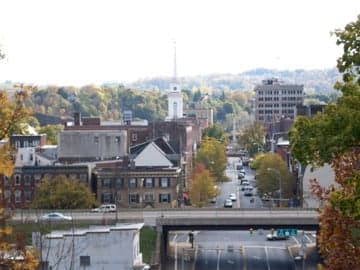
Easton, Pennsylvania, is a small, historically industrial city of 29,079 residents that retains a dense, walkable core and a working-class character distinct from its more affluent Lehigh Valley neighbors. Its population is notably diverse for a city its size, with a white population of 53.4%, a Hispanic community at 24.5%, and a Black population of 13.9%, creating a multi-ethnic fabric that is both a legacy of its industrial past and a driver of its current identity. The city feels older and more settled than many suburban developments, with a strong sense of neighborhood identity and a population that is less transient than in larger metro areas.
How the city was settled and grew
Easton’s population history begins with its founding in 1752 as a strategic trading post at the confluence of the Delaware and Lehigh Rivers. The original settlers were primarily of German and English stock, drawn by land grants from the Penn family and the promise of commerce along the river routes. The construction of the Lehigh Canal and the arrival of the railroad in the mid-19th century transformed Easton into a major industrial hub, attracting a wave of Irish immigrants who built the canals and railroads and settled in the West Ward, a neighborhood that remains a working-class entry point for new arrivals. By the late 1800s, the city’s iron, steel, and silk mills drew large numbers of Italian and Eastern European immigrants—Poles, Slovaks, and Hungarians—who established tight-knit communities in the South Side, a neighborhood defined by its rowhomes and proximity to the industrial plants along the river. These groups formed the backbone of Easton’s population through the mid-20th century, creating a city that was overwhelmingly white, Catholic, and union-oriented.
Modern era (post-1965)
The post-1965 era brought significant demographic change, driven by the decline of heavy industry and the opening of immigration from new regions. As the steel and textile mills closed in the 1970s and 1980s, many white ethnic families left for the suburbs of Forks Township and Palmer Township, creating vacancies in older neighborhoods. This exodus coincided with the arrival of Black families moving north during the Great Migration’s later waves, who settled primarily in the West Ward and parts of the Downtown area, where housing was affordable but aging. The most transformative shift, however, has been the growth of the Hispanic population, which now stands at 24.5% of the city. This community, predominantly of Puerto Rican and Dominican origin, began arriving in the 1990s and 2000s, drawn by low housing costs and existing social networks. They have concentrated heavily in the South Side, where Spanish-language storefronts and bodegas now line the main streets, and in the West Ward, where they have revitalized blocks that had seen decades of disinvestment. The foreign-born share of the population is 5.7%, a modest figure that reflects the fact that many Hispanic residents are U.S.-born citizens of Puerto Rican heritage. The East/Southeast Asian community (0.7%) and Indian subcontinent community (0.7%) are small but present, with families often drawn by professional opportunities at Lafayette College or local hospitals, and they tend to reside in the more affluent College Hill neighborhood, which overlooks the city and has a more suburban feel.
The future
Easton’s population is heading toward greater Hispanic plurality, with the white share (53.4%) declining steadily as the older, non-Hispanic white population ages out and younger Hispanic families have more children. The city is not homogenizing; rather, it is tribalizing into distinct enclaves, with the South Side becoming increasingly Hispanic, the West Ward remaining a mixed but predominantly minority area, and College Hill and the northern edges of the city retaining a whiter, more affluent character. The Black population (13.9%) has stabilized and is not growing rapidly, while the small Asian and Indian communities are likely to remain niche groups tied to specific employers. The next 10-20 years will likely see the Hispanic share approach or exceed 30%, making Easton one of the most Hispanic cities in the Lehigh Valley. This demographic shift is already reshaping local politics, schools, and small business ownership, but the city’s overall population has been relatively flat—it has not experienced the explosive growth seen in nearby Allentown or Bethlehem.
For someone moving in now, Easton is becoming a predominantly Hispanic-working-class city with a significant Black minority and a shrinking but still substantial white population. It is not a place of rapid gentrification or homogenization, but rather a city where distinct ethnic neighborhoods persist and where new arrivals will find a community that is dense, walkable, and deeply rooted in its industrial-era housing stock. The trade-off is a lower cost of living and a strong sense of place, but also a slower pace of economic opportunity compared to the broader Lehigh Valley suburbs.

* Values derived from national, state, county, city and local statistics and may differ in a specific area. Last updated: 2026-05-01T02:56:48.000Z
Narrative content on this page is AI-generated and may contain mistakes. Verify any details that matter before acting on them.
ReloMaps may earn a commission from affiliate links at no extra cost to you.

