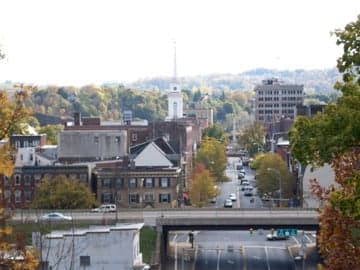
Photo: Wikipedia
Political ClimatePolitical Climate in Easton, PA
District shown is the primary district for this city’s centroid. Cities may span multiple districts.
Local Political AnalysisPolitical Analysis of Easton, PA
Easton, Pennsylvania, sits in a unique political spot. The city itself has a Cook PVI of R+1, meaning it leans just slightly Republican compared to the nation as a whole, but that number hides a lot of tension. For decades, this was a reliably blue-collar, conservative town—union Democrats who voted for Reagan and then for Trump. But over the last ten years, you’ve seen a real shift, especially in the downtown and college areas, as progressive activists and out-of-state transplants have pushed for policies that feel out of step with the values most of us grew up with. The trajectory is concerning: the old common-sense, live-and-let-live attitude is being replaced by a more activist, top-down approach to local government.
How it compares
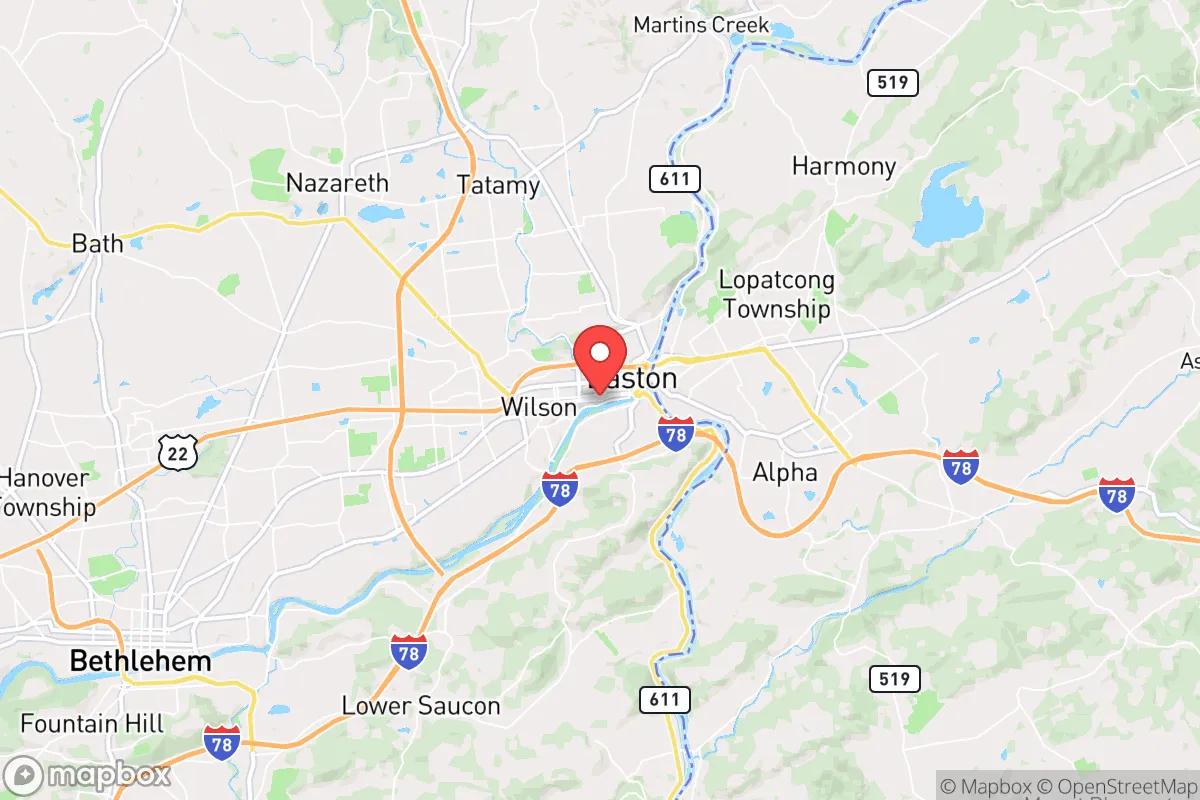
Drive ten minutes west to Bethlehem, and you’re in a city that’s gone solidly blue, with a Cook PVI of D+8. That’s where you see the full progressive playbook—higher taxes, more zoning restrictions, and a city council that’s all-in on symbolic resolutions that don’t fix potholes. Easton has held onto its R+1 lean partly because of the surrounding townships—Forks Township, Palmer Township, and Williams Township—where folks still believe in property rights and keeping government out of your business. But inside the city limits, the mayor’s office and city council have been flirting with the same kind of overreach: pushing for stricter rental inspections, trying to limit short-term rentals, and entertaining “equity” initiatives that sound good on paper but usually mean more bureaucracy and less freedom for homeowners and small landlords. It’s a stark contrast to the rural areas just north of here, like Bangor or Wind Gap, where the local governments still operate on a handshake and a prayer.
What this means for residents
For the average person living in Easton, the political climate directly affects your wallet and your daily life. Property taxes in Northampton County have been creeping up, and a lot of that is driven by mandates from Harrisburg and Washington, but also by local spending on programs that don’t seem to move the needle on the real problems—like the opioid crisis or the lack of good-paying jobs. The biggest red flag is the push for more government control over housing. If you own a duplex or a row home and want to rent it out, you’re facing a growing list of fees, inspections, and paperwork that didn’t exist ten years ago. It’s a slow erosion of personal freedom, justified as “protecting tenants,” but it really just makes it harder for regular folks to build wealth. The school board has also been a battleground, with debates over curriculum and library books that would have been unthinkable when I was a kid. The long-term worry is that if these trends continue, Easton will lose the very character that made it a great place to raise a family—affordable, independent, and free from constant government meddling.
Culturally, Easton still has a strong sense of community, especially around the farmers’ market and the State Theatre, but there’s a growing divide. The old-timers and the working families are being priced out or pushed out by newcomers who want to remake the city in their own image. The biggest policy distinction is that Easton has so far resisted the kind of sanctuary city status that Bethlehem and Allentown have embraced, which is a good sign. But the pressure is mounting, and the next few election cycles will tell you whether Easton stays a place where you can live your life without a government official looking over your shoulder, or whether it goes the way of its neighbors. Keep your eye on the school board races and the city council primaries—that’s where the real fight is.

State Political ClimatePolitical Climate in Pennsylvania
State Political AnalysisPolitical Environment in the State
Pennsylvania is a classic purple battleground that has drifted leftward over the past two decades, though it remains deeply divided. The state voted for Democrats in every presidential election from 1992 through 2012, then flipped to Donald Trump in 2016 by just 44,000 votes, then flipped back to Joe Biden in 2020 by about 80,000 votes. That razor-thin margin tells you everything: this is a state where the urban cores of Philadelphia and Pittsburgh dominate the statewide vote, but the sprawling suburbs and vast rural expanses are increasingly Republican. For a conservative considering relocation, the key question is whether the state’s trajectory favors your values or fights them at every turn.
Urban vs. rural divide
The political map of Pennsylvania is a tale of two worlds. Philadelphia and its collar counties—Montgomery, Delaware, Chester, and Bucks—are the engine of the Democratic vote. Philadelphia alone delivers about 600,000 Democratic votes in a close election, enough to offset massive Republican margins in the rest of the state. Pittsburgh and its Allegheny County base are similarly blue, though less extreme. The real story is the suburban shift: places like Bucks County (north of Philly) and Chester County (west of Philly) were reliably Republican as recently as 2004, but have flipped hard to Democrats due to an influx of college-educated professionals from the Northeast corridor. Meanwhile, the vast middle of the state—Lancaster County, York County, Franklin County in the south, and the entire northern tier from Bradford County to Tioga County—votes 65-75% Republican. The coal country around Scranton and Wilkes-Barre (Lackawanna and Luzerne counties) is a fascinating microcosm: historically blue-collar Democratic, these areas swung hard to Trump in 2016 and 2020, and now lean Republican. The Pittsburgh suburbs like Washington County and Westmoreland County are solidly red, while the city itself stays blue. So if you’re looking for a conservative-friendly area, you’ll find it in the central, northern, and southwestern rural counties—but you’ll be living in a state where the urban centers control the governor’s mansion and the legislature’s agenda.
Policy environment
Pennsylvania’s policy climate is a mixed bag for conservatives. The state has a flat income tax rate of 3.07%, which is relatively low and hasn’t changed in years—a rare bright spot. But the sales tax is 6% (8% in Philadelphia), and property taxes are among the highest in the nation, especially in the Philadelphia suburbs where school district taxes can exceed $5,000 per year on a modest home. The state has no right-to-work law, and union influence remains strong, particularly in the public sector and construction trades. Education policy is a flashpoint: the state’s school funding system was ruled unconstitutional in 2023, and the Democratic governor, Josh Shapiro, has pushed for more state funding to urban districts, which could mean higher taxes for suburban and rural homeowners. Election laws are a sore spot for conservatives: no voter ID requirement (though first-time voters must show ID), universal mail-in voting was expanded in 2019 under Act 77, and the state has no-excuse absentee voting. The 2020 election saw massive use of mail-in ballots, and the lack of signature verification has been a persistent concern. Gun laws are relatively permissive—no permit needed for open carry, and concealed carry is shall-issue—but Philadelphia and Pittsburgh have their own restrictive ordinances that the state legislature has tried to preempt. The regulatory environment is heavy: Pennsylvania has some of the strictest environmental regulations in the country, particularly for natural gas drilling (though the Marcellus Shale boom has been a huge economic driver). Overall, the state leans center-left on policy, with the legislature often passing conservative bills that get vetoed by the governor.
Trajectory & freedom
On the freedom front, Pennsylvania is trending in the wrong direction. The most concerning recent development is the expansion of mail-in voting under Act 77 in 2019, which was sold as a convenience measure but has become a permanent feature of elections. The state’s Supreme Court, controlled by Democrats 5-2, has repeatedly ruled against Republican challenges to election procedures, including a 2024 decision that allowed undated mail-in ballots to be counted. On parental rights, the state has not passed any major school choice expansion since the 2000s, and Governor Shapiro has resisted efforts to create Education Savings Accounts. Medical freedom took a hit during COVID: Pennsylvania had one of the longest-lasting school mask mandates in the country (until early 2022), and the state’s health department still has broad emergency powers that were used to shut down businesses. On gun rights, the state legislature passed a preemption bill in 2024 that would allow the state to sue cities that enact their own gun laws, but it was vetoed by Shapiro. The Second Amendment is under constant pressure in Philadelphia and Pittsburgh, where local officials push for red flag laws and magazine capacity limits. On the positive side, property rights are relatively strong—no statewide rent control, and the state has a robust right-to-farm law that protects agricultural operations from nuisance lawsuits. But the overall trajectory is one of slow, steady expansion of government control, driven by the urban vote.
Civil unrest & political movements
Pennsylvania has seen its share of political flashpoints. The 2020 election aftermath was intense: Trump’s campaign filed numerous lawsuits in the state, and there were protests at the Pennsylvania Convention Center in Philadelphia during the vote count. The January 6th Capitol riot had several Pennsylvania participants, and the state has been a hotbed of election integrity activism. On the left, Black Lives Matter protests in Philadelphia and Pittsburgh in 2020 were large and sometimes violent, with looting in Center City Philadelphia. The immigration debate is less visible here than in border states, but Philadelphia is a sanctuary city, and the state has seen a surge in migrant arrivals in 2023-2024, straining resources in the city. The fracking debate is a constant source of tension: environmental activists in Philadelphia and Pittsburgh push for a ban, while rural communities in the Marcellus Shale region (like Bradford County and Susquehanna County) depend on the industry for jobs. The parental rights movement has been active in school board meetings, particularly in Central Bucks School District (Bucks County), where debates over library books and transgender policies have been fierce. The Pennsylvania Freedom Caucus in the state legislature has been a vocal force for conservative policies, but they’re often stymied by the Democratic governor and the state Supreme Court.
Projection
Over the next 5-10 years, Pennsylvania is likely to continue its slow drift leftward, driven by demographic changes. The Philadelphia suburbs are becoming more diverse and more Democratic, while the rural areas are aging and losing population. The state’s population growth is stagnant—it’s projected to lose a congressional seat after 2030—and the growth that does occur is concentrated in the urban and suburban areas. The Marcellus Shale boom has peaked, and while natural gas will remain important, the industry is facing headwinds from federal regulations and a global shift toward renewables. The Democratic governor’s office is likely to remain in Democratic hands for the foreseeable future, given the state’s urban tilt in statewide elections. The state legislature is gerrymandered in favor of Republicans, but the state Supreme Court has been chipping away at that, and a new map after 2030 could shift the balance. For a conservative moving in now, expect to live in a state where your values are increasingly at odds with the state government, but where local control in rural and suburban counties can still provide a buffer. The key battlegrounds will be school boards and county commissions, where conservatives can still win and shape policy.
Bottom line for a new resident: If you’re a conservative looking to move to Pennsylvania, choose your county carefully. The rural and exurban areas—Lancaster County, York County, Franklin County, the northern tier—offer a lifestyle that aligns with your values, with strong communities, lower taxes, and a slower pace. But you’ll be living under a state government that is increasingly hostile to those values, and you’ll need to be engaged in local politics to protect your freedoms. The state’s purple status means every election matters, and your vote will count more here than in a deep red or deep blue state. Just be prepared for a fight—the urban machine is powerful, and it’s not going away.
* Values derived from national, state, county, city and local statistics and may differ in a specific area. Last updated: 2026-05-01T02:56:48.000Z
Narrative content on this page is AI-generated and may contain mistakes. Verify any details that matter before acting on them.
ReloMaps may earn a commission from affiliate links at no extra cost to you.

