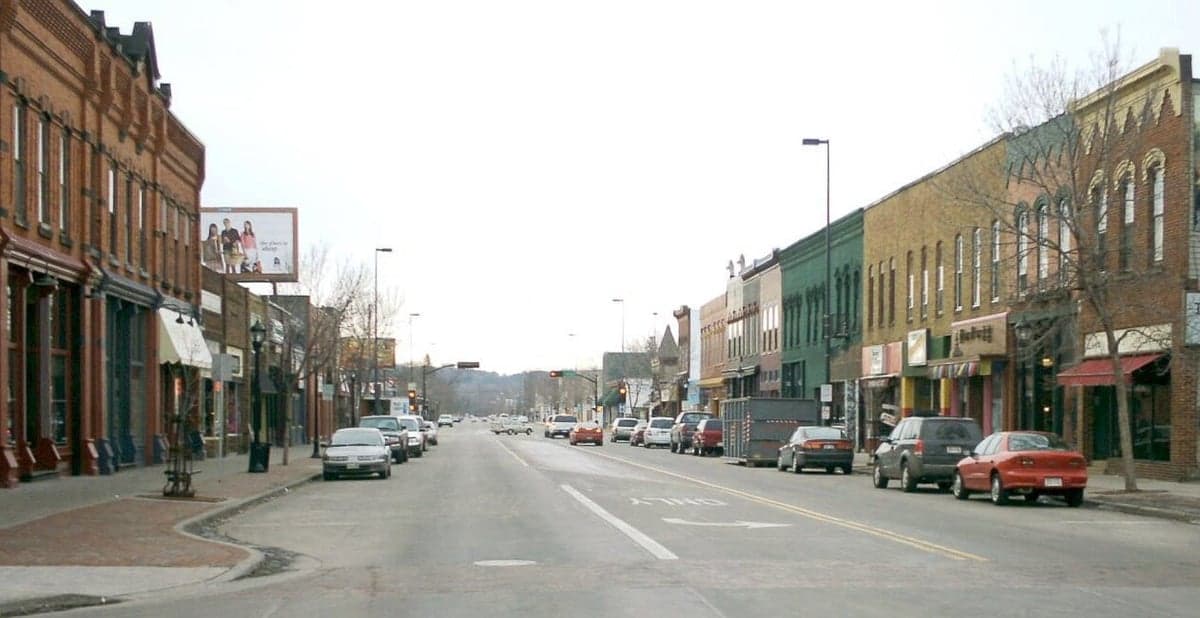
Photo: Wikipedia
Strategic Assessment of Eau Claire, WI
Workable tactical position. Some exposure to population density or targets, but generally defensible in a crisis.
What does the Strategic Assessment tell us?
Our Strategic Assessment grades tactical survivability of an area. Major population centers, military targets, fallout zones, natural disasters, and border exposure all drive risk — lower exposure means a more defensible position in a crisis.
This is heavily inspired by Joel Skousen's Strategic Relocation book. Highly recommended you checkout the book ($)What does this tell us?
Our Strategic Assessment grades tactical survivability of an area. Major population centers, military targets, fallout zones, natural disasters, and border exposure all drive risk — lower exposure means a more defensible position in a crisis.
This is heavily inspired by Joel Skousen's Strategic Relocation book. Highly recommended you checkout the book ($)Strategic Pillars

Key Distances
Regional Safe Places
Below is our recommended "safe zones" in Wisconsin and the surrounding area based on our strategic heuristics. For most people, it's unrealistic to live in a “safe zone” full-time due to work, family or other personal reasons. They tend to be more rural. However, many of these areas are perfect for second homes and retreat properties that double as a vacation home or even a short-term rental.
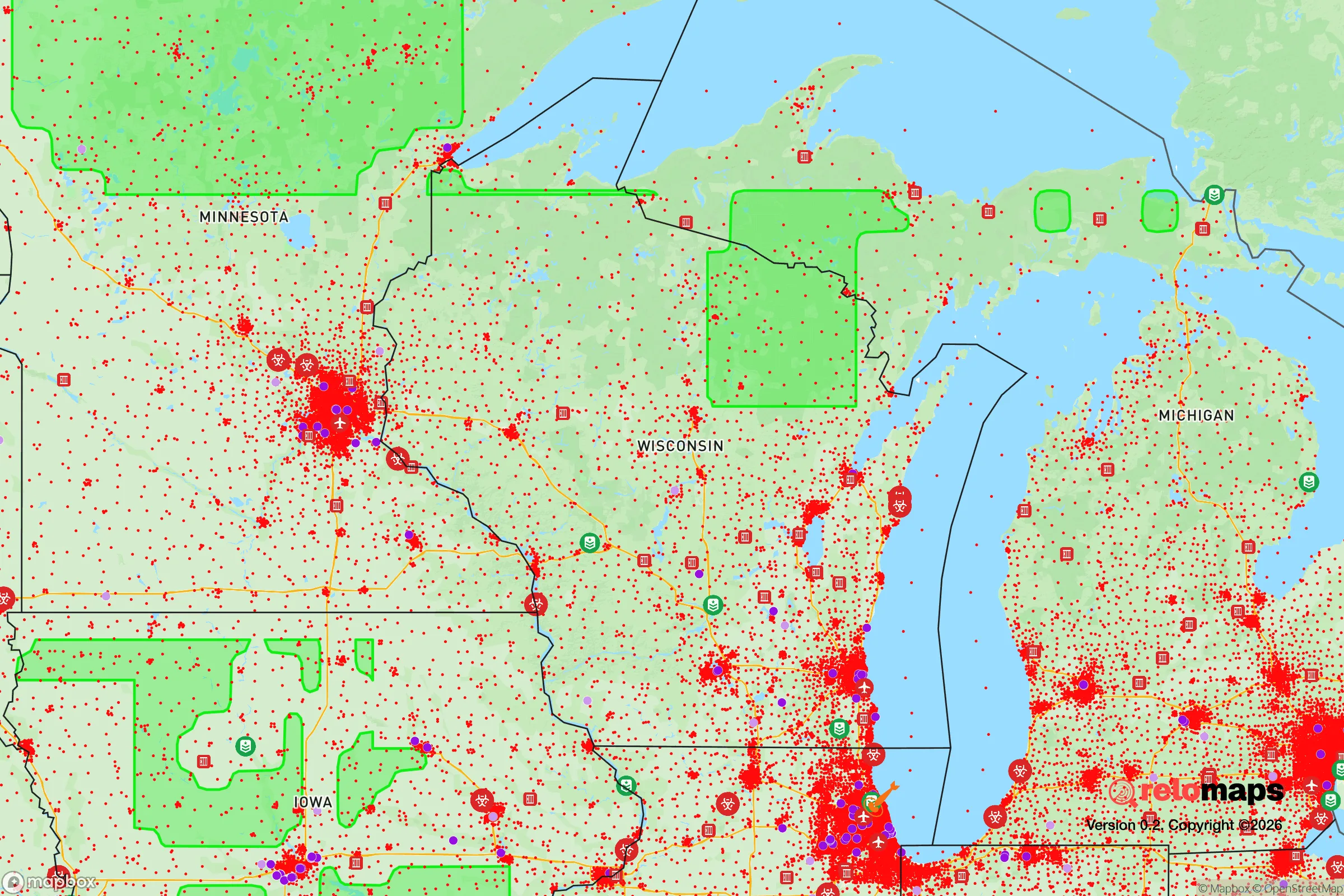
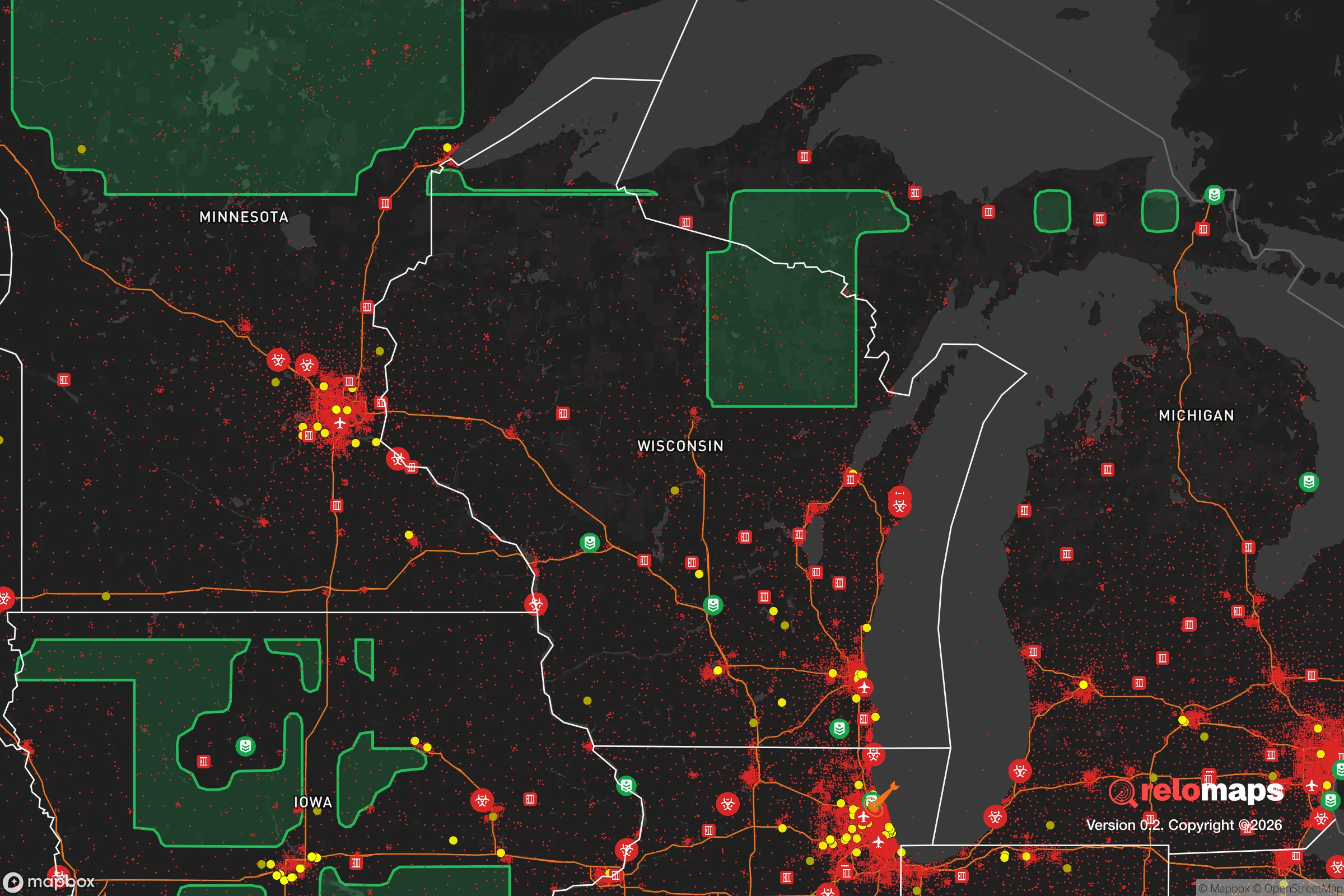


Important Note: For informational purposes only. This does not mean nothing bad ever happens in the green zones. Please use common sense. This is based on public data and modeled with AI. We tried to take a conservative approach but mistakes happen. We update this regularly as new information becomes available.
Solar Generator Recommendations
Backup power matters more here than in safer locations. We've picked three solar generators across budgets and capacity tiers — start with the budget unit if you only need a few essentials, or step up if you want to run a fridge and HVAC for days at a time.

Jackery Portable Power Station Explorer 300
Budget OptionPower on the Go: Weighing only 11 lbs, it's convenient to set up and store with book-sized foldable solar panels

BLUETTI Portable Power Station AC180
Designed for both indoor and outdoor scenarios, AC180 is highly capable as it has a robost capacity and continuous output power.

EF ECOFLOW DELTA Pro Ultra Power Station
Upgraded PickEcoFlow DELTA Pro Ultra is a whole-home energy system designed to grow with your family. Integrated with the Smart Home Panel 2, it scales to meet your evolving energy needs — keeping your home powered, intelligent, and secure through every stage of life.
We earn a commission, at no additional cost to you.
Strategic Assessment Analysis
Eau Claire, Wisconsin, offers a surprisingly resilient strategic position for those prioritizing long-term stability and self-sufficiency, combining a modest population with access to abundant freshwater and a location that sits outside the immediate blast zones of major metropolitan targets. While not a fortress, the Chippewa Valley region provides a buffer from the worst-case fallout scenarios that threaten coastal and major urban centers, making it a viable relocation option for those who value geographic insulation over economic dynamism. The city’s location at the confluence of the Eau Claire and Chippewa Rivers, coupled with its distance from the most likely national-level targets, gives it a baseline advantage that many Midwestern towns lack.
Geographic position and natural advantages for long-term stability
Eau Claire sits roughly 90 miles east of Minneapolis-St. Paul, placing it far enough from a major metropolitan area to avoid the immediate blast radius and primary fallout plumes of a nuclear event targeting the Twin Cities, yet close enough to have once benefited from its economic spillover. The city is surrounded by the rolling hills and hardwood forests of western Wisconsin, terrain that offers natural cover and defensible chokepoints along rural roads. The Chippewa River, a major tributary of the Mississippi, provides a reliable surface water source, and the region’s glacial aquifers mean groundwater is generally accessible and of decent quality. The climate, while harsh in winter, discourages mass migration from warmer zones and reduces the year-round pressure on resources that sunbelt cities face. For a relocator, the key takeaway is that Eau Claire sits in a sweet spot: far enough from the coasts to avoid sea-level rise and hurricane threats, far enough from the urban core to avoid the worst of civil unrest, but still connected to a regional infrastructure network that includes hospitals, rail lines, and Interstate 94.
Risks, exposures, and proximity to fallout-relevant landmarks
The primary strategic risk is Eau Claire’s proximity to the Twin Cities, which remains a high-value target for any adversary seeking to cripple the Upper Midwest’s economy and transportation hub. A ground burst on Minneapolis-St. Paul would send a radioactive plume northeastward, and while Eau Claire is far enough to avoid lethal acute doses, it could still face low-level fallout contamination depending on wind patterns. The city itself hosts a regional airport (Chippewa Valley Regional Airport) and a modest rail yard, but these are not likely primary targets. More concerning is the presence of the Xcel Energy coal and natural gas plants in the area, as well as the Menomonie wastewater treatment facility and the Eau Claire water treatment plant—both potential points of failure during a prolonged grid-down scenario. The region also sits within a few hundred miles of the Upper Peninsula’s nuclear power plants (e.g., the now-decommissioned Kewaunee plant and the active Point Beach plant), though these are not immediate threats. For the prepper, the real exposure is not a direct strike but the secondary effects: a surge of refugees from the Twin Cities along I-94, potential civil unrest in a city that leans left politically, and the strain on local resources if the national supply chain collapses.
Practical resilience for a relocator: food, water, energy, and defensibility
Eau Claire’s practical resilience hinges on its agricultural hinterland and water abundance. The surrounding Chippewa County is prime dairy and crop country, with ample small farms, orchards, and hunting land within a 30-minute drive. A relocator with a rural property can tap into well water, install solar panels with battery backup, and rely on wood heat from the abundant forests—all realistic options here. The city itself has a municipal water supply drawn from the Chippewa River, but a prepper should plan for filtration and storage, as the treatment plant is a single point of failure. Energy-wise, the region is served by Xcel Energy and local cooperatives, but grid reliability is average; winter storms can knock out power for days. Defensibility is moderate: the city’s layout is spread out, with neighborhoods separated by rivers and green space, making it hard to control but also hard to defend. The best bet is to buy land outside the city limits—say, in the towns of Seymour or Washington—where you can establish a homestead with good sightlines and limited road access. The local gun culture is strong, with multiple ranges and a high rate of firearm ownership, which is a plus for self-defense but also means you’re not alone in your preparations. Food storage is straightforward: the area has several bulk food co-ops, and the local Amish and Mennonite communities offer a reliable source of non-electric goods and skills.
The overall strategic picture for Eau Claire is one of cautious optimism for the survival-minded relocator. It is not a hardened bunker location like the Black Hills or the Idaho panhandle, but it offers a realistic balance of resource availability, distance from primary targets, and a community that, while not uniformly conservative, has a strong rural and self-reliant undercurrent. The biggest wildcard is the Twin Cities: if civil unrest or a major disaster triggers a mass exodus, Eau Claire could become a choke point for refugees, and the local infrastructure would buckle under the strain. For the single individual or family willing to invest in a rural property, water storage, and off-grid energy, this area provides a solid foundation for weathering the next decade’s uncertainties. Just don’t expect to be invisible—you’ll be one of many who saw the writing on the wall and moved north.

* Values derived from national, state, county, city and local statistics and may differ in a specific area. Last updated: 2026-04-21T10:10:02.000Z
Narrative content on this page is AI-generated and may contain mistakes. Verify any details that matter before acting on them.
ReloMaps may earn a commission from affiliate links at no extra cost to you.

