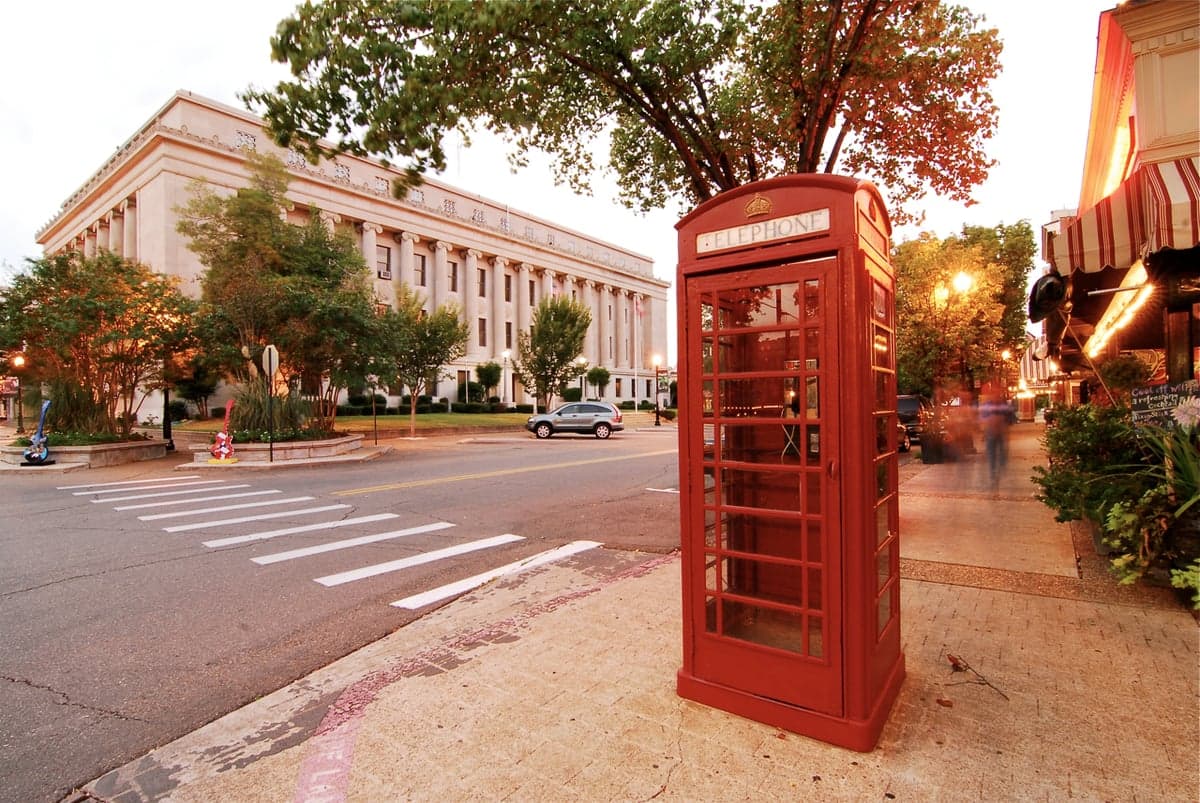
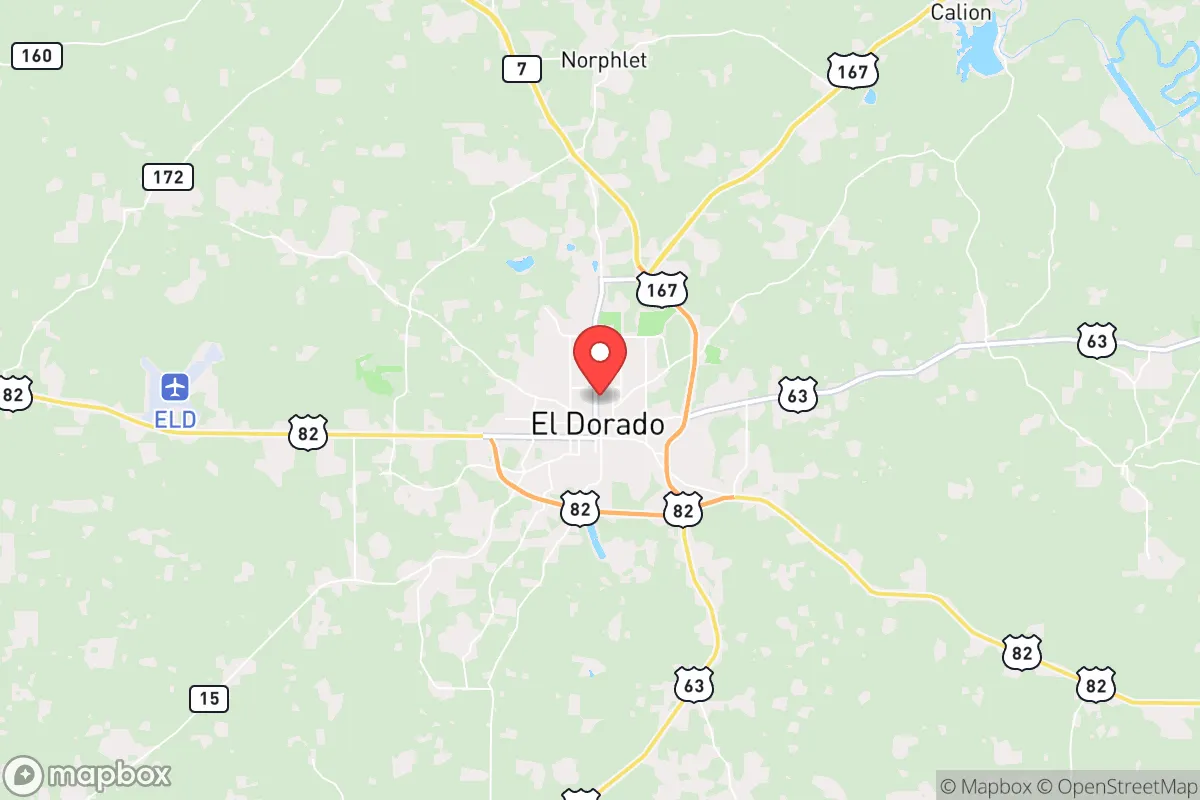
Photo: Wikipedia
Demographics of El Dorado, AR
Affluence Level in El Dorado, AR
A low-income area with significant economic hardship. Household wealth and educational attainment are well below national averages.
People of El Dorado, AR
El Dorado, Arkansas, is a city of 17,382 residents defined by a near-even Black (48.0%) and White (41.7%) population, a small but growing Hispanic community (5.9%), and a very low foreign-born rate of 2.4%. The city’s identity is rooted in its oil boom history and a subsequent long economic adjustment, producing a population that is older, less transient, and more rooted than the national average. With only 17.0% of adults holding a college degree, El Dorado’s workforce remains heavily tied to manufacturing, healthcare, and the remnants of the energy sector, giving the city a blue-collar, family-oriented character. The population is stable but aging, with little net in-migration from outside the region.
How the city was settled and grew
El Dorado was founded in 1843 as a small trading post, but its population exploded after the 1921 discovery of oil at the Busey Well, triggering one of the largest oil booms in U.S. history. The original white settlers, largely of Scots-Irish and English descent, built the early residential core in the Fairview and North West Avenue districts, establishing the city’s first churches and schools. The oil boom of the 1920s drew a massive wave of white migrant workers from Texas, Oklahoma, and the rural South, who settled in the Hillsboro neighborhood, a working-class area of small bungalows and boarding houses. African Americans, who had been present since the city’s founding as laborers and domestic workers, were largely confined to the East Side and South End neighborhoods, where they built their own commercial corridors, churches, and the historically Black Washington High School. By 1930, the city’s population had surged to over 16,000, but the boom collapsed just as quickly, leaving a legacy of boom-and-bust economic cycles that shaped the city’s cautious, insular character.
Modern era (post-1965)
After the 1965 Hart-Cellar Act, El Dorado saw very little new immigration—the foreign-born share remains under 2.5%—so the city’s demographic story is one of domestic migration and suburbanization. The post-1965 period saw white flight from the historic core to newly developed subdivisions like Westwood and College Heights, which were built on the city’s western edge and remain predominantly white and more affluent. Meanwhile, the Black population consolidated in the East Side and South End, where housing was older and less expensive, and where the city’s public housing projects were located. The small Hispanic community (5.9%) began arriving in the 1990s, drawn by work in poultry processing and timber, and settled primarily in the North El Dorado area, near the industrial parks. The East/Southeast Asian population (1.3%) is tiny and consists mostly of medical professionals at the Medical Center of South Arkansas, living in the College Heights area near the hospital. The Indian subcontinent population (0.3%) is negligible, largely composed of a few families in professional roles. The city’s population peaked at 25,270 in 1960 and has declined steadily since, as the oil industry mechanized and manufacturing jobs moved overseas.
The future
El Dorado’s population is projected to continue a slow decline, with the city aging and young adults leaving for college and jobs in Little Rock, Dallas, or Houston. The city is not homogenizing into a single identity; rather, it is tribalizing into distinct, stable enclaves: the white, more affluent Westwood and College Heights; the Black-majority East Side and South End; and the small Hispanic pocket in North El Dorado. The Hispanic share is growing slowly, but the foreign-born rate remains too low to drive significant cultural change. The Black and White populations are both aging and declining, with little intermarriage or residential mixing. The next 10-20 years will likely see the city shrink further, with the remaining population becoming older and more economically polarized between a small professional class and a larger working-poor base. There is no major immigrant gateway or new industry on the horizon to reverse the trend.
For someone moving in now, El Dorado offers a quiet, affordable, and deeply rooted community where neighborhoods are clearly defined by race and class, and where social life revolves around church, family, and local schools. The city is stable but not growing, and newcomers should expect a slow pace, limited diversity beyond the Black-White binary, and a population that is more likely to be leaving than arriving. It is a place for those seeking low cost of living and a known social order, not for those seeking demographic dynamism or rapid change.

* Values derived from national, state, county, city and local statistics and may differ in a specific area. Last updated: 2026-04-23T03:47:33.000Z
Narrative content on this page is AI-generated and may contain mistakes. Verify any details that matter before acting on them.
ReloMaps may earn a commission from affiliate links at no extra cost to you.

