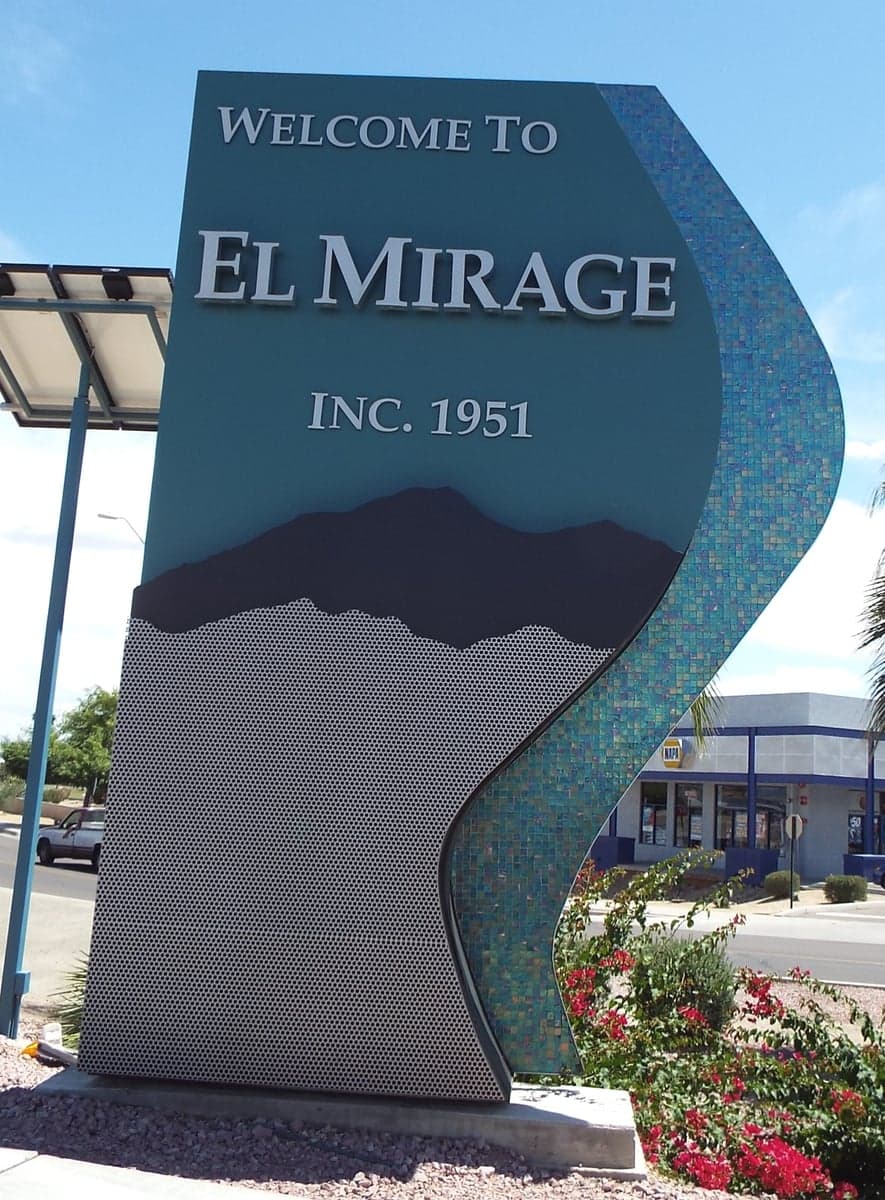
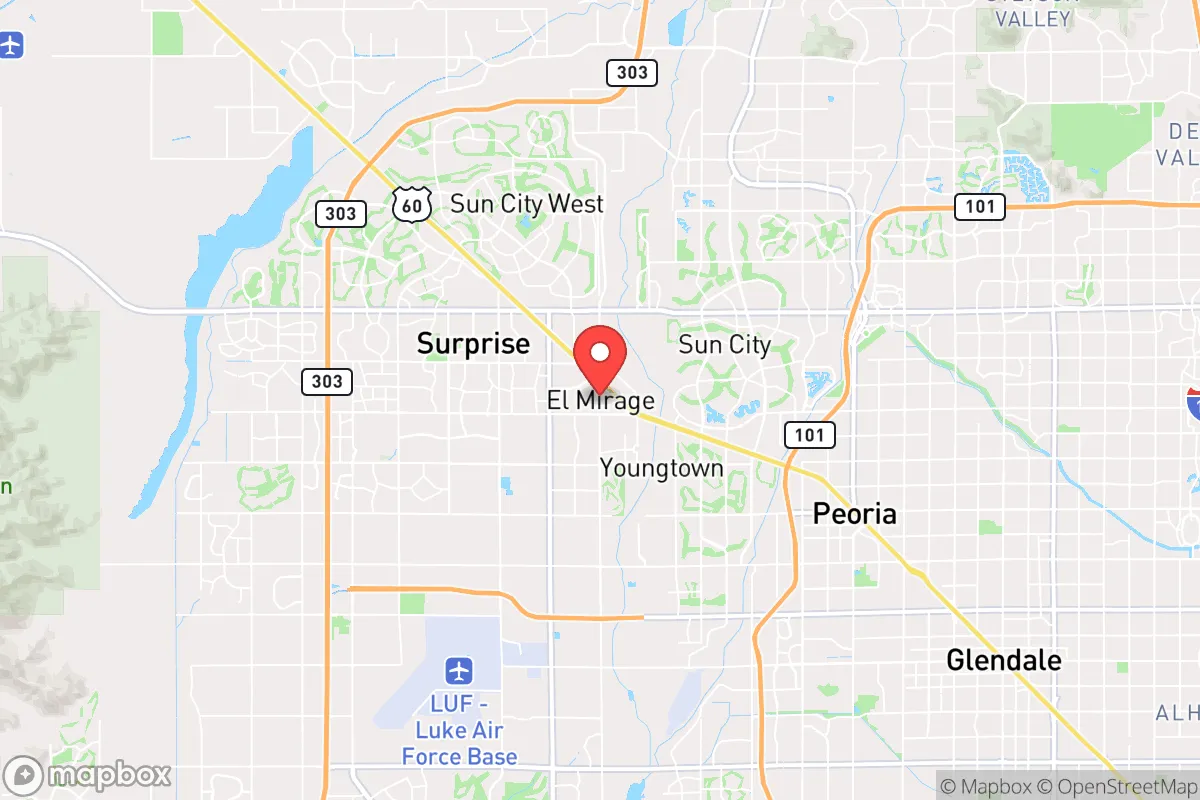
Photo: Wikipedia
Demographics of El Mirage, AZ
Affluence Level in El Mirage, AZ
A middle-class area roughly in line with national averages across income, home values, education, and employment.
People of El Mirage, AZ
The people of El Mirage, Arizona, today form a predominantly Hispanic (49.9%) and working-class community of roughly 35,823 residents, characterized by a young median age and a high rate of family households. The city is notably less diverse in its Asian and Indian populations than the broader Phoenix metro, with East/Southeast Asian residents at 0.5% and Indian-subcontinent residents at 0.2%. With only 14.9% of adults holding a bachelor’s degree, El Mirage remains a blue-collar suburb where manufacturing, logistics, and construction anchor the local economy, and where a strong sense of place is rooted in its agricultural and railroad past.
How the city was settled and grew
El Mirage was founded in 1901 as a railroad siding on the Santa Fe, Prescott and Phoenix Railway, named for the shimmering heat mirages common on the desert floor. The original settlers were Anglo-American farmers drawn by the promise of irrigated cotton and alfalfa fields, enabled by the construction of the Arizona Canal and later the Roosevelt Dam. These early families built homes in what is now the Historic Downtown El Mirage district, a compact grid of streets around the original depot. By the 1920s, a small Mexican-American community had formed, working as field laborers and living in the La Hacienda neighborhood south of the railroad tracks. The city incorporated in 1951, but remained a sleepy agricultural hamlet of fewer than 1,000 residents through the 1960s, with its population overwhelmingly white and native-born.
Modern era (post-1965)
The 1965 Immigration and Nationality Act, combined with the expansion of Phoenix’s suburban sprawl, transformed El Mirage after 1970. The city’s population surged from 1,200 in 1970 to over 15,000 by 2000, driven almost entirely by Hispanic migration. Mexican-American families from rural Arizona and northern Mexico moved into the Sun City West corridor (though technically outside El Mirage’s limits) and the El Mirage Estates subdivision, a master-planned community of single-family homes built in the 1980s. The 1990s saw a smaller but notable influx of Black families, many relocating from the West and South sides of Chicago for manufacturing jobs at the nearby Intel and Honeywell plants in Chandler and Phoenix. These families settled in the Thunderbird Village area, a newer development near the city’s northern edge. The Asian and Indian populations remained negligible throughout this period, reflecting the city’s lack of high-tech employment and its distance from the professional-class corridors of Scottsdale and Tempe. By 2020, the Hispanic share had risen to 49.9%, while the white share fell to 34.9%, and the Black share held steady at 6.1%.
The future
El Mirage’s demographic trajectory points toward continued Hispanic growth and a gradual homogenization of its ethnic enclaves. The city’s foreign-born share (7.0%) is below the national average, suggesting that the Hispanic population is increasingly native-born and English-dominant, which may accelerate assimilation into the broader working-class culture. The Rancho Mirage subdivision, a large master-planned community under construction since 2020, is attracting younger families of all backgrounds but remains overwhelmingly Hispanic in its buyer pool. The East/Southeast Asian and Indian populations are unlikely to grow significantly, as the city lacks the high-wage tech and biotech sectors that draw those groups to Chandler and Gilbert. The Black population is stable but not expanding, as most new Black arrivals to the Phoenix metro prefer the more established communities in Maryvale or Ahwatukee. Over the next 10-20 years, El Mirage will likely become a majority-Hispanic city of 50,000-60,000, with a small white minority concentrated in the older Historic Downtown and a thin scattering of Black and other groups across newer subdivisions.
For a conservative-leaning individual or family considering a move, El Mirage offers a stable, family-oriented environment where the population is becoming more culturally homogeneous even as its ethnic composition shifts. The city is not a melting pot of diverse enclaves but rather a working-class suburb where Hispanic culture and values—strong family ties, religious observance, and homeownership—are becoming the dominant norm. New arrivals should expect a community that is affordable, safe, and increasingly unified in its identity, but with limited exposure to the professional-class diversity found in other Phoenix suburbs.

* Values derived from national, state, county, city and local statistics and may differ in a specific area. Last updated: 2026-04-20T11:24:45.000Z
Narrative content on this page is AI-generated and may contain mistakes. Verify any details that matter before acting on them.
ReloMaps may earn a commission from affiliate links at no extra cost to you.

