Photo: Wikipedia
Demographics of El Paso, TX
Affluence Level in El Paso, TX
A below-average socioeconomic profile. Incomes, home values, and educational attainment trail the U.S., with higher poverty and unemployment.
People of El Paso, TX
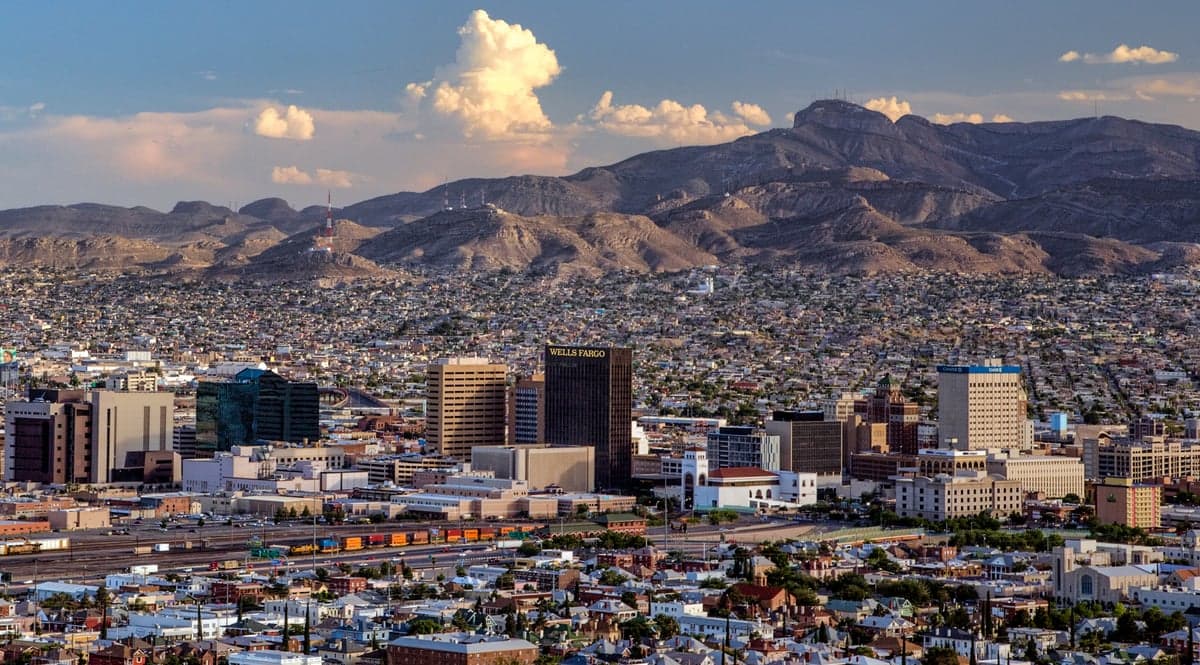
El Paso, Texas, is a city of roughly 678,000 residents where 81.3% identify as Hispanic, creating a distinctive bicultural identity that straddles the U.S.-Mexico border. The population is overwhelmingly native-born (89.9% U.S.-born), with a foreign-born share of 10.1% that is lower than many Texas border cities. Only 12.2% of residents identify as non-Hispanic White, while Black (3.1%), East/Southeast Asian (0.9%), and Indian subcontinent (0.4%) communities form small but established enclaves. With 27.5% of adults holding a bachelor’s degree or higher, El Paso is less college-educated than the national average, reflecting its historical role as a working-class industrial and military hub.
How the city was settled and grew
El Paso’s human history begins with the Manso, Suma, and Jumano peoples, but the modern city traces its founding to Spanish colonial settlement in 1659, when the Mission of Nuestra Señora de Guadalupe was established on the south bank of the Rio Grande (now Ciudad Juárez). The area remained a remote outpost through Mexican independence and the 1848 Treaty of Guadalupe Hidalgo, which placed the north bank under U.S. control. The real population boom came with the arrival of the Southern Pacific and Atchison, Topeka and Santa Fe railroads in the 1880s, which transformed El Paso into a major transportation and trade hub. Anglo-American merchants and railroad workers settled in the Chihuahuita neighborhood, the city’s oldest, while Mexican laborers crossed the border to build the rail lines and work in smelters, establishing the Segundo Barrio as a densely packed immigrant enclave. The 1910 Mexican Revolution drove tens of thousands of refugees north, solidifying the Hispanic majority that has defined the city ever since. By 1940, El Paso’s population was roughly 60% Hispanic, with Anglo residents concentrated in the Kern Place and Manhattan Heights neighborhoods near Fort Bliss, the U.S. Army post that became a major employer after World War II.
Modern era (post-1965)
The 1965 Immigration and Nationality Act ended national-origin quotas, but El Paso’s Hispanic share was already dominant and continued to grow through chain migration from northern Mexico. The 1970s and 1980s saw suburban expansion into the West Side (near the Franklin Mountains) and East Side (along Interstate 10), where upwardly mobile Hispanic families moved from older barrios into newer subdivisions. The non-Hispanic White population peaked around 1970 at roughly 25% and has since declined to 12.2%, as many Anglo families relocated to suburbs like Coronado Hills or left the city entirely for other Texas metros. The Black community, historically small, grew modestly with military assignments at Fort Bliss and settled primarily in the Northeast area near the base. East/Southeast Asian residents (0.9%) arrived mostly as professionals in healthcare and engineering, clustering near the University of Texas at El Paso and the medical district. The Indian subcontinent community (0.4%) is even smaller, concentrated among tech and medical workers in the West Side. The foreign-born share has actually declined from a peak of roughly 18% in 1990 to 10.1% today, reflecting reduced immigration from Mexico and assimilation of earlier waves.
The future
El Paso’s population is projected to grow slowly, reaching roughly 700,000 by 2030, driven by natural increase among the Hispanic majority rather than new immigration. The city is becoming more homogenously Hispanic, as non-Hispanic White out-migration continues and other minority groups remain small. The East Side and Mission Valley (the southern agricultural corridor) are absorbing most new housing construction, while the West Side is built out and increasingly expensive. The Indian and East/Southeast Asian communities are likely to remain niche populations, sustained by university and medical employment but not expanding rapidly. The foreign-born share may stabilize around 9-10% as the city attracts fewer new immigrants than other Texas metros. El Paso is not tribalizing into distinct ethnic enclaves in the way that Houston or Dallas have; instead, the Hispanic majority is so large that it creates a relatively integrated social landscape, with class divisions (West Side affluence vs. South Side poverty) more salient than racial ones.
For someone moving to El Paso today, the city offers a stable, family-oriented environment where the dominant culture is Mexican-American and bilingual. The population is not diversifying in the way many Sun Belt cities are; it is consolidating around its Hispanic identity. New residents—whether Anglo, Black, or Asian—will find themselves in a clear minority, but the city’s long border history means that cultural difference is normalized rather than contentious. The bottom line: El Paso is becoming more of what it already is—a working-to-middle-class Hispanic city with a strong military presence, low crime, and a demographic trajectory that favors continuity over change.

* Values derived from national, state, county, city and local statistics and may differ in a specific area. Last updated: 2026-04-14T07:27:33.000Z
Narrative content on this page is AI-generated and may contain mistakes. Verify any details that matter before acting on them.
ReloMaps may earn a commission from affiliate links at no extra cost to you.

