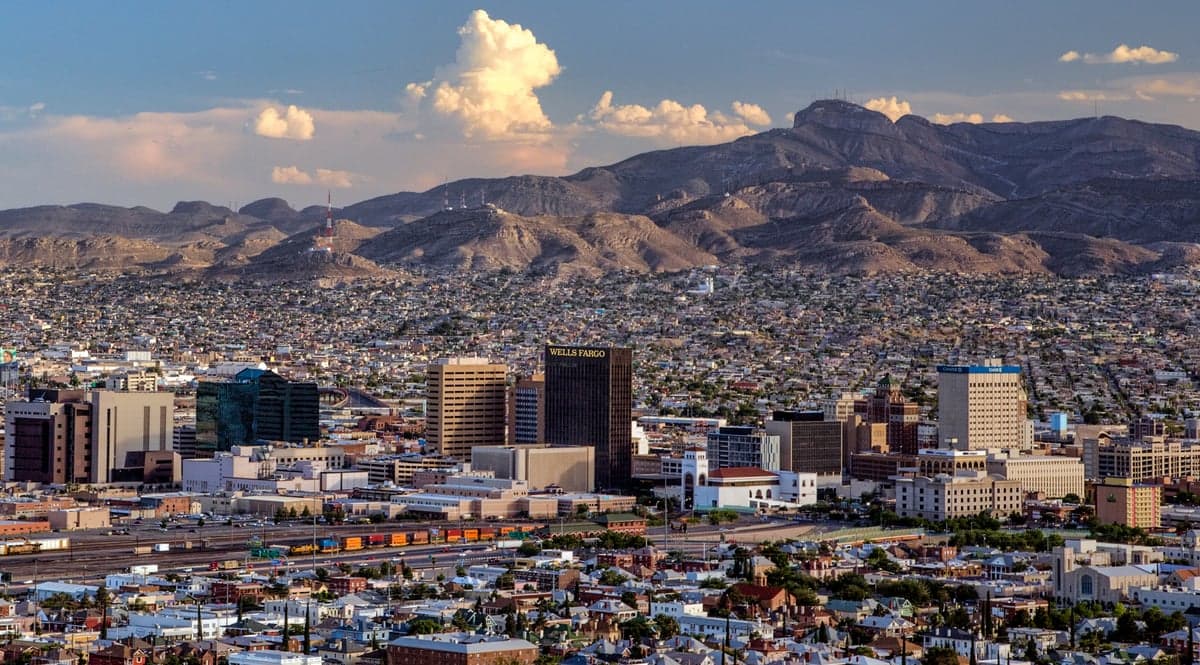
Photo: Wikipedia
Personal Sovereignty in El Paso, TX
Viable for self-reliance. Generally workable, though some barriers may limit total independence.
What does Personal Sovereignty tell us?
Personal Sovereignty measures your capacity for self-reliance and independence with minimal government friction. Higher scores mean fewer barriers between you and the way you want to live... but it assumes you have the space you need and good neighbors.
What does this tell us?
Personal Sovereignty measures your capacity for self-reliance and independence with minimal government friction. Higher scores mean fewer barriers between you and the way you want to live... but it assumes you have the space you need and good neighbors.
State Policy
Energy independence: Net exporter (220% of energy produced in-state)
Personal Liberty
Homesteading

Personal Liberty Analysis
For the individual or family approaching relocation through a lens of personal sovereignty, El Paso presents a complex but ultimately favorable environment within the broader constraints of Texas and the United States. The city’s unique border geography, its deep-rooted cultural emphasis on self-reliance, and the state’s generally pro-liberty legal framework create a space where a determined individual can carve out a high degree of autonomy. While no urban area is a libertarian utopia, El Paso’s lower cost of living, relatively light local regulatory touch compared to coastal metros, and a population that values practical self-sufficiency make it a serious contender for those prioritizing freedom from government overreach. The key is understanding where the state’s protections end and where local realities—like water scarcity and border security dynamics—begin.
Tax burden and regulatory posture for the self-reliant
Texas’s lack of a state income tax is the single most powerful tool for preserving personal sovereignty here)Skip. For a single individual or a family, every dollar not taken by Austin is a dollar you control for land, supplies, or education. El Paso’s property tax rates are a mixed bag: they are higher than the national average, hovering around 2.5% to 3.0% of assessed value, driven largely by the local school district and city levies. However, the median home value in El Paso is significantly lower than in Dallas or Austin—often 30-40% less—meaning the actual dollar amount paid is manageable, especially if you buy outside the city limits in unincorporated El Paso County. The regulatory posture at the city level is pragmatic, not punitive. Permitting for small-scale construction or home-based businesses is less onerous than in blue-state strongholds, and there is no city-level business income tax. The state’s strong homestead exemption (up to $40,000 off assessed value for school taxes) and the lack of a state estate tax further reduce the government’s long-term claim on your assets. For the prepper, this means more capital for land, water storage, and solar arrays, and less going to a bureaucracy that views your property as a revenue stream.
Self-defense and gun law specifics in a border city
Texas is a constitutional carry state, and El Paso operates fully within that framework. As of 2026, no permit is required to carry a handgun openly or concealed for any law-abiding individual 21 or older (18 for long guns). This is non-negotiable sovereignty—the right to defend yourself without asking permission from the state. El Paso’s local government has not enacted any of the “red flag” ordinances or extra waiting periods seen in cities like Austin or Houston. The sheriff’s office in El Paso County is generally pro-Second Amendment, and the city’s proximity to the border means that responsible gun ownership is widely understood as a practical necessity, not a political statement. However, be aware that federal law still prohibits carrying in certain zones (post offices, federal buildings), and the state’s “30.06” and “30.07” signage laws mean you must respect posted restrictions on private property. For the survivalist, the key advantage is that you can legally keep a rifle in your vehicle on school parking lots (with some restrictions) and store firearms in your home without registration. The lack of a state-level gun registry or licensing requirement means your inventory is your own business. The only real friction point is the ATF’s federal oversight on NFA items (suppressors, SBRs), which remains a nuisance but is not unique to El Paso.
Self-reliance and homesteading viability: lot sizes, zoning, and off-grid feasibility
El Paso’s arid climate is the primary constraint on homesteading, but the regulatory environment is surprisingly accommodating. Within the city limits, standard residential lots are small—typically 5,000 to 7,000 square feet—and HOAs are common in newer subdivisions, which can restrict chickens, gardens, or rainwater collection. The real opportunity lies in the county’s unincorporated areas, particularly east toward Fabens or west near Canutillo. Here, you can find parcels of 1 to 5 acres for under $20,000 per acre, with minimal zoning beyond basic health and safety codes. The city’s zoning code does allow for “urban agriculture” within city limits, including beekeeping and small livestock, but you’ll need to check specific neighborhood covenants. Off-grid feasibility is high in the county: solar is viable (El Paso averages 300+ sunny days per year), and rainwater harvesting is legal and encouraged by the state (with a small tax exemption for equipment). The critical issue is water. The city’s water utility is reliable but expensive for large-scale gardening; drilling a private well in the county is possible but requires a permit from the Edwards Aquifer Authority and can cost $10,000-$20,000. For the serious prepper, the strategy is to buy a county parcel with a well or the rights to drill, install a solar array with battery storage, and build a metal shop or container home. The county’s building codes are minimal—no permit is required for structures under 200 square feet, and owner-builders can act as their own general contractor. This is a place where a determined individual can achieve genuine self-sufficiency, provided they respect the water reality.
Personal liberties: parental rights, medical autonomy, speech, and property
Texas has been a battleground for personal liberties, and El Paso sits within a state that has, in recent years, taken a strong stance on parental rights. The state’s “Parental Bill of Rights” (Texas Family Code) explicitly affirms that parents have the fundamental right to direct their children’s education, healthcare, and moral upbringing. This means no government mandate for vaccine passports for school attendance, no forced curriculum on gender ideology without parental opt-out, and the ability to homeschool without state interference (no notice required, no standardized testing mandates). Medical autonomy is more mixed: Texas has not expanded Medicaid, which limits options for low-income individuals, but it also has no state-level vaccine mandate for adults. The state’s ban on COVID-19 vaccine mandates by private employers (SB 7) is still in effect, protecting your right to refuse. On speech, El Paso is in the Fifth Circuit, which has been generally protective of First Amendment rights, including religious expression and political speech. Property rights are strong under Texas law, with no state-level rent control, no forced inclusionary zoning, and a robust “castle doctrine” that presumes you have the right to use deadly force against an intruder in your home or vehicle. The only significant liberty concern is the border itself: federal checkpoints (permanent and temporary) are common within 100 miles of the border, meaning you may encounter Border Patrol agents asking about citizenship on major highways. This is a federal overreach that is a fact of life here, but it does not affect your rights inside your home or on your property. For the parent or individual who values medical and educational choice, El Paso offers a legal environment that largely leaves you alone to make your own decisions.
In the final analysis, El Paso offers a higher degree of personal sovereignty than the vast majority of American cities of its size, particularly when compared to the regulatory-heavy environments of the West Coast or Northeast. The combination of no state income tax, constitutional carry, strong parental rights, and minimal zoning in the county creates a foundation for genuine self-reliance. The trade-offs are real: you must contend with water scarcity, the federal presence at the border, and a property tax system that rewards long-term ownership but punishes rapid appreciation. For the survivalist or prepper who values autonomy over convenience, El Paso is a strategic choice—not a perfect one, but one where the state and local government are more often an ally than an adversary in the pursuit of personal freedom. If you can adapt to the desert and navigate the border bureaucracy, you will find a community that respects your right to live as you see fit.

* Values derived from national, state, county, city and local statistics and may differ in a specific area. Last updated: 2026-04-14T07:27:33.000Z
Narrative content on this page is AI-generated and may contain mistakes. Verify any details that matter before acting on them.
ReloMaps may earn a commission from affiliate links at no extra cost to you.

