Photo: Wikipedia
Demographics of Elizabeth, NJ
Affluence Level in Elizabeth, NJ
A middle-class area roughly in line with national averages across income, home values, education, and employment.
People of Elizabeth, NJ
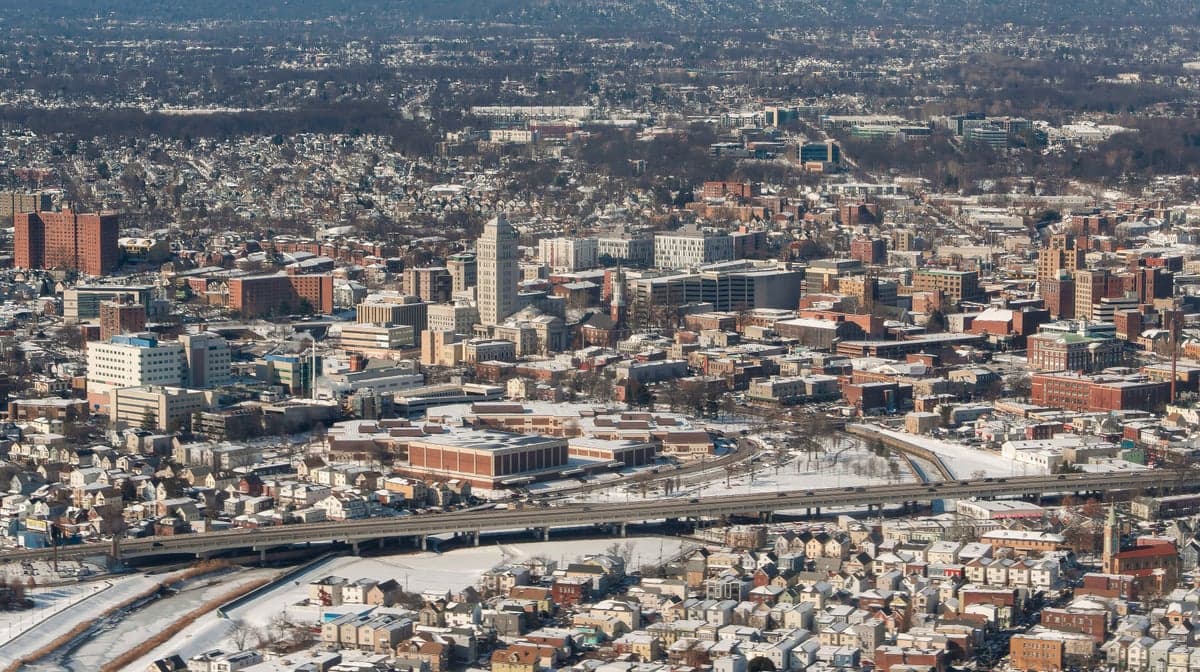
Elizabeth, New Jersey, is a dense, majority-Hispanic city of 135,887 residents where nearly one in three people was born outside the United States. Its character is defined by a working-class, family-oriented energy, with a median age of 35.7 and a strikingly low college-attainment rate of 14.2%, signaling a population that prioritizes immediate employment and community ties over higher education. Distinctive identity markers include a strong Portuguese-speaking enclave, a rapidly growing Dominican and Central American presence, and a small but historically rooted Black community concentrated in specific wards.
How the city was settled and grew
Founded in 1664 by English Puritans as part of the Elizabethtown Tract, Elizabeth was one of New Jersey’s earliest settlements. Its original population was overwhelmingly English and Dutch, drawn by fertile farmland and the promise of religious freedom. The city’s industrial takeoff began in the 19th century with the arrival of the Central Railroad of New Jersey and the establishment of Singer Manufacturing Company’s sewing-machine plant. This drew successive waves of Irish, German, and Italian immigrants, who built dense row-house neighborhoods in the Peterstown and Elmora sections. By 1900, Elizabeth was a classic immigrant gateway, with distinct ethnic parishes and mutual-aid societies anchoring each group. The mid-20th century saw a significant influx of Black Americans from the South during the Great Migration, settling primarily in the West End and Bayway neighborhoods, drawn by factory jobs at General Motors and the sprawling Elizabethport industrial complex.
Modern era (post-1965)
The 1965 Hart-Cellar Immigration Act fundamentally reshaped Elizabeth’s population. The city’s white non-Hispanic share collapsed from over 80% in 1960 to just 13.0% today. The first major post-1965 wave was Portuguese and Brazilian immigrants, who established a strong presence in the Elizabethport and Peterstown neighborhoods, creating a lasting cultural footprint visible in bakeries, Catholic festivals, and the local dialect. Beginning in the 1980s and accelerating through the 2000s, Hispanic immigration—overwhelmingly from the Dominican Republic, Puerto Rico, and Central America—became the dominant demographic force. Today, 66.8% of residents identify as Hispanic, with the highest concentrations in the West End and North Elizabeth districts. The Black population, now 15.2%, has become more geographically concentrated in the Bayway and Elmora sections, while the East/Southeast Asian share (0.9%) and Indian-subcontinent share (0.8%) remain very small and are scattered, lacking a distinct ethnic enclave. The foreign-born rate of 30.3% is nearly double the national average, and the city’s low homeownership rate (roughly 35%) reflects a population that is still settling and renting.
The future
Elizabeth’s population is likely to continue its Hispanic-majority trajectory, with the Dominican and Central American communities growing through both immigration and higher birth rates. The city is not homogenizing into a single pan-Hispanic identity; rather, it is tribalizing into distinct national-origin enclaves within the existing neighborhoods—Dominicans in the West End, Puerto Ricans in North Elizabeth, and a smaller but growing Salvadoran presence in the Bayway area. The Portuguese and Brazilian communities are plateauing and slowly assimilating, with younger generations moving to suburban Union County towns like Union and Hillside. The Black population is stable but aging, with limited new in-migration. The white non-Hispanic share will likely continue to shrink below 10% as the remaining elderly Italian and Irish residents pass away. The city’s low college-attainment rate (14.2%) and heavy reliance on logistics and warehouse jobs at the nearby Port Newark-Elizabeth Marine Terminal suggest that future growth will be driven by low-skill, high-turnover employment rather than a knowledge-economy influx.
For someone moving in now, Elizabeth is a city that remains a true immigrant gateway—dense, affordable by regional standards, and deeply communal, but with limited upward mobility for those without a college degree. The neighborhoods are safe and family-oriented, but the city’s future is one of continued ethnic clustering rather than broad assimilation, making it a place where newcomers will find a strong, specific community rather than a melting pot.

* Values derived from national, state, county, city and local statistics and may differ in a specific area. Last updated: 2026-04-30T05:31:32.000Z
Narrative content on this page is AI-generated and may contain mistakes. Verify any details that matter before acting on them.
ReloMaps may earn a commission from affiliate links at no extra cost to you.

