
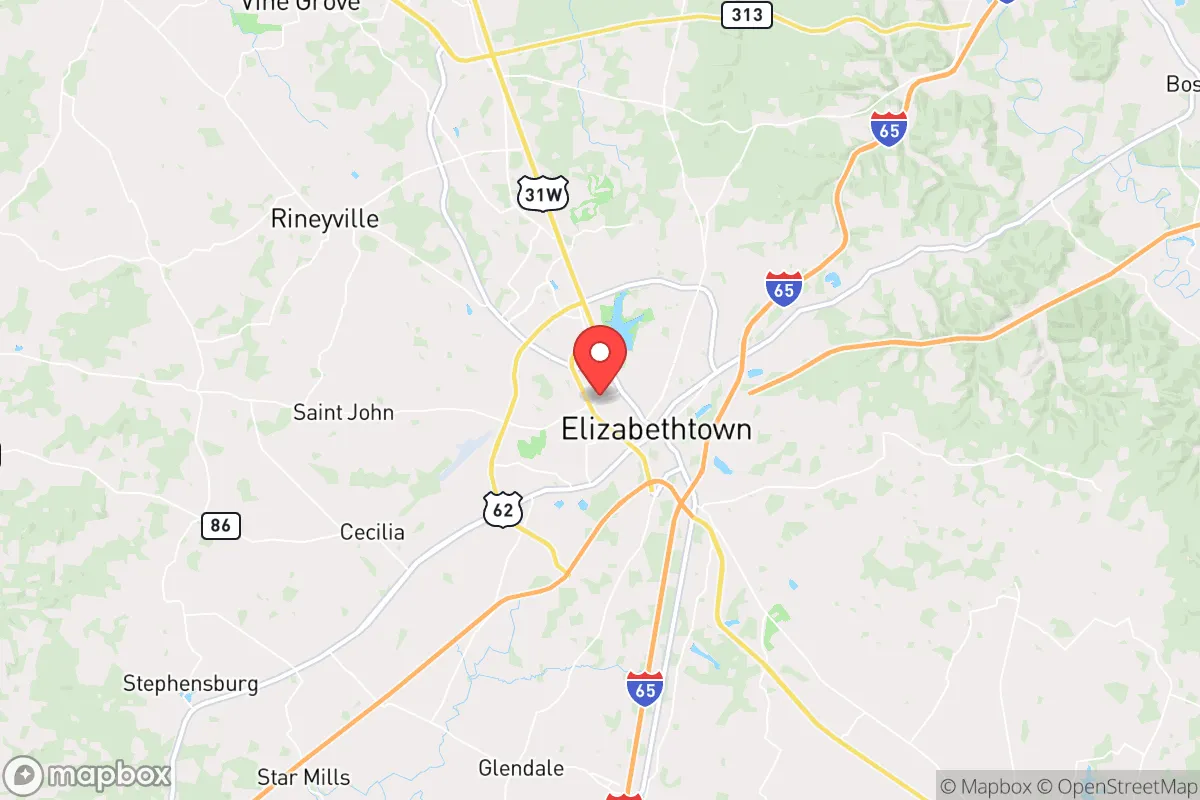
Photo: Wikipedia
Personal Sovereignty in Elizabethtown, KY
Viable for self-reliance. Generally workable, though some barriers may limit total independence.
What does Personal Sovereignty tell us?
Personal Sovereignty measures your capacity for self-reliance and independence with minimal government friction. Higher scores mean fewer barriers between you and the way you want to live... but it assumes you have the space you need and good neighbors.
What does this tell us?
Personal Sovereignty measures your capacity for self-reliance and independence with minimal government friction. Higher scores mean fewer barriers between you and the way you want to live... but it assumes you have the space you need and good neighbors.
State Policy
Energy independence: Importer (60% of energy produced in-state)
Personal Liberty
Homesteading

Personal Liberty Analysis
Elizabethtown, Kentucky, offers a notably high degree of personal sovereignty compared to many other regions in the country, particularly for those who prioritize minimal government interference in daily life. Nestled in Hardin County, this community operates within a state framework that consistently ranks among the most free in the nation for property rights, gun laws, and tax burden. For the strategic relocator—whether a single individual or a parent—this translates into an environment where self-reliance is not just tolerated but actively supported by local culture and policy. The key question is whether the practical realities of zoning, local governance, and community norms align with the survivalist and prepper mindset that values autonomy above all else.
Tax burden and regulatory posture: How Kentucky compares to high-tax states
Kentucky’s state-level tax structure is a significant draw for those seeking to keep more of their earnings and reduce government reach. The state has a flat individual income tax rate of 4.5% as of 2025, with a scheduled phase-down to 4.0% by 2026, and no state-level tax on Social Security benefits. Property taxes are among the lowest in the nation, with an effective rate of roughly 0.87% of assessed home value in Hardin County—far below the national average of 1.11%. For a $300,000 home, that’s about $2,610 annually, compared to over $6,000 in many Northeastern or West Coast counties. Sales tax is a modest 6%, with no local add-ons in Elizabethtown. Critically, there is no state inheritance or estate tax, meaning your assets pass to heirs without the government taking a cut. The regulatory environment is equally favorable: Kentucky is a right-to-work state, has no state-level OSHA plan (federal OSHA covers workplaces), and imposes minimal business licensing requirements. For a prepper running a home-based business or a homestead, this means fewer bureaucratic hurdles and lower compliance costs. However, note that Hardin County does enforce standard building codes and zoning ordinances, so you cannot simply build an unpermitted bunker without local approval—a point of friction for the truly off-grid.
Self-defense and gun law specifics: Constitutional carry and castle doctrine
For the survivalist, Kentucky’s gun laws are a major asset. The state has permitted constitutional carry since 2019, meaning any law-abiding adult 21 or older can carry a concealed firearm without a permit. Open carry is also legal without a license. There is no state-level waiting period, no universal background check requirement for private sales, and no magazine capacity restrictions. The castle doctrine is codified in Kentucky Revised Statutes 503.055, which establishes a legal presumption that a person using deadly force against an intruder in their home, vehicle, or occupied structure acted in self-defense—no duty to retreat. Stand-your-ground protections extend to any place you have a legal right to be. Local law enforcement in Elizabethtown is generally supportive of Second Amendment rights; the Elizabethtown Police Department does not maintain a public registry of gun owners. For parents, this means you can legally train your children in firearm safety on your own property without state interference. The only notable restriction: Kentucky prohibits carrying firearms into K-12 schools, government buildings, and establishments that derive more than 50% of revenue from alcohol sales. Overall, this is one of the most permissive legal environments in the country for armed self-defense.
Self-reliance and homesteading viability: Lot sizes, zoning, and off-grid feasibility
Elizabethtown itself is a growing city of about 32,000, so true off-grid homesteading is more feasible in the surrounding unincorporated areas of Hardin County. Within city limits, zoning regulations require minimum lot sizes of 6,000 to 10,000 square feet for single-family homes, and raising livestock (chickens, goats) is restricted or prohibited in most residential zones. However, just 10 to 15 minutes outside town, in areas like Cecilia, Rineyville, or Glendale, you can find parcels of 1 to 10 acres with agricultural zoning that permits chickens, goats, and even cattle. Water rights are favorable: Kentucky follows the "reasonable use" doctrine for groundwater, meaning you can drill a well on your property without a permit for domestic use, though a permit is needed for irrigation or commercial use. Rainwater harvesting is legal and encouraged—no state restrictions. Solar panels are allowed with standard building permits, and net metering is available through local utility Nolin RECC, though at a reduced rate. Septic systems require county health department approval, but the process is straightforward for standard gravity-fed systems. The biggest hurdle for the prepper is that Hardin County does not have a formal "off-grid" exemption from building codes; any permanent dwelling must meet state residential codes, including electrical and plumbing. A tiny house on wheels registered as an RV can bypass this, but a stationary cabin will require permits. For those willing to work within the system, the area offers solid potential for self-sufficiency without excessive government meddling.
Personal liberties: Parental rights, medical autonomy, speech, and property
Kentucky has strong legal protections for parental rights, codified in KRS 158.183, which affirms that parents have the fundamental right to direct the upbringing, education, and healthcare of their children. This means no mandatory vaccine requirements for school attendance (though some vaccines are required, with a broad religious exemption available), and parents can opt their children out of sex education or any curriculum they find objectionable. Medical autonomy is more mixed: Kentucky has not expanded Medicaid under the Affordable Care Act in a way that creates a state-run insurance mandate, but it does have a prescription drug monitoring program that some view as overreach. There is no state-level vaccine passport or mask mandate in effect as of 2026. Free speech is robustly protected under the Kentucky Constitution, which explicitly states that "no law shall be passed to restrain or abridge the liberty of speech." Property rights are strong: Kentucky is a "pure" fee simple state with no state-level rent control, no forced annexation without a vote, and no statewide zoning authority—local governments control land use, but they cannot take property without just compensation under eminent domain. The biggest concern for the liberty-minded is that Kentucky does have a state income tax and a sales tax, which some view as a form of government overreach. Additionally, the state has a "bluegrass" political culture that leans conservative but is not libertarian—local officials generally support law enforcement and public safety measures that can feel intrusive to the hardcore prepper. Still, compared to states like California, New York, or Illinois, Elizabethtown offers a vastly higher degree of personal autonomy in daily life.
In the broader context of American personal sovereignty, Elizabethtown and Hardin County rank well above the median. The combination of constitutional carry, low taxes, minimal business regulation, and strong parental rights creates a legal environment where a self-reliant individual or family can operate with relatively little government interference. The main trade-offs are the need to comply with local building codes and zoning if you want a permanent structure, and the presence of a state income tax that some libertarians find objectionable. For the strategic relocator weighing the balance between freedom and practicality, this area offers a solid foundation for a life built on personal responsibility and preparedness—without the constant friction of a hostile state apparatus. If you can accept the modest regulatory framework of a red state with a functioning local government, Elizabethtown is a strong candidate for those seeking to maximize their personal sovereignty in an increasingly uncertain world.

* Values derived from national, state, county, city and local statistics and may differ in a specific area. Last updated: 2026-04-21T09:23:15.000Z
Narrative content on this page is AI-generated and may contain mistakes. Verify any details that matter before acting on them.
ReloMaps may earn a commission from affiliate links at no extra cost to you.

