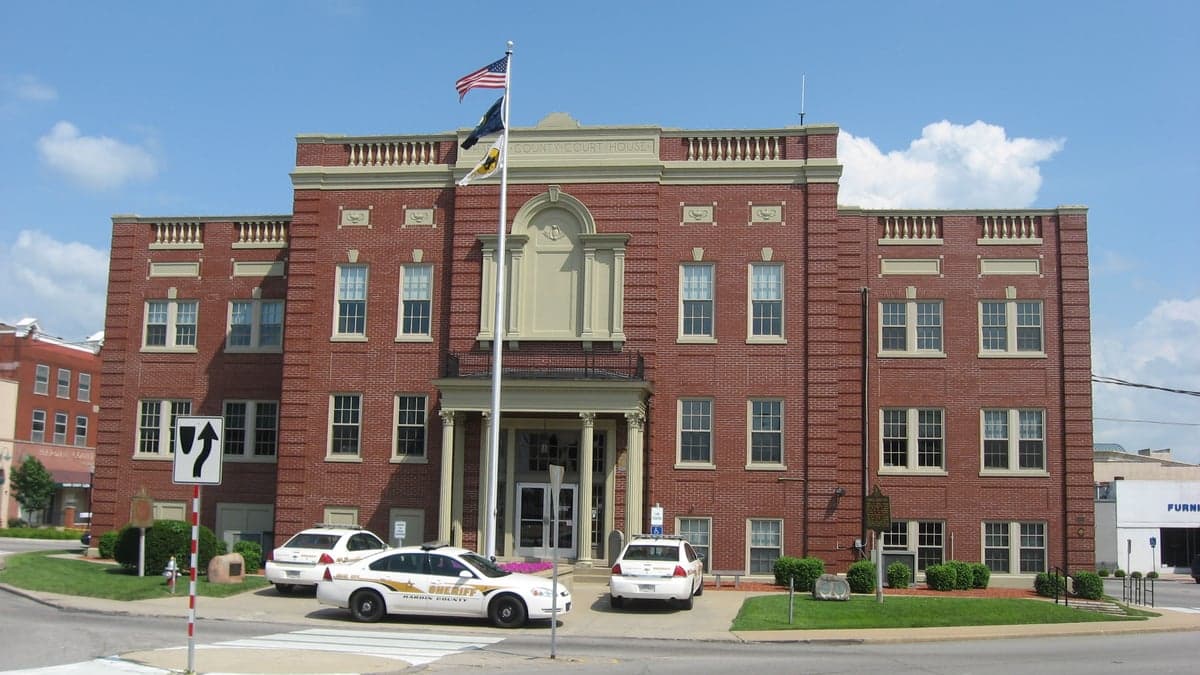
Photo: Wikipedia
Demographics of Elizabethtown, KY
Affluence Level in Elizabethtown, KY
A middle-class area roughly in line with national averages across income, home values, education, and employment.
People of Elizabethtown, KY
The people of Elizabethtown, Kentucky, today number 31,870, forming a predominantly white (73.8%) and native-born (97.2% U.S.-born) community with a notable Black minority (12.0%) and smaller Hispanic (5.7%) and East/Southeast Asian (1.8%) populations. The city’s character is shaped by its role as a regional commercial and medical hub for Hardin County, with a college-educated rate of 28.3% reflecting a workforce anchored by Fort Knox, Baptist Health Hardin, and local manufacturing. Distinctive identity markers include a strong military-connected population, a visible but declining historic Black community centered in the West End, and a growing but still small immigrant presence that has not fundamentally altered the city’s overwhelmingly native-born, English-speaking character.
How the city was settled and grew
Elizabethtown was founded in 1793 on a land grant to Colonel Andrew Hynes, who named it for his wife. The original settlers were largely of English, Scots-Irish, and German descent, moving west from Virginia, Maryland, and Pennsylvania along the Wilderness Road. The town’s early economy centered on the stagecoach trade and later the Louisville and Nashville Railroad, which arrived in 1859 and made Elizabethtown a shipping point for tobacco, livestock, and timber. The historic Downtown district, centered on the Public Square, was built by these early Anglo-American families, with brick commercial blocks and frame houses dating to the 1820s–1850s. A small free Black population existed before the Civil War, but the city’s Black community grew substantially after emancipation, settling in the West End neighborhood along Poplar and Mulberry streets. By 1900, Elizabethtown was a segregated town of about 4,000, with Black residents concentrated in the West End and white residents in the East End and College Street areas. The arrival of Fort Knox in 1918 brought a wave of military personnel and civilian contractors, many of whom settled in the North Park and Ring Road areas, expanding the city’s housing stock with bungalows and mid-century ranches. The post-World War II boom saw the city’s population double between 1950 and 1970, driven by the expansion of Fort Knox during the Cold War and the construction of Interstate 65 in the 1960s, which connected Elizabethtown to Louisville and Nashville.
Modern era (post-1965)
The 1965 Hart-Cellar Act had a minimal direct effect on Elizabethtown, as the city’s foreign-born population remains just 2.8% in 2026, well below the national average. Instead, the modern era has been defined by domestic in-migration. The closure of Fort Knox’s Armor School in 2011 and its partial replacement by the Army Human Resources Command and other agencies shifted the military population from training-focused to administrative, bringing a more educated, white-collar workforce. These newcomers have concentrated in newer subdivisions on the city’s periphery, particularly South Central (near the Western Kentucky Parkway) and Ring Road East, where large-lot homes built since 2000 attract families seeking good schools and low crime. The Black population, which peaked at roughly 15% in the 1990s, has declined to 12.0% as younger Black residents have moved to Louisville or Atlanta for better job opportunities, leaving an aging cohort in the West End. Hispanic growth (5.7%) has been modest and concentrated in the West End and North Park areas, driven by construction and service-sector jobs. The East/Southeast Asian community (1.8%) is largely composed of Korean and Filipino families connected to Fort Knox, living in Ring Road and South Central neighborhoods. The Indian-subcontinent population (0.7%) is small and professional, tied to medical and engineering roles at Baptist Health and local manufacturing plants.
The future
Elizabethtown’s population is projected to grow slowly, reaching roughly 35,000 by 2040, driven by continued expansion of Fort Knox’s administrative footprint and the city’s role as a regional retail and healthcare center. The city is not tribalizing into distinct ethnic enclaves; rather, it is homogenizing around a white, native-born, military-affiliated core. The West End’s Black population will likely continue to shrink as older residents pass away and younger families leave, while Hispanic and Asian populations will grow slowly but remain small single-digit shares. The foreign-born share may rise to 4–5% by 2040, still far below national averages, as Fort Knox attracts a modest number of immigrant professionals. The city’s political character—solidly Republican, with Hardin County voting +36 R in 2024—will remain stable, as in-migrants from more liberal areas are few.
For someone moving in now, Elizabethtown is becoming a quieter, more suburban version of its 1990s self: whiter, more educated, and more oriented toward Fort Knox and healthcare than toward manufacturing or agriculture. The West End’s historic Black community is fading, while the newer subdivisions on the east and south sides are filling with military and professional families. The city offers low crime, good schools, and a stable, conservative social environment, but little ethnic diversity or immigrant-driven change. It is a place where the population is slowly aging and slowly growing, with no major demographic disruption on the horizon.

* Values derived from national, state, county, city and local statistics and may differ in a specific area. Last updated: 2026-04-21T09:23:15.000Z
Narrative content on this page is AI-generated and may contain mistakes. Verify any details that matter before acting on them.
ReloMaps may earn a commission from affiliate links at no extra cost to you.

