
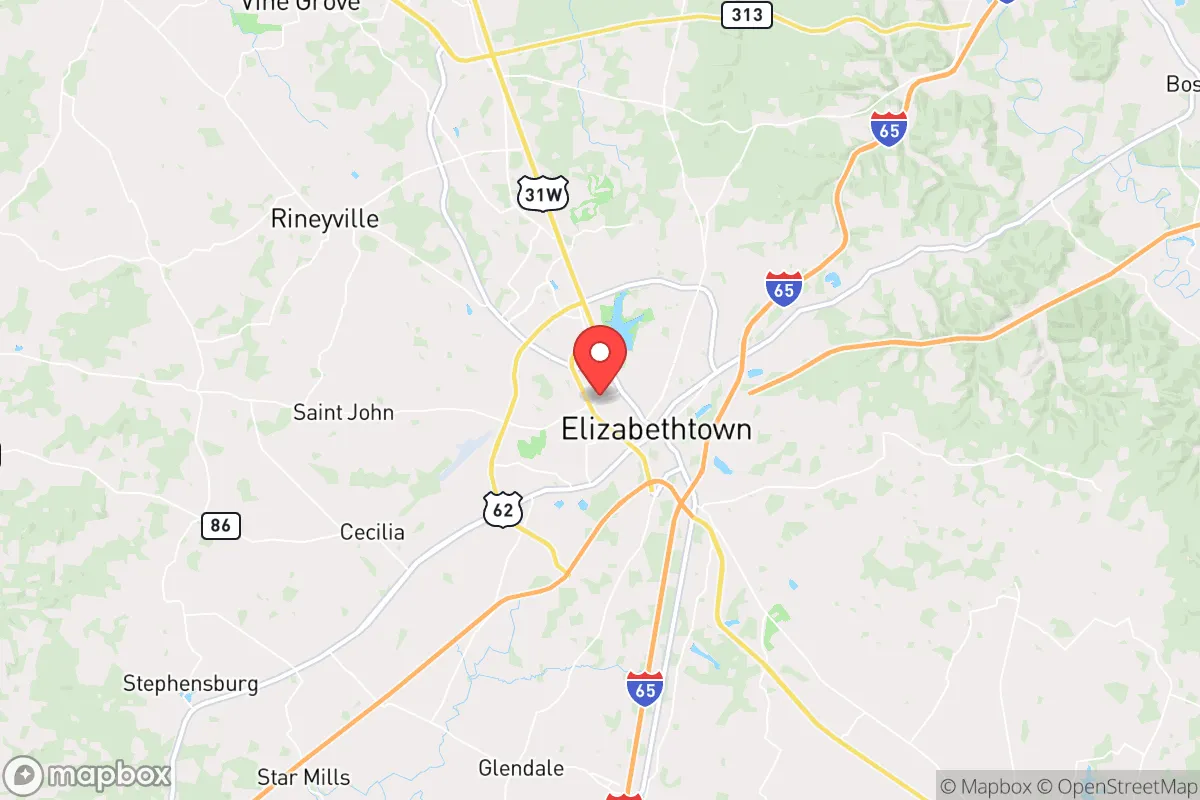
Photo: Wikipedia
Political ClimatePolitical Climate in Elizabethtown, KY
District shown is the primary district for this city’s centroid. Cities may span multiple districts.
Local Political AnalysisPolitical Analysis of Elizabethtown, KY
Elizabethtown, Kentucky, has long been a solidly conservative community, and that hasn't changed much. The area's Cook PVI of R+20 tells you everything you need to know about the baseline political lean here—this is Trump country, through and through. Hardin County as a whole has voted Republican in every presidential election since 2000, and the margins have only gotten wider. In 2024, the county went for Trump by about 35 points, which is actually a bit more lopsided than the PVI suggests. That said, you can feel a subtle shift happening, especially in the newer subdivisions and around the college. It's not a blue wave or anything dramatic, but there's a creeping unease among folks who've been here a while—a sense that the old, reliable conservative values are being tested by outside influences and a growing government footprint.
How it compares
If you drive 30 minutes north to Louisville, you might as well be in a different country politically. Jefferson County is reliably Democratic, with a Cook PVI of D+18. That contrast is stark, and it's a big reason why Elizabethtown feels like a bulwark against the progressive policies you see in the big city. To the south, Bowling Green is also conservative, but it's a bit more purple around the edges thanks to Western Kentucky University's student population. Elizabethtown, by comparison, is more uniformly red. The surrounding small towns—like Vine Grove, Radcliff, and Cecilia—are even more conservative, often voting +40 or more for Republican candidates. The real contrast, though, is with the state government in Frankfort. While the state legislature is solidly Republican, the governor's office has been held by a Democrat, Andy Beshear, since 2019. That creates a constant tension: local leaders in Hardin County are pushing for lower taxes and less regulation, while the state level sometimes throws up roadblocks. It's a reminder that even in a deep-red county, you're still dealing with government overreach from above.
What this means for residents
For the most part, life here is what you'd expect in a conservative stronghold. The Second Amendment is taken seriously—you see "Come and Take It" stickers on trucks, and gun shops do brisk business. Property taxes are low, and the county government generally stays out of your business. But there are warning signs. The biggest concern I hear from neighbors is the slow creep of federal and state mandates into local affairs. Zoning fights are getting more common, especially around the new housing developments near the interstate. There's also a growing unease about the school board—some parents worry that progressive curriculum ideas from Louisville or Lexington are being pushed into local classrooms, even if they're dressed up as "diversity initiatives." The local economy is strong, thanks to the Fort Knox military base and a growing logistics sector, but that also brings in new residents from blue states who don't always share the local values. It's not a crisis yet, but you can feel the cultural friction. The long-time residents are watching closely, and they're not shy about showing up at city council meetings to push back.
One thing that sets Elizabethtown apart from other conservative towns in Kentucky is its relationship with Fort Knox. The base brings in a transient population from all over the country, which means the political culture here is a bit more pragmatic and less ideological than, say, rural counties further east. You'll find plenty of veterans who are staunchly conservative but also skeptical of foreign entanglements and big defense budgets. There's also a strong libertarian streak—people here don't like being told what to do, whether it's by Washington, Frankfort, or the local HOA. That independence is part of the charm, but it also means that any attempt to impose new regulations—like mask mandates or business restrictions—is met with fierce resistance. The local paper, the News-Enterprise, still runs letters to the editor that sound like they were written in 1985, and that's exactly how most folks want it. If you're looking for a place where the government keeps its nose out of your personal life and your wallet, Elizabethtown is still that place—but you have to stay vigilant to keep it that way.

State Political ClimatePolitical Climate in Kentucky
State Political AnalysisPolitical Environment in the State
Kentucky has long been a reliably Republican state at the federal level, voting for the GOP presidential candidate by double digits in every election since 2000, but its state-level politics tell a more nuanced story. The dominant coalition is a mix of rural, socially conservative voters and a growing suburban base, though the state has shifted noticeably rightward over the past 20 years, particularly as the Democratic stronghold in the urban core of Louisville has weakened. While the state remains solidly red, the real political action is in the tension between the deeply conservative rural counties and the increasingly progressive urban islands of Louisville and Lexington.
Urban vs. rural divide
The political map of Kentucky is a textbook study in the urban-rural split. Jefferson County (Louisville) and Fayette County (Lexington) are the only reliably blue areas, with Louisville’s Democratic margins shrinking from +25 points in 2008 to about +15 in 2024. The rest of the state is overwhelmingly red, with rural counties like Pike, Harlan, and Letcher in the east voting 75-80% Republican. The northern suburbs of Cincinnati, particularly Boone, Kenton, and Campbell counties, have become a fascinating battleground: they’re still red, but the margin has tightened as professionals move in from Ohio. Meanwhile, the Bowling Green area (Warren County) has become a GOP stronghold, driven by the growth of Western Kentucky University and a booming manufacturing base. The Owensboro region (Daviess County) is reliably red but with a moderate streak, often splitting tickets for local offices.
Policy environment
Kentucky’s policy environment is broadly conservative, but with some notable exceptions that frustrate freedom-minded residents. The state has a flat income tax of 4% (down from 5% in 2022, with a path to 3% by 2029), and no inheritance tax. Property taxes are low, with a statewide average effective rate of 0.82%. However, the state’s sales tax is 6% and applies to groceries, which is a regressive burden. On education, Kentucky has a robust school choice movement: the 2022 “Education Opportunity Account Act” created tax-credit scholarships for private school tuition, though it was struck down by the state Supreme Court in 2023. The legislature passed a constitutional amendment in 2024 to allow school choice, which voters will decide in 2025. Healthcare policy is mixed: the state expanded Medicaid under the Affordable Care Act in 2014, but the 2023 “Working to Save Lives” law imposed work requirements for able-bodied adults on Medicaid. Election laws are solid: Kentucky requires a photo ID to vote, has no-excuse absentee voting only for those 65+ or with a medical reason, and purges inactive voters from rolls every two years. The state also has a constitutional carry law (permitless concealed carry) since 2019, and a 2023 law banned all “sanctuary city” policies for illegal immigration.
Trajectory & freedom
Kentucky is becoming more free in several key areas, but the pace is uneven. The 2019 constitutional carry law was a major win for gun rights, and the 2023 law banning sanctuary cities was a strong stand for rule of law. The 2024 “Parents’ Bill of Rights” (HB 174) requires schools to notify parents of any medical or mental health services provided to their child, and prohibits instruction on sexual orientation or gender identity in grades K-5. This is a significant expansion of parental rights. On the tax front, the 2022 income tax cut and the planned phase-out to 3% are positive, but the state still has the 6% sales tax on groceries, which is a regressive burden. The biggest concern for freedom-minded residents is the state’s heavy-handed approach to medical marijuana: while medical cannabis was legalized in 2023, the program is so restrictive (only a handful of conditions, no smokable flower, and a 2025 start date) that many see it as a government overreach. The 2024 “Safer Kentucky Act” increased penalties for fentanyl trafficking and expanded the death penalty for certain drug offenses, which some view as an overreach of state power. Overall, the trajectory is toward more personal liberty on guns, education, and taxes, but with a heavy hand on drugs and healthcare.
Civil unrest & political movements
Kentucky has seen its share of political flashpoints. The 2020 Breonna Taylor protests in Louisville were the most intense, with months of demonstrations, property damage, and a state of emergency. The city’s Democratic mayor and governor (Andy Beshear) were criticized by conservatives for being too lenient on rioters. In response, the 2021 “Breonna’s Law” banned no-knock warrants statewide, a rare bipartisan move. The “Freedom March” in Frankfort in 2023 drew thousands of parents protesting school mask mandates and critical race theory, leading to the Parents’ Bill of Rights. Immigration politics are relatively quiet, but the 2023 sanctuary city ban was a direct response to Louisville’s 2022 resolution declaring itself a “welcoming city.” Election integrity remains a hot topic: the 2020 election saw no major scandals, but the 2022 law requiring all absentee ballots to be returned by mail (no drop boxes) and the 2024 law requiring signature verification for all mail ballots have kept the issue alive. The “Nullification” movement is small but vocal, with some rural counties passing resolutions declaring federal gun laws unenforceable. A new resident would notice the strong presence of “Don’t Tread on Me” flags and “Thin Blue Line” flags in rural areas, and the occasional “Fuck Biden” sign on a pickup truck in the eastern coalfields.
Projection
Over the next 5-10 years, Kentucky is likely to become more conservative, but with a growing suburban moderate wing. The in-migration from Ohio, Indiana, and Illinois is bringing people who are fiscally conservative but socially moderate, particularly in the northern suburbs and the Lexington area. The urban cores of Louisville and Lexington will continue to drift left, but their political power is diluted by the state’s gerrymandered legislative districts. The biggest demographic shift is the aging of the rural population: eastern Kentucky is losing population fast, which will reduce the influence of the most conservative counties. The state’s tax cuts will continue, likely reaching the 3% flat rate by 2029, making Kentucky more attractive to businesses. The school choice amendment will likely pass in 2025, opening up more educational freedom. However, the state’s heavy-handed approach to drugs and healthcare is unlikely to change, and the medical marijuana program will remain restrictive. A new resident moving in now should expect a state that is solidly red, but with a growing libertarian streak on taxes and guns, and a strong cultural conservatism on education and family issues.
For a new resident, the bottom line is this: Kentucky offers a low-tax, high-freedom environment for those who value gun rights, parental control over education, and a government that stays out of your business on most issues. The trade-offs are a regressive sales tax on groceries, a restrictive medical marijuana program, and a healthcare system that still leans heavily on Medicaid expansion. If you’re moving from a blue state, you’ll find the political culture refreshingly straightforward: people here are generally polite but direct, and they expect government to be limited. The biggest practical takeaway is to choose your county carefully — the urban-rural divide is real, and your daily experience of freedom will be very different in Louisville versus a place like Bowling Green or Owensboro. If you want the most freedom from government overreach, stick to the rural and suburban counties outside the two blue cities.
* Values derived from national, state, county, city and local statistics and may differ in a specific area. Last updated: 2026-04-21T09:23:15.000Z
Narrative content on this page is AI-generated and may contain mistakes. Verify any details that matter before acting on them.
ReloMaps may earn a commission from affiliate links at no extra cost to you.

