Photo: Wikipedia
Demographics of Elk River, MN
Affluence Level in Elk River, MN
An upper-middle-class area. Household wealth, education levels, and homeownership run ahead of national benchmarks.
People of Elk River, MN
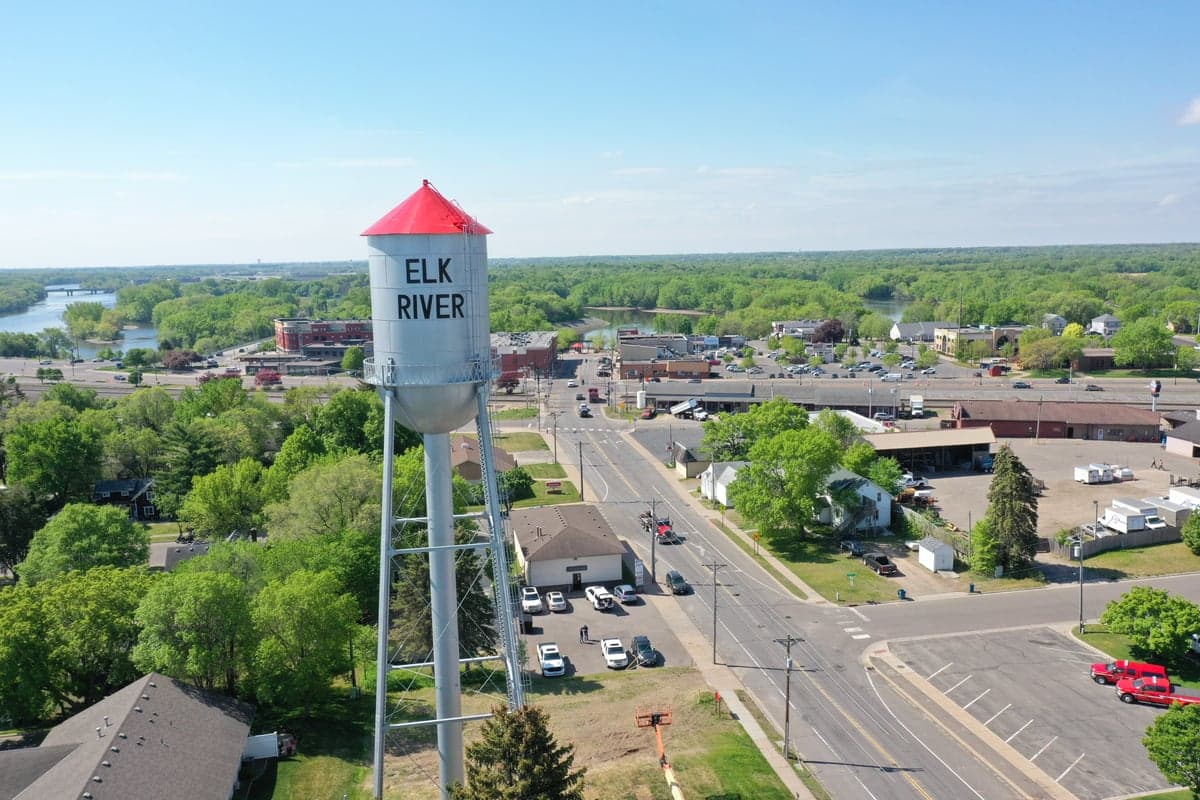
The people of Elk River, Minnesota, today number 26,367, forming a predominantly white (82.4%) and family-oriented community with a notably low foreign-born population of just 1.9%. The city carries a distinctly small-town, Midwestern character despite its growth, with a strong sense of local identity rooted in its riverfront history and outdoor recreation culture. Residents tend to be politically moderate-to-conservative, and the population is less diverse than the broader Twin Cities metro area, with a college attainment rate of 30.8% that aligns closely with state averages.
How the city was settled and grew
Elk River’s human history begins with the Dakota and Ojibwe peoples, who used the Mississippi River corridor for trade and seasonal camps long before European arrival. The first permanent white settlers arrived in the 1850s, drawn by the promise of cheap land under the Preemption Act and the potential of water-powered industry along the Elk River and Mississippi confluence. The original village plat was laid out in 1855, and the community grew slowly as a farming and lumbering hub. The arrival of the St. Paul and Pacific Railroad in the 1860s cemented Elk River as a regional shipping point for grain and timber. The historic Downtown Elk River district, centered on Main Street and Jackson Avenue, was built by Scandinavian and German immigrant families—primarily Swedes, Norwegians, and Germans—who cleared the land, built the first mills, and established the town’s Lutheran and Catholic church foundations. A second wave of settlers, largely of Irish and French-Canadian stock, arrived in the 1880s and 1890s to work in the expanding lumber camps and railroad yards, settling in what is now the West Side neighborhood along the river bluffs. By 1900, Elk River was a stable, ethnically homogeneous community of fewer than 1,000 souls, with a social fabric woven from Protestant and Catholic congregations, fraternal lodges, and agricultural cooperatives.
Modern era (post-1965)
Elk River’s modern demographic story is one of steady, mostly white domestic in-migration rather than international diversification. The 1965 Hart-Cellar Act had minimal direct impact here; the city’s foreign-born share remains under 2%, far below the national average. Instead, the major population driver after 1970 was suburban spillover from the northwest Twin Cities metro. Families seeking larger lots, lower taxes, and newer housing moved out from Anoka, Coon Rapids, and Minneapolis. The Riverwood neighborhood, developed in the 1980s and 1990s along the Mississippi River bluffs, absorbed many of these middle-class, white professional families. The Pond View Farms and Woodland Trails subdivisions, built from the late 1990s through the 2010s, attracted a similar demographic—married couples with children, many employed in the trades, healthcare, or local government. The city’s Black population (5.6%) and Hispanic population (3.8%) are modest but growing, concentrated in the Orono Park area and along the Highway 10 corridor, where rental housing and older single-family homes offer more affordable entry points. East and Southeast Asian residents (1.0%) and Indian-subcontinent residents (0.1%) are present in very small numbers, largely in professional households in the newer Preserve at Elk River development. The city’s overall racial composition has shifted only slightly since 2000, with the white share declining from about 94% to 82.4%, driven almost entirely by domestic migration of non-white families rather than international immigration.
The future
Elk River’s population trajectory points toward slow, incremental diversification rather than rapid change. The foreign-born share is likely to remain low, as the city lacks the ethnic enclaves, refugee resettlement agencies, or large immigrant-employing industries that drive international migration in other Minnesota cities. The Hispanic and Black populations will likely continue to grow gradually, primarily through domestic moves from the inner-ring suburbs, but the city is not expected to become a majority-minority community within the next 20 years. The Elk River Village and Bristol Park neighborhoods, both master-planned communities currently under development, are marketing to young families and empty-nesters alike, and will likely attract a similar demographic mix as the existing subdivisions—predominantly white, married, and middle-class. The city is homogenizing in terms of income and lifestyle (most residents are homeowners in single-family homes) but slowly tribalizing into distinct age-based enclaves: older retirees in the riverfront neighborhoods, younger families in the newer subdivisions, and a small but stable working-class population in the older core near the railroad tracks. For a conservative-leaning family or individual moving in now, Elk River offers a predictable, low-crime, and culturally stable environment where the population is growing but not transforming in character.
The bottom line: Elk River is becoming a more polished, suburban version of its historic self—whiter and more American-born than the metro average, with a population that is slowly diversifying through domestic migration rather than international immigration. For someone seeking a community where the demographic and cultural baseline is unlikely to shift dramatically in the next decade, Elk River represents a stable choice.

* Values derived from national, state, county, city and local statistics and may differ in a specific area. Last updated: 2026-04-19T08:35:51.000Z
Narrative content on this page is AI-generated and may contain mistakes. Verify any details that matter before acting on them.
ReloMaps may earn a commission from affiliate links at no extra cost to you.

