Photo: Wikipedia
Demographics of Elkhart, IN
Affluence Level in Elkhart, IN
A below-average socioeconomic profile. Incomes, home values, and educational attainment trail the U.S., with higher poverty and unemployment.
People of Elkhart, IN
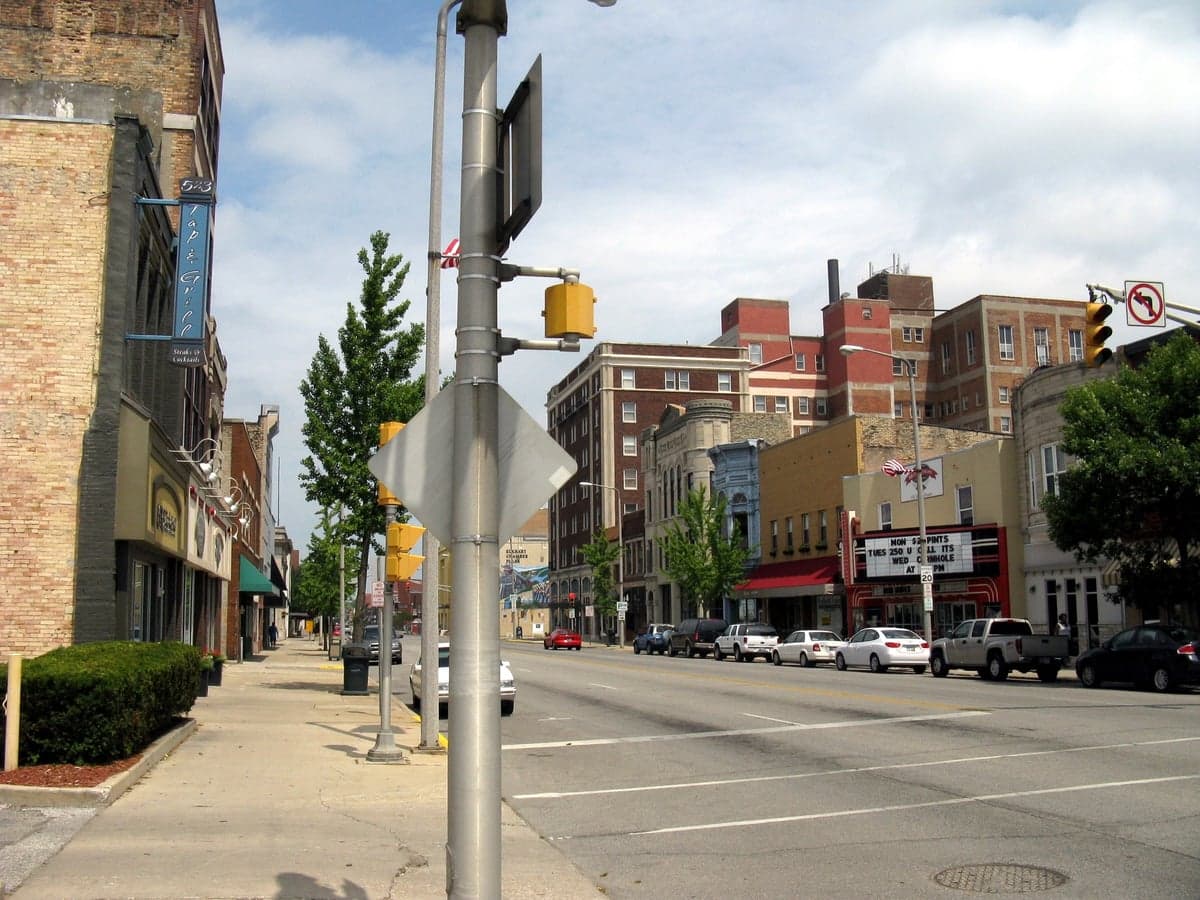
The people of Elkhart, Indiana, today number 53,726, forming a majority-minority city where White residents make up 55.6% of the population, Hispanic residents 27.4%, and Black residents 12.1%. The city is notably less college-educated than the national average—only 17.5% of adults hold a bachelor’s degree—reflecting its historic identity as a working-class manufacturing hub. A distinctive marker of Elkhart’s character is its high concentration of immigrant communities, with 9.0% of residents foreign-born, a figure that has reshaped neighborhoods and local politics in the last two decades.
How the city was settled and grew
Elkhart was founded in 1832 by Dr. Havilah Beardsley, who purchased land at the confluence of the St. Joseph and Elkhart Rivers and laid out a town grid. The original settlers were primarily Yankees from New England and upstate New York, drawn by water power for mills and later by the arrival of the Michigan Southern Railroad in 1851. These early families built the Island Park and Bristol Street neighborhoods, where large Victorian homes still stand. The city’s first major industrial boom came with the carriage and wagon trade in the 1870s, which attracted German and Irish immigrants who settled in the East Side district near the factories. By 1900, Elkhart had become a center for band instrument manufacturing—Conn, Selmer, and Blessing all located here—drawing skilled German and Italian craftsmen to the South Side neighborhoods around Main Street. The post-World War II era brought a second wave: Appalachian whites from Kentucky and Tennessee migrated for jobs at Miles Laboratories and the growing RV industry, settling in the Northwest area near the new industrial parks. These waves established Elkhart’s white working-class base, which dominated the city’s politics and culture through the 1960s.
Modern era (post-1965)
The 1965 Hart-Cellar Act opened immigration channels that transformed Elkhart’s demographics, though the shift took decades to materialize. The first major post-1965 group was Hispanic migrants, primarily from Mexico and later Central America, who arrived in the 1980s and 1990s to work in the RV and manufactured-housing plants. They concentrated in the Roosevelt Center area and along Prairie Street, where Spanish-language businesses and Catholic churches now anchor a dense corridor. The Black population, which had been small and historically confined to the Benham Avenue district near the railroad tracks, grew from about 5% in 1970 to 12.1% today, driven by domestic migration from Chicago and Gary for manufacturing jobs. East and Southeast Asian communities remain tiny at 0.4%, mostly Vietnamese and Burmese refugees who settled near County Road 6 in the city’s eastern fringe. The Indian-subcontinent population is negligible at 0.2%, largely professionals in healthcare and engineering who live scattered rather than in a distinct enclave. Suburbanization after 1990 hollowed out the historic core: white families moved to unincorporated areas like Concord and Osolo Township, leaving the city limits increasingly nonwhite. The 2020 census confirmed that Elkhart crossed the majority-minority threshold, with White residents falling below 60% for the first time.
The future
Elkhart’s population is trending toward further diversification, but the pattern is one of tribalization into distinct enclaves rather than homogenization. The Hispanic share, already 27.4%, is projected to reach 35-40% by 2040, driven by both immigration and higher birth rates, with the Roosevelt Center corridor becoming denser and more politically influential. The Black population is plateauing, as manufacturing job losses since 2008 have slowed domestic in-migration; the Benham Avenue area shows signs of aging in place. White flight to the surrounding townships continues, but a small counter-flow of young professionals is renovating homes in the Island Park historic district, drawn by low housing costs. The East and Southeast Asian and Indian populations are likely to remain small, as Elkhart lacks the professional job base—only 17.5% college-educated—to attract the tech and healthcare workers who cluster in larger metros. The next decade will likely see the city become more Hispanic-majority, with political power shifting accordingly, while the school system grapples with rising English-learner enrollment and declining overall enrollment.
For a conservative-leaning individual or family considering relocation, Elkhart is becoming a city where the old white working-class identity is fading, replaced by a younger, more Hispanic, and more Democratic-leaning electorate. The neighborhoods that once defined the city—Island Park, Bristol Street, the East Side—are now islands of historic stability surrounded by a rapidly changing demographic landscape. The practical implications are clear: schools are under strain, property taxes are rising to fund infrastructure for a growing immigrant population, and the local economy remains heavily dependent on the cyclical RV industry. Elkhart is not a homogenizing suburb; it is a working-class city in transition, where the next generation of residents will look very different from the last.

* Values derived from national, state, county, city and local statistics and may differ in a specific area. Last updated: 2026-04-22T09:09:50.000Z
Narrative content on this page is AI-generated and may contain mistakes. Verify any details that matter before acting on them.
ReloMaps may earn a commission from affiliate links at no extra cost to you.

