Photo: Wikipedia
Demographics of Ellicott City, MD
Affluence Level in Ellicott City, MD
An upper-middle-class area. Household wealth, education levels, and homeownership run ahead of national benchmarks.
People of Ellicott City, MD
Today, Ellicott City is a highly educated, majority-minority suburb of 73,737 residents where no single ethnic group holds a numerical majority. The city is defined by its large and nearly equal Indian-subcontinent (15.1%) and East/Southeast Asian (15.0%) populations, alongside a White population of 51.4% and smaller Black (7.9%) and Hispanic (5.0%) communities. With 69.6% of adults holding a college degree, the population is among the most credentialed in Maryland, and the 9.3% foreign-born share reflects a community built largely by professional-class immigrants and domestic migrants drawn to top-ranked schools and proximity to Washington, D.C., and Baltimore.
How the city was settled and grew
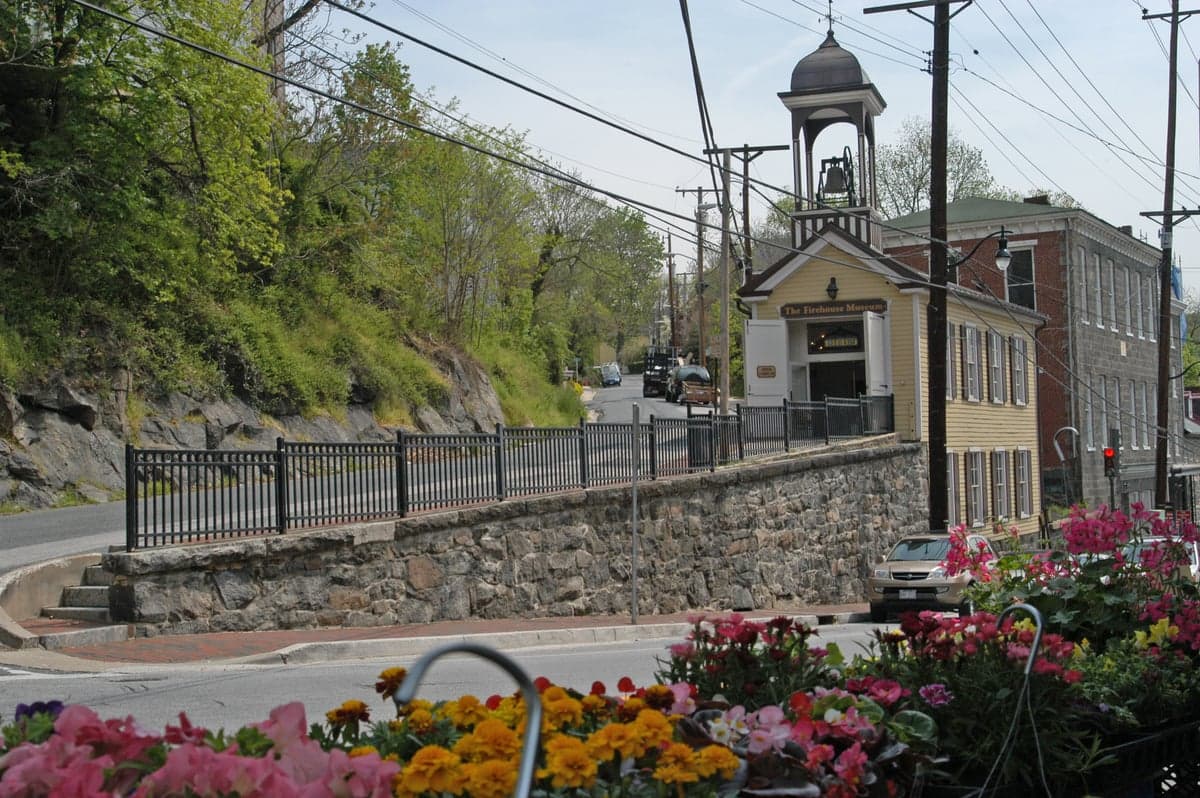
Ellicott City’s original population was shaped by the Patapsco River valley’s industrial potential. Founded in 1772 by the Quaker Ellicott brothers, the settlement grew around their flour mills and ironworks, attracting a workforce of European immigrants—primarily German and Irish laborers—who built the stone mill houses and workers’ cottages still visible in the Historic Ellicott City district along Main Street. The B&O Railroad’s arrival in 1830 made the town a transportation hub, drawing more Irish and later Italian immigrants to work on the rails and in the granite quarries. By the early 20th century, the population was overwhelmingly White and native-born, with a small Black community concentrated in the Harper’s Choice area, many descended from families who had worked the tobacco plantations that preceded the mills. The city remained a modest mill town until the post-World War II era, when the construction of U.S. Route 40 and the Baltimore Beltway (I-695) began transforming it into a bedroom suburb.
Modern era (post-1965)
The 1965 Hart-Celler Act and the expansion of the federal government in the 1970s and 1980s fundamentally reshaped Ellicott City’s population. The opening of the Columbia planned community next door in 1967 created a regional magnet for educated professionals, and Ellicott City’s older housing stock and larger lots attracted families who wanted more space. The first major wave of East/Southeast Asian immigrants—Chinese and Korean professionals—arrived in the 1980s, settling in the Dunloggin and Ellicott Hills neighborhoods, drawn by the Howard County public school system’s reputation. A second, larger wave of Indian-subcontinent immigrants—engineers, doctors, and IT workers—began arriving in the 1990s and 2000s, clustering in newer subdivisions like Centennial Lane and Worthington, where large single-family homes and easy access to the Baltimore-Washington corridor made the area attractive. Today, the Indian and East/Southeast Asian populations are nearly equal in size, but they remain residentially distinct: Indian families are more concentrated in the western parts of the city near Centennial Park, while East/Southeast Asian households are more dispersed across the eastern and central neighborhoods. The White population, while still the largest single group, has declined from over 80% in 1990 to 51.4% today, driven by both out-migration to more rural parts of Carroll County and the rapid influx of Asian and Indian families.
The future
Ellicott City’s population is projected to become more diverse and more Asian and Indian in the coming decade. The White share is expected to fall below 50% by 2030, while the Indian-subcontinent population is growing fastest, driven by both continued immigration and high birth rates among established families. New construction is concentrated in the Turf Valley area, where large townhome and single-family developments are attracting younger Indian and East/Southeast Asian families who want newer homes but cannot afford the older, larger lots in Centennial Lane. The Hispanic and Black populations are growing slowly, primarily through natural increase rather than new migration, and remain concentrated in the more affordable apartment complexes along Route 40 near the Ellicott City border with Catonsville. The city’s cultural identity is becoming more visibly Asian and Indian: the Main Street historic district now hosts several Indian grocery stores and restaurants, and the Howard County public schools have become a national model for serving a high-achieving, majority-minority student body. Flooding risks from the Patapsco River, which devastated Historic Ellicott City in 2016 and 2018, are pushing new development uphill toward the western edge of the city, accelerating the shift away from the old mill-town core.
For someone moving in now, Ellicott City is a high-cost, high-opportunity suburb where educational attainment and professional ambition define the social landscape. The population is becoming more Asian and Indian, more educated, and more dispersed across newer western neighborhoods, while the historic core struggles with infrastructure challenges. It is a place where a family’s zip code matters more than its ethnic background, and where the next decade will likely see the White share drop below half for the first time in the city’s 250-year history.

* Values derived from national, state, county, city and local statistics and may differ in a specific area. Last updated: 2026-08-26T18:44:07.000Z
Narrative content on this page is AI-generated and may contain mistakes. Verify any details that matter before acting on them.
ReloMaps may earn a commission from affiliate links at no extra cost to you.

