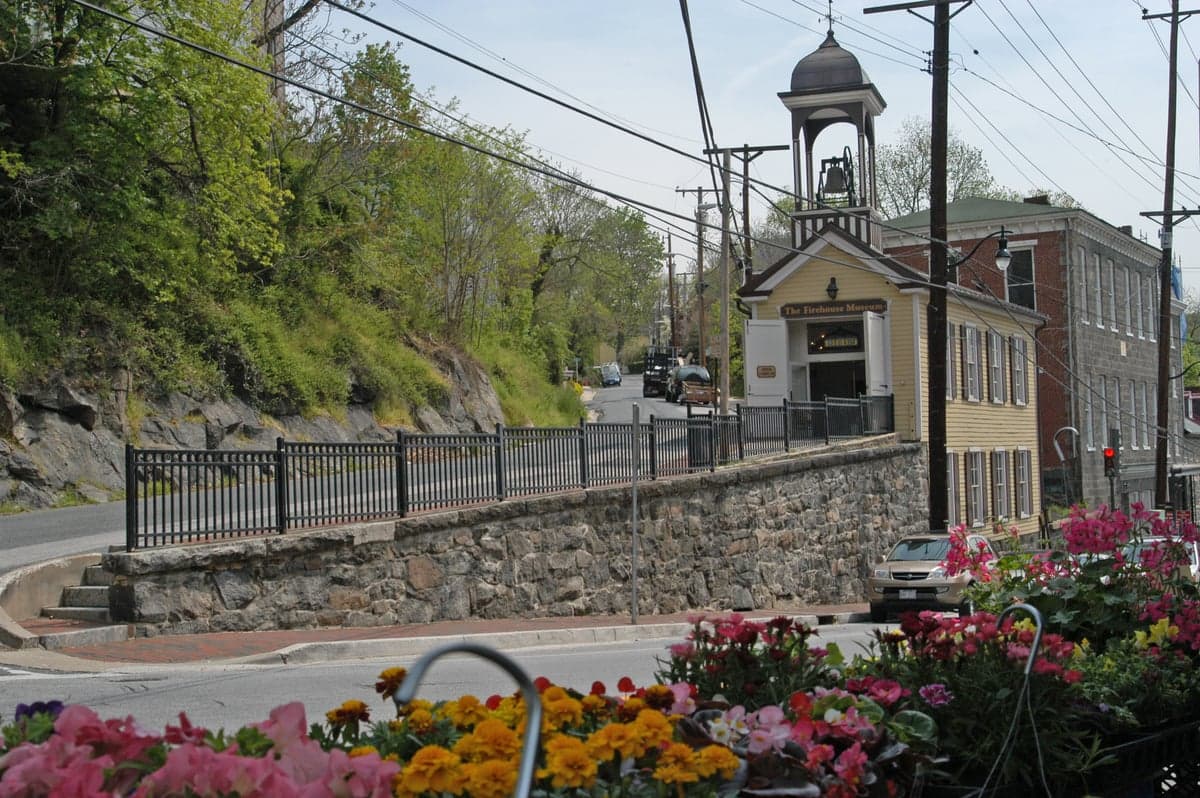
Photo: Wikipedia
Strategic Assessment of Ellicott City, MD
Meaningful friction. Expect exposure to either population pressure, blast zones, or natural disaster risk. Consider buying a retreat property.
What does the Strategic Assessment tell us?
Our Strategic Assessment grades tactical survivability of an area. Major population centers, military targets, fallout zones, natural disasters, and border exposure all drive risk — lower exposure means a more defensible position in a crisis.
This is heavily inspired by Joel Skousen's Strategic Relocation book. Highly recommended you checkout the book ($)What does this tell us?
Our Strategic Assessment grades tactical survivability of an area. Major population centers, military targets, fallout zones, natural disasters, and border exposure all drive risk — lower exposure means a more defensible position in a crisis.
This is heavily inspired by Joel Skousen's Strategic Relocation book. Highly recommended you checkout the book ($)Strategic Pillars

Key Distances
Regional Safe Places
Below is our recommended "safe zones" in Maryland and the surrounding area based on our strategic heuristics. For most people, it's unrealistic to live in a “safe zone” full-time due to work, family or other personal reasons. They tend to be more rural. However, many of these areas are perfect for second homes and retreat properties that double as a vacation home or even a short-term rental.
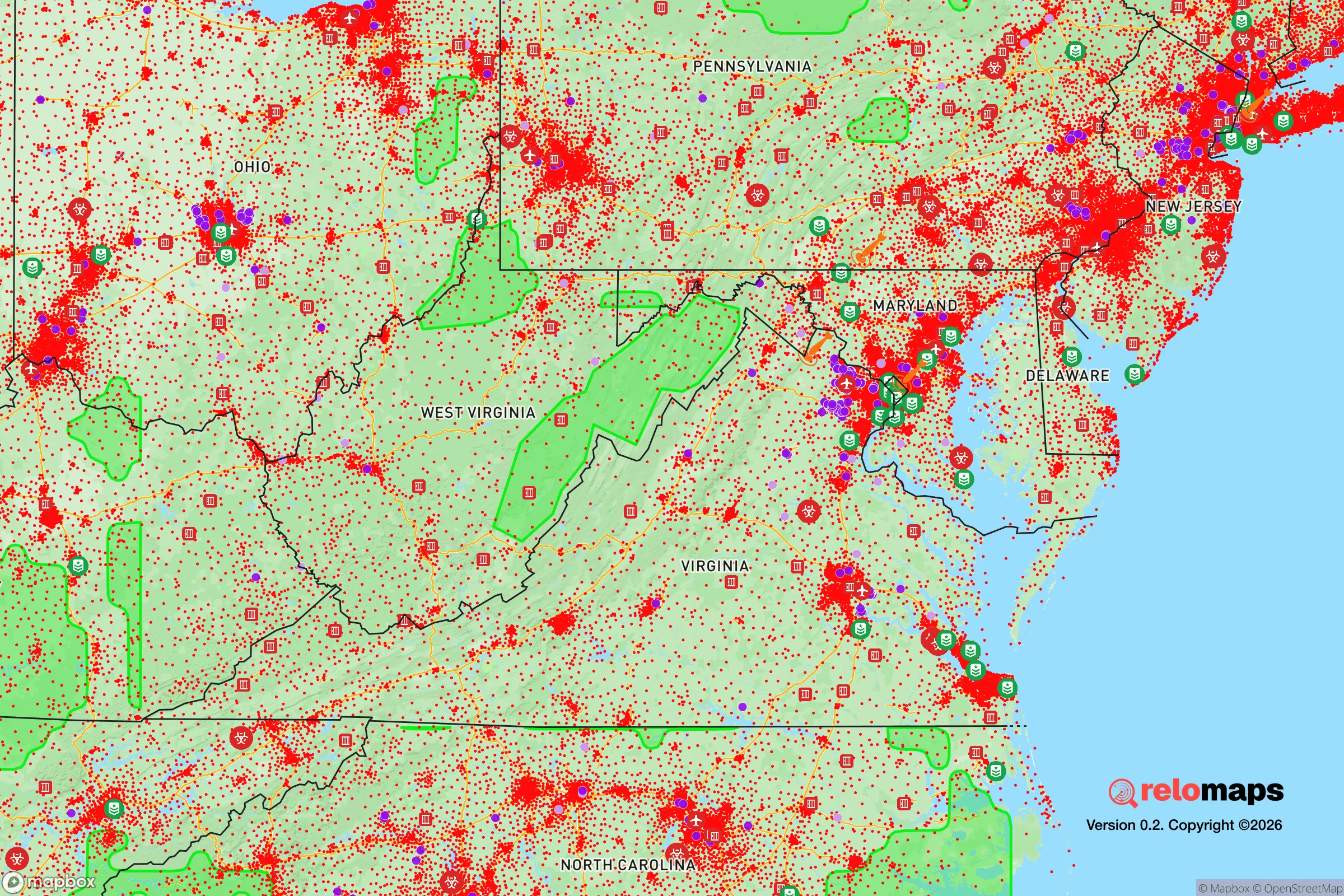
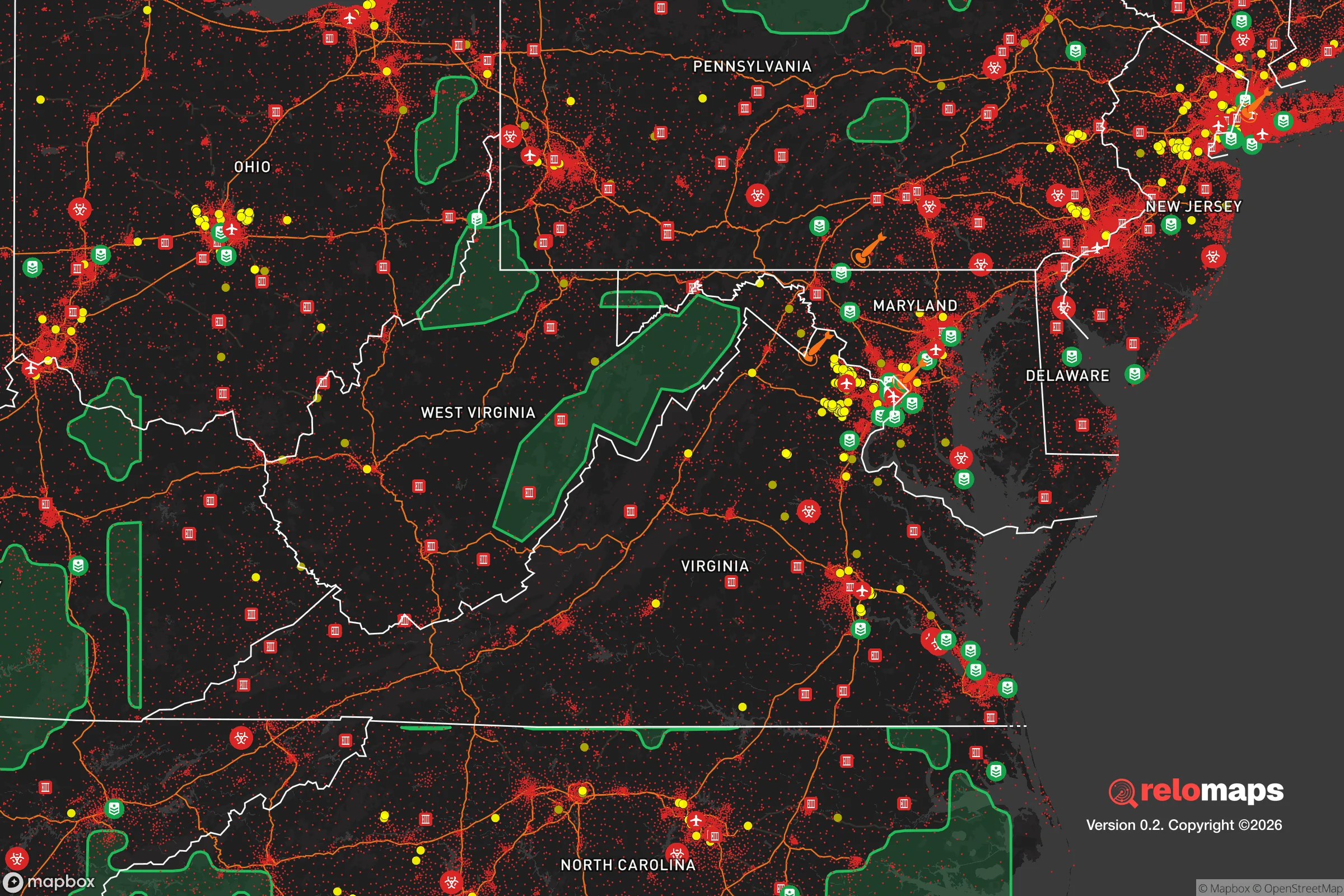


Important Note: For informational purposes only. This does not mean nothing bad ever happens in the green zones. Please use common sense. This is based on public data and modeled with AI. We tried to take a conservative approach but mistakes happen. We update this regularly as new information becomes available.
Solar Generator Recommendations
Backup power matters more here than in safer locations. We've picked three solar generators across budgets and capacity tiers — start with the budget unit if you only need a few essentials, or step up if you want to run a fridge and HVAC for days at a time.

Jackery Portable Power Station Explorer 300
Budget OptionPower on the Go: Weighing only 11 lbs, it's convenient to set up and store with book-sized foldable solar panels

BLUETTI Portable Power Station AC180
Designed for both indoor and outdoor scenarios, AC180 is highly capable as it has a robost capacity and continuous output power.

EF ECOFLOW DELTA Pro Ultra Power Station
Upgraded PickEcoFlow DELTA Pro Ultra is a whole-home energy system designed to grow with your family. Integrated with the Smart Home Panel 2, it scales to meet your evolving energy needs — keeping your home powered, intelligent, and secure through every stage of life.
We earn a commission, at no additional cost to you.
Strategic Assessment Analysis
Ellicott City, Maryland, presents a complex strategic picture for the relocation-minded reader prioritizing resilience and self-sufficiency. While its location in the Patapsco River valley offers genuine natural advantages in terms of water access and defensible terrain, the area’s well-documented flood history and its proximity to major metropolitan and military targets introduce significant vulnerabilities that demand careful consideration. For the conservative-leaning individual or family weighing disaster readiness, Ellicott City is a study in contrasts: a historically resilient community with deep local roots, yet one that sits within the shadow of Baltimore and Washington, D.C., and faces acute environmental risks that have repeatedly tested its infrastructure and resolve.
Geographic position and natural advantages for self-sufficiency
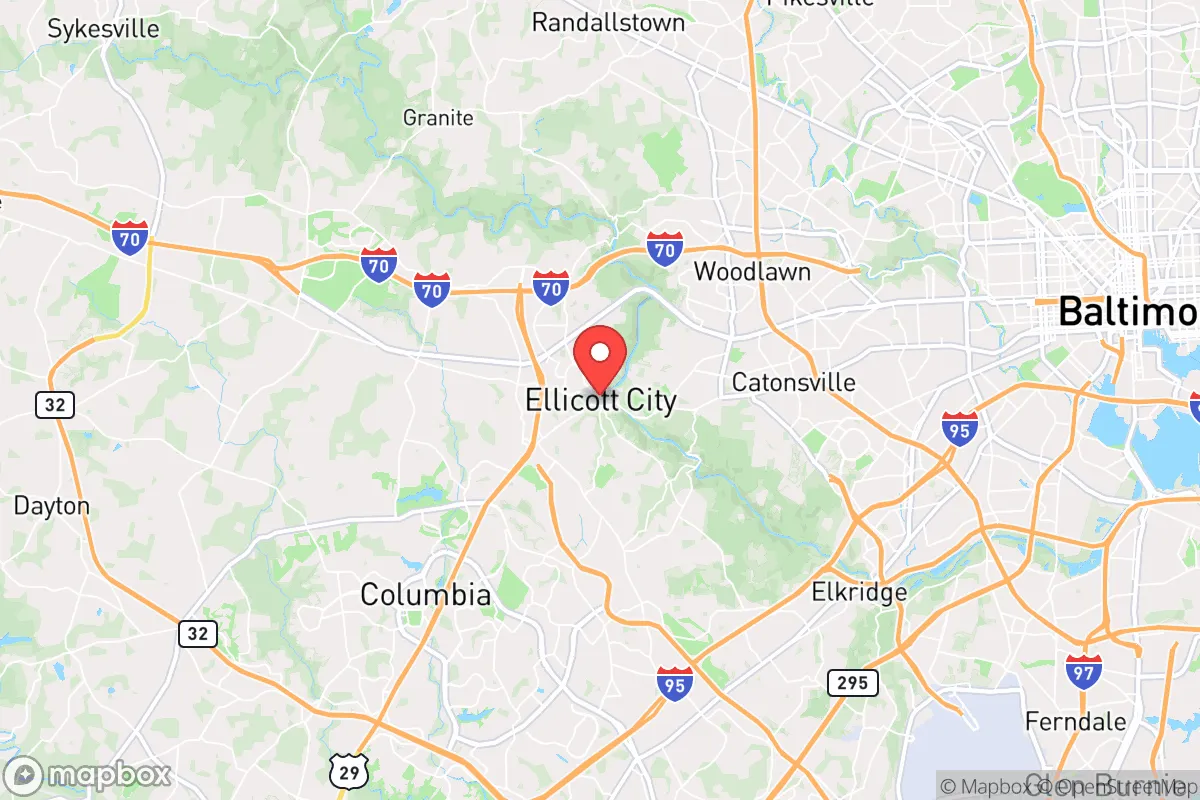
Ellicott City’s geography is a double-edged sword, but its natural advantages are real and worth examining first. The town is nestled in the Patapsco River valley, which provides a reliable freshwater source and a topography that historically offered natural defense and isolation. The surrounding Howard County landscape is a mix of rolling hills, forested ridges, and agricultural land, giving residents access to rural buffer zones that are increasingly rare along the I-95 corridor. The area’s position roughly 15 miles west of Baltimore and 30 miles north of Washington, D.C., means it sits at the edge of the suburban sprawl, where land is still affordable enough for small-scale homesteading or hobby farming. The proximity to the Patapsco Valley State Park—over 16,000 acres of protected forest—offers a substantial natural resource for foraging, hunting, and emergency wood fuel, though legal restrictions apply. For the self-sufficient relocator, the key advantage is that Ellicott City is not a dense urban core; it retains a small-town feel with a historic district that predates the modern grid, and its elevation in certain neighborhoods (particularly west of the historic downtown) provides some natural vantage points. The area’s temperate climate supports a long growing season (roughly 180 frost-free days), making year-round food production feasible with proper planning. However, these advantages are tempered by the fact that the valley floor itself is prone to flash flooding, which has repeatedly devastated the historic downtown and low-lying residential areas.
Risks, exposures, and proximity to fallout-relevant landmarks
The most significant strategic liability for Ellicott City is its location within the Baltimore-Washington metropolitan area, a region that ranks among the highest-priority targets for any large-scale conflict or terrorist event. The area lies within 20 miles of Fort Meade (home to the NSA), 25 miles of the Pentagon, and 30 miles of the White House and Capitol complex. Additionally, the Port of Baltimore, a major East Coast shipping hub, and BWI Thurgood Marshall Airport are both within a 15-minute drive. In a nuclear or radiological event, Ellicott City’s position in the Patapsco River valley could channel fallout from a strike on Washington or Baltimore, depending on prevailing winds. The proximity to these high-value targets is a clear negative for the resilience-minded relocator. Beyond man-made risks, the area’s natural hazard profile is dominated by flooding. The historic downtown has experienced catastrophic flash floods in 2016, 2018, and 2024, with the 2016 event killing two people and causing over $22 million in damage. The Federal Emergency Management Agency (FEMA) has designated large portions of the Patapsco floodplain as Special Flood Hazard Areas, and the county has spent over $50 million on mitigation efforts, including buyouts and channel improvements. Other natural risks include occasional derechos (the 2012 event left 1.2 million Marylanders without power), winter storms that can knock out power for days, and the potential for landslides on the steep valley slopes. The area’s seismic risk is low, but not zero—the 2011 Mineral, Virginia earthquake was felt strongly in Ellicott City. For the relocator, the key takeaway is that the flood risk is not theoretical; it is a recurring, documented threat that has shaped the town’s recent history and will continue to do so.
Practical resilience for a relocator: food, water, energy, and defensibility
For the individual or family serious about self-sufficiency, Ellicott City offers a mixed but workable environment. Water access is a genuine strength: the Patapsco River and its tributaries provide surface water, and the area’s groundwater table is generally high, making well drilling feasible in many parts of the county. However, the municipal water supply for most of Ellicott City comes from the Liberty Reservoir and the Patapsco River, both of which are vulnerable to contamination from upstream industrial sites or a coordinated attack. A private well with a hand pump is a prudent investment. Food production is viable but requires effort. The soil in the valley is loamy and fertile, and Howard County’s agricultural preservation program has protected over 20,000 acres of farmland. Local farmers’ markets and CSAs are abundant, but for the self-sufficient relocator, the key is to secure land outside the floodplain—ideally on the western ridges or near the county’s rural west. The growing season is long enough for two crops of cool-weather vegetables, and deer hunting is legal in designated areas of the Patapsco Valley State Park. Energy resilience is a moderate challenge. The grid in Howard County is maintained by BGE, which has a mixed record on storm restoration; the 2012 derecho left some areas without power for over a week. Solar potential is decent (Maryland averages 4.5 peak sun hours per day), but the tree canopy in the valley can limit rooftop solar efficiency. A backup generator or a small off-grid solar system with battery storage is strongly recommended. Defensibility is the area’s weakest point. The historic downtown is a choke point, with narrow streets and limited egress routes. The main evacuation corridors—US-40, MD-144, and I-70—can gridlock quickly during an emergency. The valley topography creates natural funnels that could be exploited by an adversary, and the proximity to major highways means that any large-scale evacuation from Baltimore or Washington would likely overwhelm local roads. For the relocator, the best defensive posture is to live on the western edge of the county, away from the floodplain and the major transit corridors, where rural roads offer multiple escape routes and the terrain provides natural cover.
The overall strategic picture for Ellicott City is one of calculated trade-offs. It offers genuine natural advantages—water, fertile soil, forested buffer zones, and a temperate climate—that support a self-sufficient lifestyle, and its historic community has demonstrated remarkable resilience in the face of repeated disasters. However, the area’s proximity to high-value targets in Baltimore and Washington, D.C., its acute flood risk, and its limited egress routes make it a less-than-ideal choice for the relocator whose primary concern is strategic security. For the conservative-leaning individual or family who values community ties, local governance, and the ability to produce their own food, Ellicott City can work—but only if they choose a home site carefully, invest in flood mitigation and backup systems, and maintain a low profile. It is not a survivalist’s paradise, but it is a place where a prepared and determined household can build a resilient life, provided they accept the risks that come with living in the shadow of the nation’s capital.

* Values derived from national, state, county, city and local statistics and may differ in a specific area. Last updated: 2026-08-26T18:44:07.000Z
Narrative content on this page is AI-generated and may contain mistakes. Verify any details that matter before acting on them.
ReloMaps may earn a commission from affiliate links at no extra cost to you.

