
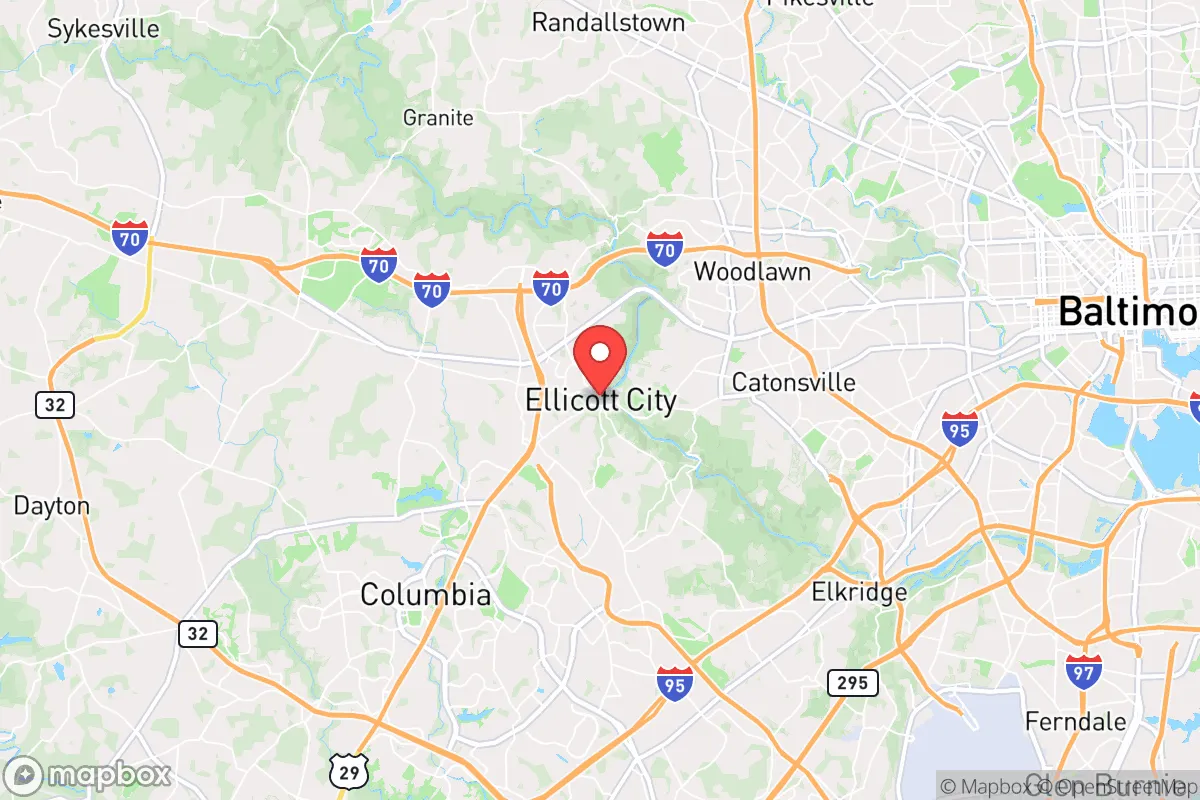
Photo: Wikipedia
Personal Sovereignty in Ellicott City, MD
Viable for self-reliance. Generally workable, though some barriers may limit total independence.
What does Personal Sovereignty tell us?
Personal Sovereignty measures your capacity for self-reliance and independence with minimal government friction. Higher scores mean fewer barriers between you and the way you want to live... but it assumes you have the space you need and good neighbors.
What does this tell us?
Personal Sovereignty measures your capacity for self-reliance and independence with minimal government friction. Higher scores mean fewer barriers between you and the way you want to live... but it assumes you have the space you need and good neighbors.
State Policy
Energy independence: Importer (8% of energy produced in-state)
Personal Liberty
Homesteading

Personal Liberty Analysis
Ellicott City, Maryland, presents a nuanced personal sovereignty environment where local autonomy is shaped by a mix of Howard County’s progressive governance and Maryland’s state-level regulatory framework. For individuals and families prioritizing independence, the area offers strong property rights and a relatively low-crime setting, but it also imposes notable constraints on self-defense options, tax burdens, and off-grid living. The overall autonomy picture is one of trade-offs: robust personal freedoms in daily life and parental rights coexist with higher taxes and tighter gun laws than in many neighboring states.
Tax burden and regulatory posture in Howard County
Maryland’s tax burden ranks among the highest in the nation, and Howard County is no exception. The state’s income tax ranges from 2% to 5.75%, with Howard County adding a local income tax of 3.2% — one of the highest county rates in Maryland. Property taxes in Ellicott City are levied at a combined rate of roughly $1.10 per $100 of assessed value, including county, state, and fire district taxes. This places the total effective property tax rate around 1.1%, which is moderate for the region but higher than many Sun Belt states. The regulatory posture in Howard County is generally heavy-touch, particularly in land use and development. Zoning is strict, with most residential areas designated for single-family homes on minimum lot sizes of 10,000 to 20,000 square feet, limiting density but also restricting alternative housing like tiny homes or accessory dwelling units without special permits. Business regulations are thorough, with county-level permitting processes that can be time-consuming for new ventures. However, the county does not impose a local sales tax beyond the state’s 6% rate, and there is no county-level business income tax, which slightly offsets the overall burden. For a relocation-minded reader, the tax and regulatory environment in Ellicott City is best described as high-cost but predictable — a trade-off for access to top-tier schools and infrastructure.
Self-defense and gun law specifics in Maryland
Maryland’s gun laws are among the most restrictive in the United States, and Ellicott City residents must navigate a dense regulatory landscape. The state requires a Handgun Qualification License (HQL) to purchase a handgun, which involves fingerprinting, a background check, and an approved firearms safety course. Long gun purchases (rifles and shotguns) require a separate background check and a seven-day waiting period. Maryland is a “may issue” state for concealed carry permits, meaning applicants must demonstrate a “good and substantial reason” to carry a firearm — a standard that has been somewhat loosened after the 2022 Supreme Court ruling in NYSRPA v. Bruen, but the state still maintains a rigorous application process. The state bans certain “assault weapons” and limits magazine capacity to 10 rounds for long guns and 10 rounds for handguns. Self-defense in the home is generally protected under the Castle Doctrine, but Maryland does not have a “stand your ground” law; instead, it imposes a duty to retreat in public spaces if safely possible. For residents of Ellicott City, this means that while owning a firearm for home defense is legally accessible (with the HQL), carrying one outside the home is heavily regulated and practically difficult without a permit. The county itself has a low violent crime rate — roughly 1.5 incidents per 1,000 residents in 2024 — which reduces the urgency for self-defense measures but also reflects the community’s overall safety profile.
Self-reliance and homesteading viability: lot sizes, zoning, and off-grid feasibility
Ellicott City’s suburban character limits the viability of traditional homesteading and off-grid living. Most residential lots in the area range from 0.25 to 0.5 acres in established neighborhoods, with some larger parcels (1–2 acres) in the western parts of the county. Zoning regulations in Howard County are strict: raising livestock (chickens, goats, etc.) is generally prohibited on lots under one acre, and even on larger properties, permits and setback requirements apply. Off-grid systems like solar panels and rainwater collection are permitted but heavily regulated. Solar installations must comply with county building codes and homeowners’ association (HOA) rules, which often restrict panel placement. Rainwater harvesting for non-potable uses (irrigation) is allowed, but potable rainwater collection requires a state-approved filtration system and is rare. Composting toilets and greywater systems are legal but require permits and inspections, making true off-grid living impractical for most residents. The county’s infrastructure is robust — grid electricity, municipal water, and sewer are standard — so disconnecting from utilities is not a realistic option without significant regulatory hurdles. For those seeking self-reliance, the best approach in Ellicott City is to focus on small-scale gardening, backyard composting, and energy efficiency within the existing suburban framework, rather than full homesteading.
Personal liberties: parental rights, medical autonomy, speech, and property
Maryland law generally respects parental rights in education and healthcare, though with some state-level mandates. Parents in Howard County have the right to homeschool under the state’s “portfolio review” option, which requires annual submission of a curriculum plan and a portfolio of student work for review by the local school system — a moderate regulatory burden compared to states with no oversight. Medical autonomy is mixed: Maryland has broad vaccine mandates for school attendance (including COVID-19 for K-12 students, with limited religious exemptions), and the state’s medical aid-in-dying law (the “End of Life Option Act”) is available to terminally ill adults. Free speech protections are strong under both the First Amendment and Maryland’s state constitution, with no notable local restrictions beyond standard time, place, and manner regulations for public demonstrations. Property rights are well-protected in Howard County, with clear zoning laws and a predictable permitting process. Eminent domain is rarely used for private development, and the county has a strong record of respecting property boundaries and land use. However, homeowners’ associations (HOAs) are common in newer subdivisions and can impose additional restrictions on exterior modifications, landscaping, and parking — a factor to consider for those who value unencumbered property use.
Overall, Ellicott City offers a moderate level of personal sovereignty that is constrained by Maryland’s high tax burden and restrictive gun laws, but supported by strong property rights, good public services, and a low-crime environment. For a conservative-leaning individual or family, the area’s autonomy profile is best suited to those who prioritize safety, education, and predictable governance over low taxes or off-grid independence. Compared to rural areas in the South or Midwest, Ellicott City is less permissive; compared to neighboring states like Virginia or Pennsylvania, it is more regulated. The trade-off is access to one of the best public school systems in the nation and a stable, well-maintained community — a calculation that many families find worthwhile despite the regulatory overhead.

* Values derived from national, state, county, city and local statistics and may differ in a specific area. Last updated: 2026-08-26T18:44:07.000Z
Narrative content on this page is AI-generated and may contain mistakes. Verify any details that matter before acting on them.
ReloMaps may earn a commission from affiliate links at no extra cost to you.

