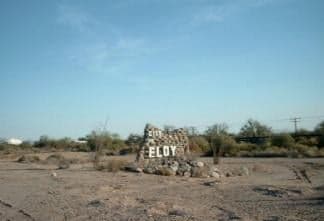
Photo: Wikipedia
Demographics of Eloy, AZ
Affluence Level in Eloy, AZ
A low-income area with significant economic hardship. Household wealth and educational attainment are well below national averages.
People of Eloy, AZ
Eloy, Arizona, is a small, working-class city of 16,671 residents with a distinctly Hispanic-majority character (47.4%) and a significant White minority (34.8%). Its population is younger and less college-educated than state averages—only 12.6% hold a bachelor’s degree—and its foreign-born share of 9.8% reflects a steady, though not explosive, immigrant presence. The city’s identity is shaped by its agricultural roots, its role as a state prison hub, and a growing but still modest Black community (7.9%), giving it a blue-collar, multiethnic feel that differs sharply from the retirement-heavy towns of Pinal County.
How the city was settled and grew
Eloy was founded in 1907 as a railroad siding on the Southern Pacific line, named after the wife of a railroad official. The city’s original population was drawn by irrigated cotton farming, which boomed after the construction of the San Carlos Irrigation Project in the 1920s. White tenant farmers from the Dust Bowl states—Oklahoma, Texas, Arkansas—arrived in the 1930s and 1940s, settling in the Historic Downtown area around Main Street and the railroad tracks. At the same time, Mexican-American laborers, many from Sonora and Chihuahua, were recruited for cotton picking and established the Barrio Libre neighborhood south of the tracks, a tight-knit enclave that remains the heart of Eloy’s Hispanic community. A smaller wave of Black farmworkers, mostly from the Deep South, arrived during World War II and formed a cluster near Sunland Gin Road, though their numbers remained small until later decades. By 1950, Eloy’s population was roughly 4,000, overwhelmingly White and Hispanic, with a rigid social divide between the Anglo downtown and the Mexican-American barrio.
Modern era (post-1965)
The 1965 Immigration and Nationality Act, combined with the expansion of the state prison system in the 1980s, reshaped Eloy’s demographics. The opening of the Arizona State Prison Complex – Eloy in 1985 brought a wave of correctional officers and support staff, many of whom were White and Hispanic, settling in the newer Sunland Meadows subdivision on the city’s west side. Meanwhile, agricultural mechanization reduced the need for seasonal labor, but year-round farmwork in cotton, alfalfa, and pecans continued to attract Mexican immigrants, who filled the Santa Cruz Village mobile home park and the Eloy Estates area. The Hispanic share rose from roughly 30% in 1980 to 47.4% today, driven by both immigration and higher birth rates. The Black population grew from under 2% in 1990 to 7.9% by 2020, largely due to prison-related relocations—families of inmates and former inmates settling in the Sunland Gin Road corridor. East/Southeast Asian communities remain tiny at 0.9%, concentrated among a few Hmong and Filipino families in Sunland Meadows. The Indian-subcontinent population is effectively zero, reflecting Eloy’s lack of tech or professional-sector jobs.
The future
Eloy’s population is trending toward further Hispanicization, with the White share declining from 45% in 2000 to 34.8% today. The foreign-born share has plateaued at around 10%, suggesting that growth is now driven by U.S.-born Hispanic families rather than new immigration. The city is not tribalizing into distinct enclaves—Barrio Libre and Santa Cruz Village remain heavily Hispanic, but newer subdivisions like Sunland Meadows are more mixed, with White, Hispanic, and Black families living side by side. The Black population is likely to stabilize or grow slowly, tied to the prison economy, while East/Southeast Asian numbers will remain negligible. Over the next 10–20 years, Eloy will likely become a majority-Hispanic city with a significant White minority and a small but stable Black community, resembling other Pinal County farm towns like Casa Grande and Coolidge. The lack of college-educated residents and professional jobs means the city will remain working-class, with limited in-migration from outside Arizona.
For someone moving in now, Eloy is a predominantly Hispanic, blue-collar city with a stable population and a modest immigrant presence. It is not a place of rapid demographic change or cultural friction—rather, it is a slow-growing, family-oriented community where the main dividing lines are economic, not ethnic. New residents should expect a quiet, affordable environment with a strong agricultural and correctional-industry base, and little of the suburban sprawl or retirement influx seen in nearby Maricopa or Casa Grande.

* Values derived from national, state, county, city and local statistics and may differ in a specific area. Last updated: 2026-05-01T02:03:48.000Z
Narrative content on this page is AI-generated and may contain mistakes. Verify any details that matter before acting on them.
ReloMaps may earn a commission from affiliate links at no extra cost to you.

