Photo: Wikipedia
Demographics of Escondido, CA
Affluence Level in Escondido, CA
A middle-class area roughly in line with national averages across income, home values, education, and employment.
People of Escondido, CA
Escondido, California, is a majority-Hispanic city of 149,913 residents where no single ethnic group holds a demographic majority, creating a distinctive blend of working-class immigrant energy and established suburban stability. The city’s population is 51.7% Hispanic, 34.5% White, 6.6% East/Southeast Asian, 2.1% Black, and 0.3% Indian (subcontinent), with 13.9% foreign-born and 27.8% college-educated. Escondido feels less like a San Diego bedroom suburb and more like a self-contained inland city with its own downtown core, agricultural roots, and a growing sense of cultural identity shaped by successive waves of Mexican, Filipino, and Vietnamese settlement.
How the city was settled and grew
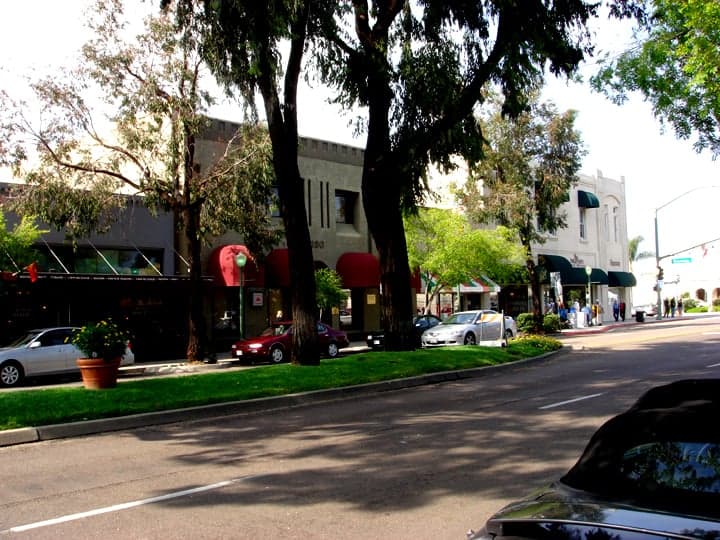
Escondido’s population history begins not with Spanish missions but with the 1846 Mexican land grant of Rancho Rincon del Diablo, which passed to American hands after the U.S. annexation of California. The city was formally founded in 1888 by the Escondido Land and Town Company, which marketed the area to Midwestern farmers seeking a Mediterranean climate for citrus, olives, and grapes. The original Anglo-American settlers—largely from Iowa, Illinois, and Missouri—built the core of what is now Old Escondido, the historic downtown grid centered on Grand Avenue and Broadway. These early residents were predominantly Protestant, small-town Midwesterners who established a conservative civic culture that persisted for decades. By the 1920s, a small Mexican labor population had settled in what became Barrio Escondido, the neighborhood south of downtown along Mission Avenue, working the citrus groves and packing houses. A second pre-war wave brought Dust Bowl migrants from Oklahoma and Arkansas, who settled in the North Broadway corridor and the working-class tracts near the railroad line. The city’s population remained overwhelmingly white and agricultural through the 1950s, reaching about 16,000 by 1960.
Modern era (post-1965)
The 1965 Hart-Cellar Immigration Act fundamentally reshaped Escondido’s population. The city’s agricultural economy—avocados, citrus, and nursery crops—drew a large Mexican and Central American labor force, and by 1980 the Hispanic share had risen to roughly 20%. These families concentrated in Barrio Escondido and the Midway District along Mission Road, where older housing stock and proximity to farm work made settlement practical. A second major post-1965 wave brought East/Southeast Asian immigrants, particularly Filipinos and Vietnamese, who arrived after the Vietnam War and settled in the East Escondido neighborhoods near Valley Parkway and the Felicitas area east of I-15. These communities were drawn by affordable housing, existing ethnic networks, and service-sector jobs in the growing retail and healthcare industries. Domestic in-migration from the 1980s through the 2000s brought white retirees and families from coastal San Diego County seeking cheaper land, filling master-planned subdivisions like Hidden Meadows in the north and San Pasqual Valley in the south. By 2010, the Hispanic share had crossed 50%, and the white share had fallen below 40%, a shift driven both by immigration and by white out-migration to more distant exurbs like Temecula and Murrieta. The Asian population grew steadily but more slowly, reaching 6.6% by the 2020 Census, while the Black population remained small at 2.1% and the Indian-subcontinent population negligible at 0.3%.
The future
Escondido’s population is likely to continue its gradual Hispanicization, though at a slower pace than the 1990–2010 period. The foreign-born share of 13.9% is below the California average of about 27%, suggesting that the Hispanic growth is now driven more by U.S.-born second-generation families than by new immigration. The white population is aging and declining, while the East/Southeast Asian communities are stable but not rapidly expanding. The city is not tribalizing into hostile enclaves—neighborhoods like Barrio Escondido and East Escondido remain mixed-income and ethnically diverse—but distinct residential patterns persist: Hidden Meadows remains overwhelmingly white and affluent, while Barrio Escondido is heavily Hispanic and working-class. The college-educated share of 27.8% is below the San Diego County average of roughly 40%, reflecting the city’s blue-collar base, but new housing developments near the I-15 corridor and the planned Escondido Transit Center redevelopment may attract more educated professionals priced out of coastal cities. The next decade will likely see continued demographic stability rather than dramatic change, with the Hispanic share plateauing near 55–58% and the white share settling around 30–32%.
For a conservative-leaning mover today, Escondido offers a politically moderate-to-conservative inland city with a strong working-class identity, a growing Hispanic majority, and a declining but still influential white population. The city is not homogenizing into a monoculture; it is becoming a stable, majority-minority community where distinct neighborhoods retain their character. New arrivals should expect a place where agricultural roots still matter, where the cost of living is lower than coastal San Diego, and where the population is more family-oriented and less transient than in many Southern California suburbs.

* Values derived from national, state, county, city and local statistics and may differ in a specific area. Last updated: 2026-04-29T23:44:57.000Z
Narrative content on this page is AI-generated and may contain mistakes. Verify any details that matter before acting on them.
ReloMaps may earn a commission from affiliate links at no extra cost to you.

