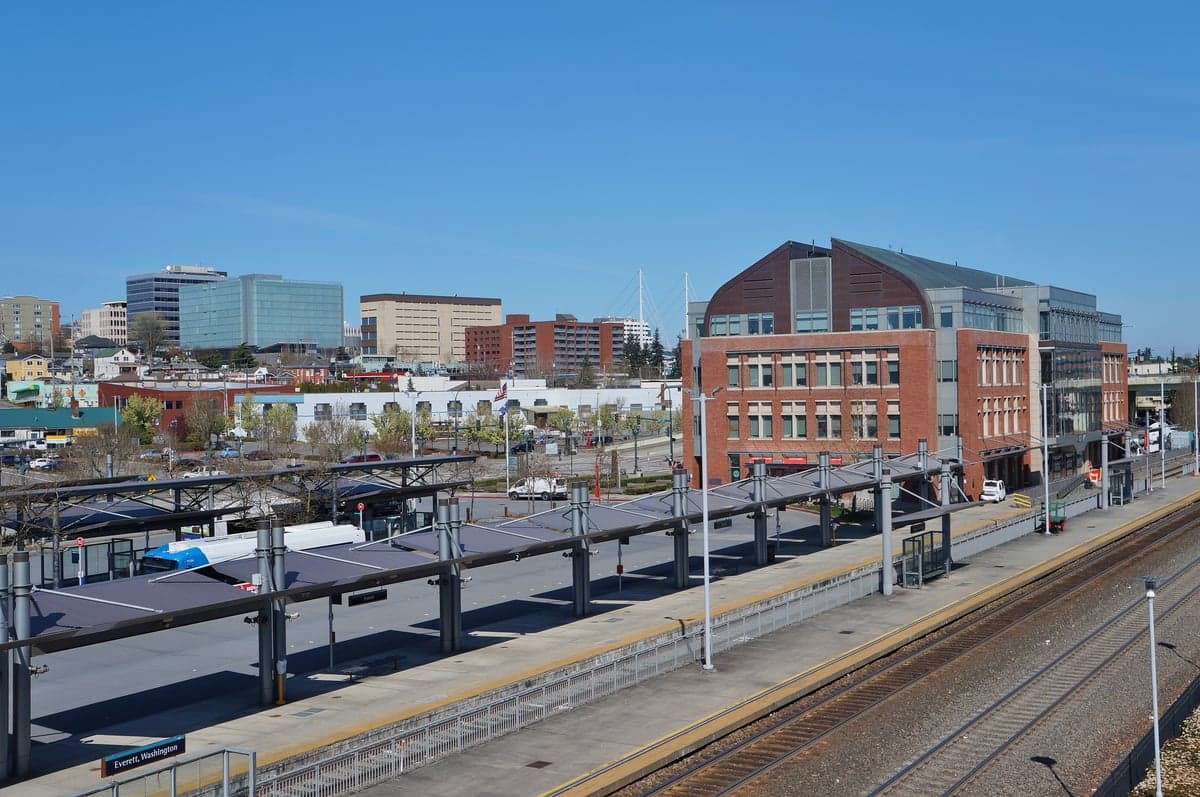
Photo: Wikipedia
Personal Sovereignty in Everett, WA
Viable for self-reliance. Generally workable, though some barriers may limit total independence.
What does Personal Sovereignty tell us?
Personal Sovereignty measures your capacity for self-reliance and independence with minimal government friction. Higher scores mean fewer barriers between you and the way you want to live... but it assumes you have the space you need and good neighbors.
What does this tell us?
Personal Sovereignty measures your capacity for self-reliance and independence with minimal government friction. Higher scores mean fewer barriers between you and the way you want to live... but it assumes you have the space you need and good neighbors.
State Policy
Energy independence: Importer (55% of energy produced in-state)
Personal Liberty
Homesteading

Personal Liberty Analysis
Everett, Washington, presents a complex picture for those prioritizing personal sovereignty. While the city itself operates under the broader constraints of Washington State’s increasingly centralized governance, certain local conditions offer a degree of autonomy that can be leveraged by the prepared individual. The key is understanding that personal freedom here is not a given but a terrain to be navigated—a mix of high taxes, restrictive state laws, and pockets of practical self-reliance that reward strategic thinking. For the survivalist or prepper, Everett is a location where you must actively carve out your sphere of control, rather than having it handed to you.
Tax burden and regulatory posture: the cost of staying free
Washington State’s lack of a personal income tax is often cited as a freedom-friendly feature, but the reality is more nuanced. Everett residents face a combined state and local sales tax rate of 10.1% (as of 2025), one of the highest in the nation, which hits every purchase hard—from bulk ammo to freeze-dried food. Property taxes in Snohomish County are also significant, with effective rates around 0.9% to 1.1% of assessed value, and assessments have climbed sharply with the region’s real estate inflation. The regulatory environment is equally burdensome: Washington’s Growth Management Act imposes strict land-use controls that limit rural development and off-grid building, while the state’s energy code and environmental regulations add layers of permitting costs. For the prepper, this means that every square foot of land you own comes with a tax and compliance price tag that can eat into your self-reliance budget. The state’s business-friendly reputation is largely a myth for the small-scale operator; home-based enterprises face zoning hurdles and licensing fees that discourage true economic independence.
Self-defense and gun law specifics: navigating a restrictive landscape
Washington has moved decisively toward firearm restrictions in recent years, and Everett residents must operate within this tightening framework. The state’s I-1639 (2018) imposed enhanced background checks, a 10-day waiting period, and a minimum age of 21 for semi-automatic rifle purchases—a direct hit on the prepper’s preferred toolset. In 2023, the legislature passed a ban on the manufacture, sale, and import of many semi-automatic firearms (HB 1240), along with a ban on magazines holding more than 10 rounds (HB 1143). These laws are actively enforced in Snohomish County, with local law enforcement generally compliant with state mandates. However, Everett’s proximity to Skagit and Island counties offers a practical workaround for those willing to travel for private transfers or to store certain items outside city limits. The city itself has a mixed record on concealed carry: while Washington is a “shall issue” state for permits, the process requires a 90-day wait, a state-approved training course, and a fee of around $50. Open carry is legal but practically discouraged in urban areas. For the survivalist, the takeaway is clear: stockpile legally compliant magazines and firearms now, because the window for acquisition is closing, and enforcement is not lenient.
Self-reliance and homesteading viability: lot sizes, zoning, and off-grid feasibility
Within Everett’s city limits, traditional homesteading is nearly impossible. Standard residential lots average 5,000 to 7,000 square feet, with zoning that prohibits livestock, large gardens, or any structure not tied to the municipal water and sewer grid. The city’s urban growth boundary (UGB) effectively caps rural expansion, pushing serious self-reliance seekers to unincorporated Snohomish County or neighboring counties. In areas like Lake Stevens, Granite Falls, or Arlington (30-45 minutes north), you can find 1- to 5-acre parcels zoned for agricultural use, where chickens, goats, and even small-scale orchards are permitted. Off-grid living is legally challenging: Washington’s building codes require connection to approved septic and water systems, and solar panels must meet utility interconnection standards. Rainwater collection is allowed but regulated, and composting toilets require a permit. The practical reality is that true off-grid independence is not feasible within Everett’s jurisdiction; you need to buy land outside the UGB, where county-level enforcement is less aggressive. For the prepper, this means commuting to your retreat property is a necessary trade-off—but the proximity to the Puget Sound and Cascade foothills offers excellent foraging, hunting, and water access that many inland areas lack.
Personal liberties: parental rights, medical autonomy, speech, and property
Washington State has become a battleground for personal liberties, and Everett reflects that tension. Parental rights are under pressure: the state’s 2023 “shield law” for gender-affirming care effectively overrides parental consent in certain medical decisions, and school districts in Snohomish County have adopted policies that limit parental notification on student health matters. Medical autonomy is similarly constrained—Washington has a strict vaccine mandate for healthcare workers and school attendance, and the state’s public health emergency powers were used aggressively during COVID-19, including business closures and mask mandates that were enforced by local health departments. Free speech is protected under the First Amendment, but the state’s malicious harassment law and local “hate crime” ordinances create a chilling effect on political expression, particularly around sensitive topics. Property rights are the strongest of the bunch: while zoning is restrictive, eminent domain is rarely used for private development, and the state’s takings law offers some compensation for regulatory overreach. For the conservative-leaning individual, the key is to build a legal buffer—form an LLC for your property, document all medical decisions, and keep your political speech private or within trusted circles. The legal climate is not hostile to all freedoms, but it is selectively restrictive, and the burden of proof often falls on the citizen.
In the broader context of the Pacific Northwest, Everett offers a moderate level of personal sovereignty—better than Seattle or King County, but far worse than rural Idaho or Montana. The city’s industrial base (Boeing, naval station) provides economic resilience, but the state’s tax and regulatory apparatus steadily erodes the margin of freedom. For the survivalist or prepper, the strategic play is to use Everett as a base for income and logistics while securing a retreat property in a less restrictive county. The trade-offs are real: you pay high taxes and accept limited gun rights, but you gain access to a robust job market, a major port, and a climate that supports year-round food production. Personal sovereignty here is not about total independence—it’s about knowing where the lines are drawn and positioning yourself to operate within them without surrendering your core values. If you’re willing to be strategic, Everett can work; if you expect freedom to be handed to you, look elsewhere.

* Values derived from national, state, county, city and local statistics and may differ in a specific area. Last updated: 2026-04-21T11:03:12.000Z
Narrative content on this page is AI-generated and may contain mistakes. Verify any details that matter before acting on them.
ReloMaps may earn a commission from affiliate links at no extra cost to you.

