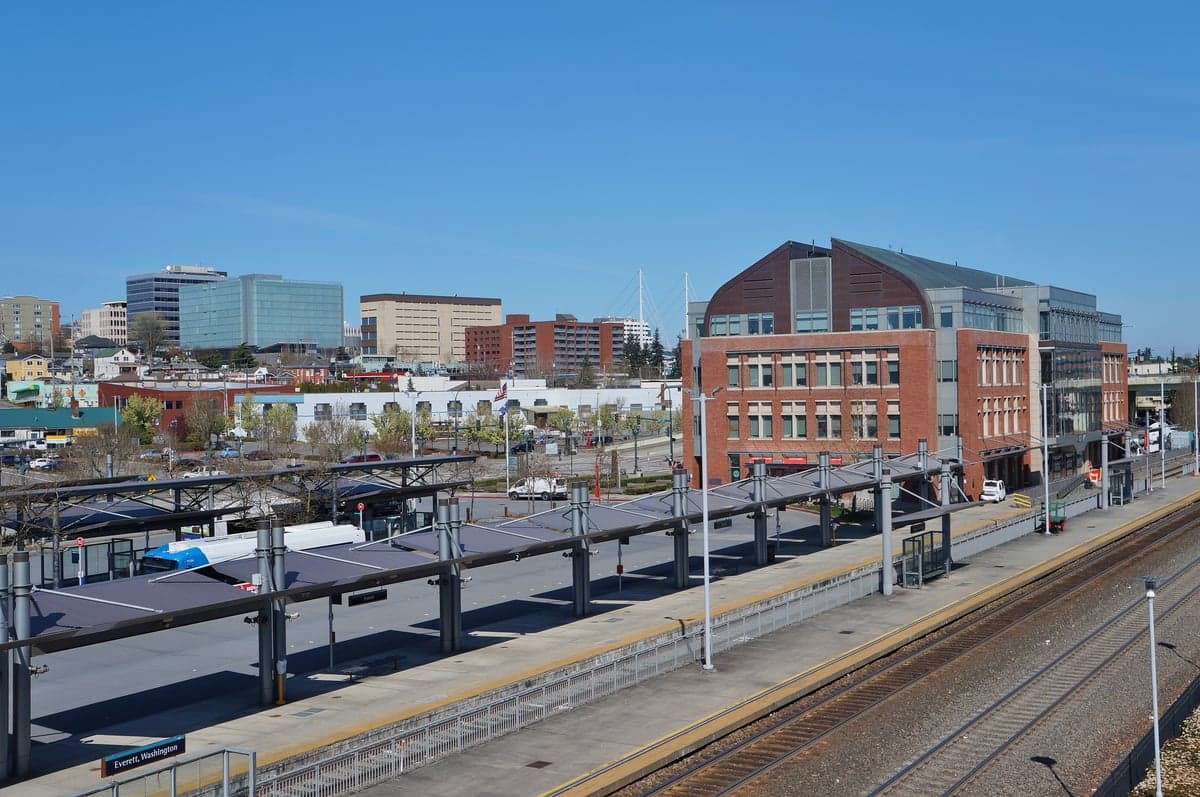
Photo: Wikipedia
Political ClimatePolitical Climate in Everett, WA
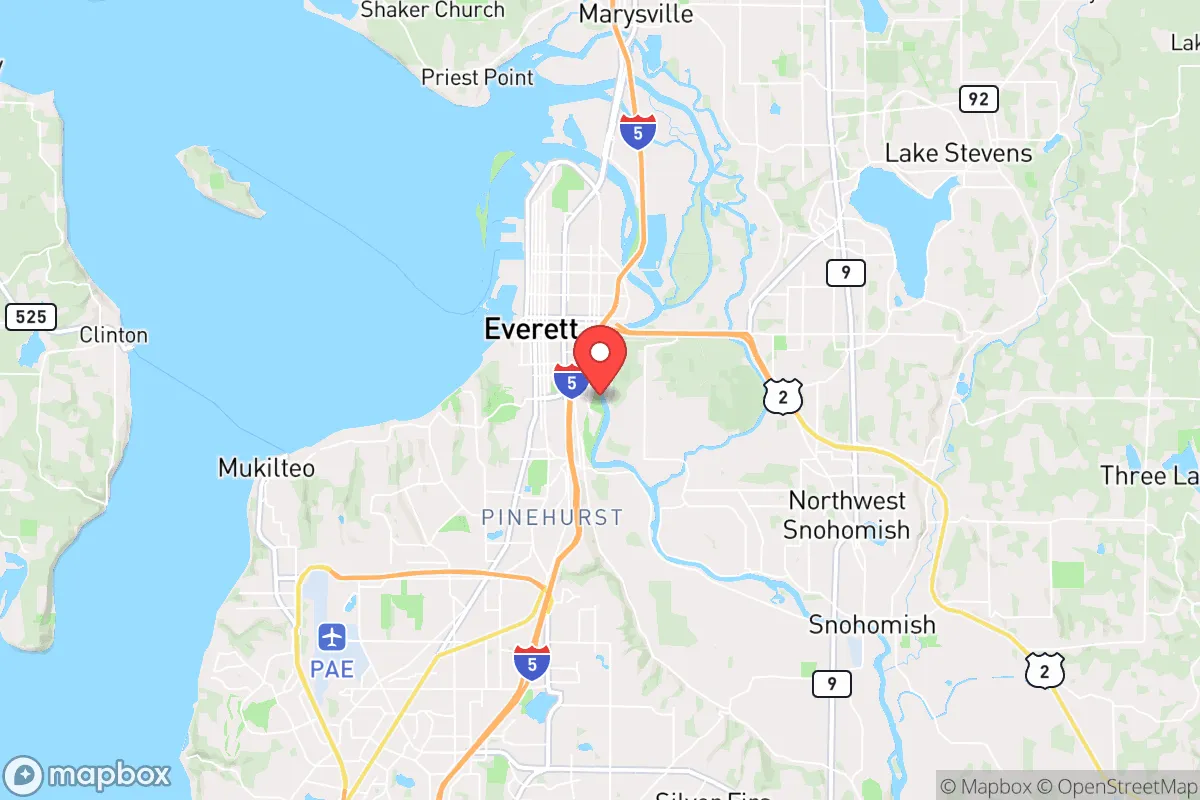
District shown is the primary district for this city’s centroid. Cities may span multiple districts.
Local Political AnalysisPolitical Analysis of Everett, WA
Everett, Washington, has a political climate that’s shifted hard to the left over the past decade, and if you’ve lived here as long as I have, you’ve felt it. The Cook Partisan Voting Index (PVI) gives it a D+12 rating, meaning it’s about 12 points more Democratic than the national average. That’s not just a number—it’s a reality you see in everything from city council meetings to how the local police operate. The trajectory has been steadily progressive, especially since the 2020 protests, and it’s not slowing down. If you value personal freedoms and limited government, this trend is something to keep a close eye on.
How it compares
Everett sits in Snohomish County, which is a deep blue stronghold, but the contrast with surrounding areas is stark. Drive 20 minutes east to Lake Stevens or north to Arlington, and you’ll find communities that lean more conservative—places where property rights and Second Amendment protections are still taken seriously. Even Marysville, just a few miles up I-5, has a noticeably different vibe, with more skepticism toward the kind of progressive policies Everett has embraced. The city itself, though, is surrounded by blue suburbs like Mukilteo and Lynnwood, which only reinforce the political bubble. If you’re used to a place where your vote actually balances things out, Everett can feel like you’re shouting into a void.
What this means for residents
For the average person living here, the biggest day-to-day impact is the steady creep of government overreach into things that used to be straightforward. Everett’s city council has pushed through zoning changes that limit single-family home development, making it harder to own a house with a yard if that’s what you want. Business regulations have gotten tighter, especially for small shops and contractors, with new permitting requirements that feel more like control than safety. And if you’re a gun owner, you’ve probably noticed the local ordinances getting stricter—things like storage mandates and restrictions on where you can carry that go beyond state law. Property taxes have climbed about 8% in the last two years alone, partly to fund social programs that not everyone asked for. It’s not a crisis yet, but it’s a slow squeeze on personal choice and financial freedom.
On the cultural side, Everett has leaned hard into progressive identity politics. Public schools have adopted curriculum that emphasizes social justice over core academics, and you’ll see more city-funded events focused on diversity and inclusion than on traditional community gatherings. The police department has faced repeated calls to defund or restructure, and while that hasn’t fully happened, officer morale is low and response times have ticked up. If you’re a conservative or even a moderate who just wants to be left alone, you might feel like the city’s priorities don’t match yours. Looking ahead, I expect more of the same—more regulations, more taxes, and a continued drift away from the kind of live-and-let-live attitude that used to define this area. It’s not a bad place to live, but you’ve got to be ready to push back or adapt.

State Political ClimatePolitical Climate in Washington
State Political AnalysisPolitical Environment in the State
Washington State has shifted from a purple swing state to a solidly blue stronghold over the past two decades, with Democrats controlling the governorship, both U.S. Senate seats, and both chambers of the state legislature since 2017. The state’s overall partisan lean is now roughly D+8 to D+10 in presidential elections, driven overwhelmingly by the Seattle metro area and its sprawling suburbs. However, this blue veneer masks a deep and growing urban-rural chasm, with vast eastern and southwestern counties voting Republican by margins of 20 to 40 points. For a conservative considering relocation, the state’s trajectory is concerning: a 2024 election saw King County (Seattle) cast nearly 1.2 million votes for Kamala Harris, while the rest of the state combined barely broke even, illustrating how one metro area now dictates statewide policy.
Urban vs. rural divide
The political map of Washington is essentially two states. The I-5 corridor from Seattle south to Olympia and north to Everett is a Democratic stronghold, with King County alone producing about 35% of the state’s total vote. Seattle, Bellevue, Redmond, and Tacoma are the engines of progressive policy, with city councils and county commissions routinely passing rent control, defunding police initiatives, and sanctuary ordinances. In contrast, the eastern half of the state—Spokane, the Tri-Cities (Kennewick, Pasco, Richland), and Yakima—votes reliably Republican, as do rural counties like Stevens, Ferry, and Pend Oreille. The once-purple suburbs of Snohomish and Pierce counties have flipped decisively blue since 2016, driven by an influx of tech workers and out-of-state transplants. A notable exception is Clark County (Vancouver), which has become a competitive swing area, voting for Biden by 4 points in 2020 but flipping to Trump by 2 points in 2024, reflecting its growing conservative exurban population from Portland.
Policy environment
Washington’s policy environment is aggressively progressive, with a state income tax still absent (thanks to a 1930s law and repeated ballot defeats) but replaced by some of the highest sales taxes in the nation—averaging 9-10% in most cities. The state has no right-to-work law, and public-sector unions wield enormous influence, particularly the Washington Education Association and SEIU. Education policy is dominated by a top-down approach: the state mandates comprehensive sex education (including LGBTQ+ content) in all public schools, and parental opt-out rights are limited. Healthcare is heavily regulated, with a state-run insurance exchange and a public option law passed in 2021. Election laws are among the most liberal in the country: universal mail-in voting, same-day registration, and no voter ID requirement at the polls (though a signature match is used). The state also has a strict assault weapons ban (passed in 2023), a magazine capacity limit of 10 rounds, and a red-flag law that allows for temporary firearm seizure without a criminal conviction.
Trajectory & freedom
Washington is becoming less free by nearly every measure of personal liberty. The 2023 assault weapons ban (HB 1240) effectively outlaws the sale of AR-15s and similar rifles, and a 2024 law (SB 5078) bans the open carry of firearms at public meetings and protests. Parental rights have eroded: a 2023 law (HB 1235) requires schools to withhold a student’s gender identity or sexual orientation from parents if the student requests it, overriding parental notification. Medical autonomy is shrinking: the state has a vaccine mandate for healthcare workers and school employees, and a 2024 law (SB 5236) allows minors 13 and older to consent to gender-affirming care without parental permission. Property rights are under pressure from the state’s Growth Management Act, which forces cities to upzone for high-density housing, and a 2023 law (HB 1110) that effectively eliminates single-family zoning in most cities. On the positive side, Washington has no state income tax, no capital gains tax (a 2021 capital gains tax was ruled unconstitutional by the state supreme court in 2024), and no estate tax for estates under $2.2 million. But the overall trend is toward more regulation, higher taxes (gas taxes are among the highest in the nation), and less individual autonomy.
Civil unrest & political movements
Washington has been a flashpoint for civil unrest since the 2020 CHOP/CHAZ occupation in Seattle, where six blocks were taken over by armed protesters for three weeks, resulting in two deaths and millions in property damage. The state’s sanctuary policies—a 2019 law (SB 5497) prohibits state and local law enforcement from cooperating with federal immigration authorities—have made it a magnet for illegal immigration, with King County alone seeing a 40% increase in migrant arrivals since 2021. Organized activist movements are powerful: the Washington State Labor Council and Moms Demand Action are major lobbying forces, while the left-wing Cascadia movement advocates for secession from the U.S. and the creation of an independent bioregional state. On the right, the Washington State Republican Party has been fractured between establishment and populist factions, but grassroots groups like the Washington Gun Rights Coalition and the Family Policy Institute of Washington have successfully challenged some laws in court. Election integrity remains a hot-button issue: the 2020 and 2024 elections saw widespread allegations of ballot harvesting and signature verification failures, particularly in King County, though no major fraud was proven. A new resident would notice the omnipresence of political signage, the frequency of protests in Seattle and Olympia, and the palpable tension between urban and rural residents.
Projection
Over the next 5-10 years, Washington will likely become even more blue, driven by continued in-migration from California, Oregon, and other blue states. The tech industry’s expansion into Spokane and the Tri-Cities may slowly shift those areas purple, but the dominant trend is the Seattle metro’s growing political weight. Expect further restrictions on gun rights (magazine bans, mandatory liability insurance), expansion of gender-affirming care for minors, and increased taxes on high-income earners (a state income tax may finally pass via a constitutional amendment). The rural-urban divide will widen, with talk of secession or a “51st state” movement in eastern Washington gaining traction but ultimately failing due to constitutional hurdles. For a conservative moving in now, the practical reality is that you will live under a government that is increasingly hostile to your values, but you can find community in the eastern counties, Clark County, or the exurbs of Pierce and Snohomish counties. The state’s natural beauty and economic opportunities remain strong, but the political climate is a trade-off you must be willing to accept.
Bottom line: If you value low taxes and stunning geography, Washington still offers those—but be prepared for a state government that is actively restricting your Second Amendment rights, overriding your parental authority, and taxing you heavily for the privilege. The best bet for a conservative is to settle in Spokane, the Tri-Cities, or Vancouver, where local politics are more aligned with your values, and to brace for a decade of continued progressive dominance in Olympia.
* Values derived from national, state, county, city and local statistics and may differ in a specific area. Last updated: 2026-04-21T11:03:12.000Z
Narrative content on this page is AI-generated and may contain mistakes. Verify any details that matter before acting on them.
ReloMaps may earn a commission from affiliate links at no extra cost to you.

