Demographics of Falling Waters, WV
Affluence Level in Falling Waters, WV
A middle-class area roughly in line with national averages across income, home values, education, and employment.
People of Falling Waters, WV
The people of Falling Waters, West Virginia, today number 2,384, forming a small, predominantly white community with a 92.1% white population and no measurable foreign-born, Hispanic, or Asian (East/Southeast Asian) residents. The city is characterized by its rural, family-oriented character, with a 24.0% college-educated rate reflecting a working-class base. Distinctive identity markers include a strong sense of local history tied to the Potomac River and the Baltimore and Ohio Railroad, and a population that is notably homogeneous compared to the broader Eastern Panhandle region.
How the city was settled and grew
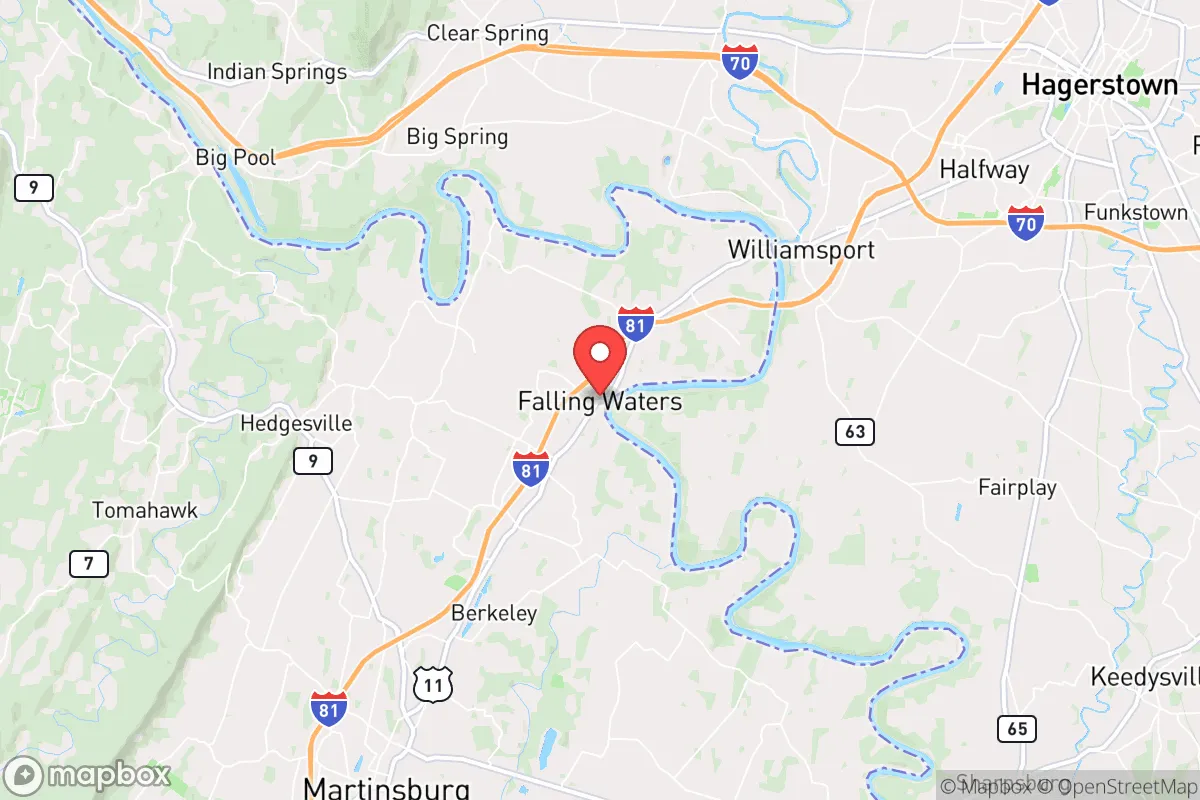
Falling Waters' human history begins with its strategic location along the Potomac River, which served as a transportation corridor for early settlers. The area was originally part of a land grant to Lord Fairfax in the 18th century, attracting primarily English and Scots-Irish farmers who established small homesteads. The arrival of the Baltimore and Ohio Railroad in the mid-19th century spurred the first significant growth wave, turning the settlement into a minor shipping point for agricultural goods and timber. The historic Old Town neighborhood, centered near the railroad depot and the Falling Waters Presbyterian Church, was built by these early railroad workers and farmers. A second wave came in the late 19th and early 20th centuries as the area's apple orchards and limestone quarries drew additional laborers, many of whom settled in the River Bend area along the Potomac, where small clusters of homes housed quarry workers and their families. By 1950, the population remained under 1,000, with the community largely composed of multi-generational families of British Isles descent.
Modern era (post-1965)
After the 1965 Immigration and Nationality Act, Falling Waters experienced virtually no international immigration, with the foreign-born population remaining at 0.0% through the present day. Instead, the modern era has been defined by domestic in-migration from the Washington, D.C., and Baltimore metropolitan areas, beginning in the 1990s. This suburbanization wave brought families seeking lower housing costs and a rural lifestyle within commuting distance of jobs in Martinsburg, Hagerstown, and even the D.C. suburbs. The Falling Waters Estates subdivision, developed in the 1990s and 2000s, absorbed many of these newcomers, who were predominantly white and middle-class. A smaller but notable influx of retirees from the Northeast settled in the Potomac Shores area, a collection of newer homes along the river. The city's Black population, at 2.0%, is largely concentrated in older sections of Old Town and represents families who have been in the area since the early 20th century, with no significant growth from recent migration. The Hispanic and Asian populations remain at 0.0%, making Falling Waters one of the most ethnically homogeneous small cities in the Eastern Panhandle.
The future
Demographic projections suggest Falling Waters will continue to homogenize rather than diversify over the next 10–20 years. The 0.0% foreign-born rate and absence of Hispanic or Asian growth indicate no significant immigrant-driven change on the horizon. The primary demographic shift will be an aging of the existing population, as the 1990s suburban wave ages in place, and a slow influx of additional white domestic migrants from the D.C. region seeking affordable housing. The Falling Waters Crossing development, a planned 200-home subdivision approved in 2023, is expected to attract more of these same demographics—white, middle-class families and retirees. There is no evidence of tribalization into distinct ethnic enclaves; rather, the city is becoming more uniformly white and older, with younger adults often leaving for college or jobs in larger cities. The Indian and East/Southeast Asian populations are projected to remain at 0.0%.
For someone moving in now, Falling Waters is becoming a stable, homogeneous bedroom community for the Eastern Panhandle's growing employment centers. The lack of ethnic or cultural diversity means newcomers should expect a population that is overwhelmingly white, native-born, and family-oriented, with a strong emphasis on local history and outdoor recreation along the Potomac. The city offers a quiet, low-density lifestyle but little demographic change on the horizon.

* Values derived from national, state, county, city and local statistics and may differ in a specific area. Last updated: 2026-04-23T05:59:21.000Z
Narrative content on this page is AI-generated and may contain mistakes. Verify any details that matter before acting on them.
ReloMaps may earn a commission from affiliate links at no extra cost to you.

